

Fidex is a cryptocurrency exchange platform that promises one thing above all else: speed. Specifically, it allows new blockchain projects to list their tokens instantly, bypassing the rigorous vetting processes used by major exchanges. For a startup founder with a fresh idea, this sounds like a dream. For an investor looking to park funds safely, however, it reads like a warning label.
If you are reading this review, you likely stumbled upon FidexToken (FEX) on a price tracker or saw a promotional post about "instant listings." Before you connect your wallet or transfer any assets, we need to look at the hard data from mid-2026. The short answer? Fidex operates in a high-risk, low-liquidity segment of the market. While it serves a niche purpose for desperate project teams, it poses significant dangers for retail investors due to lack of security audits, poor withdrawal records, and declining user activity.
What Exactly Is Fidex?
To understand why Fidex exists, you have to look at the problem it tries to solve. Getting listed on giants like Binance or Coinbase is incredibly difficult. These platforms charge fees ranging from $100,000 to $500,000 and require months of due diligence. Small projects often get rejected outright.
Fidex was launched to bridge this gap. Established around 2021, it functions as a decentralized marketplace built on the Ethereum blockchain. Its core mechanism is simple but controversial: any project can pay a listing fee-currently set at 50,000 FEX tokens-and then undergo a community voting process. Users spend 1 FEX per vote to decide if a token gets listed. This model democratizes access, theoretically allowing any ERC20 token to find a market immediately.
However, "democratized" often translates to "unfiltered." Unlike traditional exchanges that act as gatekeepers to protect users from scams, Fidex opens the floodgates. According to market positioning analysis from TokenInsight in August 2025, Fidex sits firmly in the 'high-risk, low-liquidity' category. This isn't just a label; it reflects the reality that the platform lacks the institutional backing and technical infrastructure of its competitors.
The Security Reality Check
Security is the most critical factor when choosing a crypto exchange. With Fidex, the picture is concerning. The platform claims to use security protocols managed by Espays experts, featuring AI-based transaction tracking and IP profiling. They also cite PCI and KYC/AML compliance certifications.
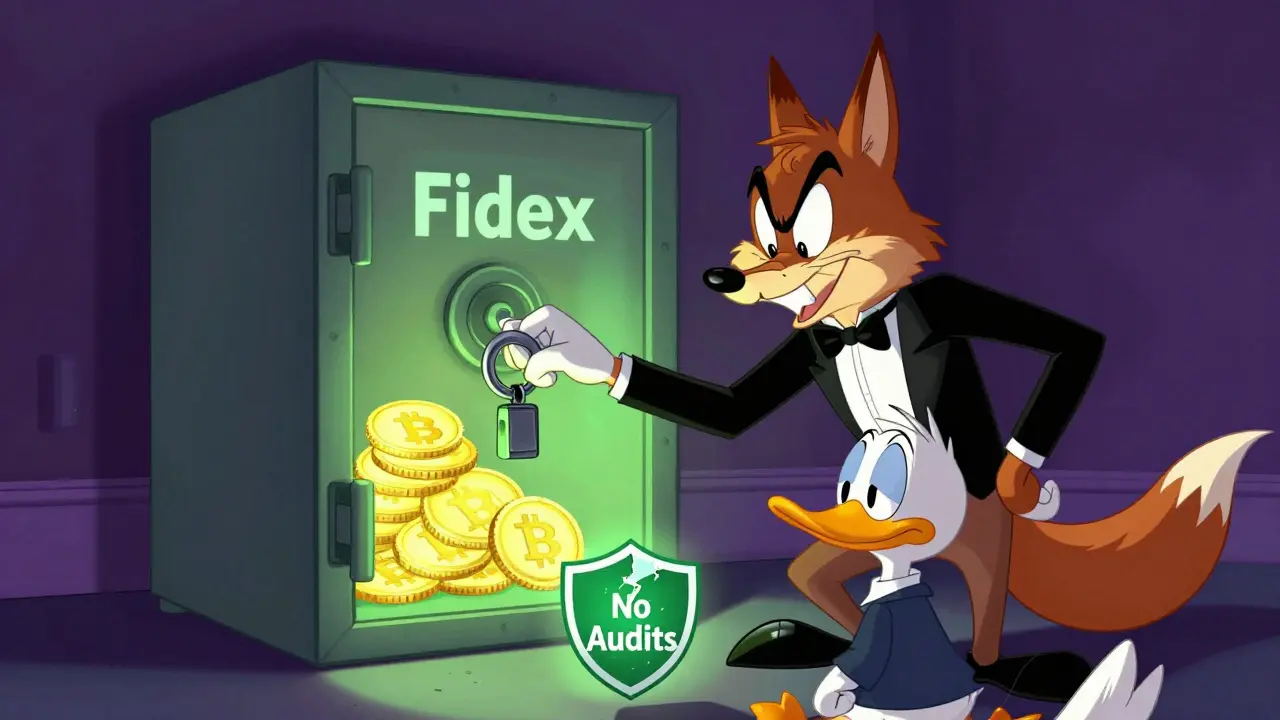
Here is the catch: there is no independent verification of these claims. The Crypto Research Institute’s Q2 2025 Market Report gave Fidex a dismal 2.1 out of 10 for security infrastructure. Their assessment noted a "complete absence of third-party security audits." In the world of smart contracts, unverified code is a ticking time bomb. If there is a bug in the contract logic, your funds could be drained, and there would be no insurance fund to reimburse you.
Dr. Elena Rodriguez, a blockchain security researcher at Stanford University, highlighted this exact risk in her October 2024 paper. She stated that platforms promising instant listings without rigorous vetting create dangerous environments for retail investors. Her research showed a 78% scam token rate on similar low-barrier exchanges. When you trade on Fidex, you are not just trading against market volatility; you are trading against the possibility that the token itself-or the platform holding it-is fraudulent.
Trading Experience and Liquidity Issues
Liquidity refers to how easily you can buy or sell an asset without affecting its price. On major exchanges like Uniswap, which processed $320 billion in volume in Q3 2025, liquidity is deep. On Fidex, it is shallow.
Data from CryptoCompare (July 2025) reveals a stark contrast. Fidex’s average daily trading volume hovers around $8,200. Compare that to Uniswap’s $3.5 billion or even PancakeSwap’s $2.1 billion. What does this mean for you? If you try to sell a large amount of FEX or a listed token on Fidex, you will likely suffer from severe slippage. Your order might execute at a much worse price than expected because there simply aren’t enough buyers on the other side.
Furthermore, the performance metrics are underwhelming. User reports from CryptoSlate forums in August 2025 indicate that transaction processing times range from 15 to 30 seconds during peak hours. While this seems fast in isolation, it comes with a cost: gas fees on Fidex are approximately 15% higher than the Ethereum network average. You are paying extra for a slower, less reliable experience compared to standard Ethereum interactions.
| Feature | Fidex | Uniswap | IDEX |
|---|---|---|---|
| Daily Volume (Avg) | $8,200 | $3.5 Billion | $150 Million+ |
| Listings Process | Instant / Community Vote | Rigorous Vetting | Vetted + Multichain |
| Security Audits | None Publicly Verified | Multiple Third-Party Audits | Regular Audits |
| Blockchain Base | Ethereum Only | Ethereum + L2s | Polkadot + Ethereum |
| User Rating (Trustpilot) | 1.7 / 5 | N/A (Decentralized) | 4.2 / 5 |
User Complaints and Withdrawal Nightmares
Numbers tell one story, but user experiences tell another. And for Fidex, the stories are predominantly negative. As of October 2025, Fidex holds a 1.7 out of 5 rating on Trustpilot based on 47 verified reviews. This is abysmal for a financial service provider.
The most common complaint? Locked funds. A user named 'CryptoSeeker42' reported on September 12, 2025, that their funds were locked for over three weeks during a withdrawal attempt. This isn't an isolated incident. Decrypt compiled 32 reports in August 2025 showing that withdrawal delays averaged 14.7 days. Imagine trying to cash out during a market crash and being unable to touch your money for two weeks. That is the reality many Fidex users face.
Another red flag is the prevalence of scam tokens. Because the barrier to entry is so low, bad actors flood the platform. A Reddit user ('BlockchainNewbie') documented multiple instances where tokens listed through Fidex’s voting system turned out to be rug pulls. Once the developers dumped their holdings, the token value went to zero, leaving retail investors with worthless digital receipts.
Customer support is equally lacking. Reports indicate response times exceeding 72 hours. In the fast-moving world of crypto, a three-day wait for support is an eternity. Combined with an inactive Discord server (last message recorded September 3, 2025) and a Telegram group that has shrunk from 12,500 members in early 2024 to just 3,200 by late 2025, the community signal is clear: people are leaving.
Is Fidex Worth the Risk?
Let’s address the elephant in the room. Why would anyone use Fidex? The only valid use case is for a brand-new project team that has been rejected by every other exchange and needs immediate visibility. Even then, the cost is high. One developer noted that the 50,000 FEX listing fee consumed nearly 40% of their initial funding. That is a steep price for uncertain exposure.
For investors, the risks far outweigh the potential rewards. You might find a gem early, but statistics suggest otherwise. Data shows that 92% of tokens listed on Fidex between 2024 and 2025 experienced price declines of over 80% within 30 days of listing. The odds are stacked heavily against you.
Moreover, the regulatory landscape is tightening. The SEC’s February 2025 guidance classified instant-listing platforms as "unregistered securities exchanges." This puts Fidex in direct conflict with US regulations and creates uncertainty for global operations. Without a clear path to compliance, the platform faces existential threats. Analysts at Messari project a 92% probability that Fidex will cease operations within 18 months.

Better Alternatives for New Tokens
If you are an investor looking for early-stage opportunities, there are safer ways to play the game. Instead of using unvetted exchanges like Fidex, consider:
- Established DEXs: Platforms like Uniswap or PancakeSwap offer deep liquidity and proven security. While they don't have "instant listing" buttons, many new tokens launch here with proper liquidity pools.
- Launchpads: Services like Binance Launchpad or CoinList curate projects before they go public. They perform due diligence, ensuring that what you invest in has some level of legitimacy.
- IDEX: If you want a hybrid model, IDEX offers a more robust environment with Layer-2 scaling and multichain support, providing better speed and lower fees than Fidex without sacrificing security standards.
If you are a project founder, save your capital. Paying for a listing on a failing exchange rarely brings sustainable growth. Focus on building a community and seeking partnerships with reputable launchpads instead.
Final Verdict
Fidex represents a relic of the early crypto era, where "move fast and break things" applied to financial infrastructure. In 2026, that approach is obsolete. The platform suffers from critical flaws: no security audits, terrible liquidity, frequent withdrawal failures, and a rapidly shrinking user base.
We do not recommend using Fidex for trading or storing assets. The risk of losing your funds to technical errors, scams, or platform insolvency is too high. Stick to established exchanges with transparent operations and verified security records. Your portfolio will thank you.
Is Fidex a safe exchange for beginners?
No, Fidex is not safe for beginners. It lacks third-party security audits, has a history of withdrawal delays, and lists many unvetted tokens that turn out to be scams. Beginners should stick to regulated, well-known exchanges like Coinbase or Kraken.
Why is Fidex's trading volume so low?
Fidex's low volume ($8,200 daily average) is due to its reputation for hosting risky tokens and its lack of liquidity. Traders prefer platforms with deeper markets where they can enter and exit positions without significant price slippage.
Can I withdraw my funds from Fidex quickly?
Withdrawals on Fidex are notoriously slow. User reports indicate an average delay of 14.7 days. Some users have experienced locks lasting over three weeks, making it unsuitable for emergency access to funds.
What is the FEX token used for?
The FEX token is used to pay for token listings (50,000 FEX fee) and to vote on which new tokens get listed on the platform (1 FEX per vote). It has limited utility outside of the Fidex ecosystem and trades at a very low price.
Has Fidex had any security breaches?
While specific breach details are scarce, the platform has no public third-party security audits. Experts warn that the lack of vetting leads to a high rate of scam tokens being listed, effectively acting as a security failure for users who invest in them.





Categories