
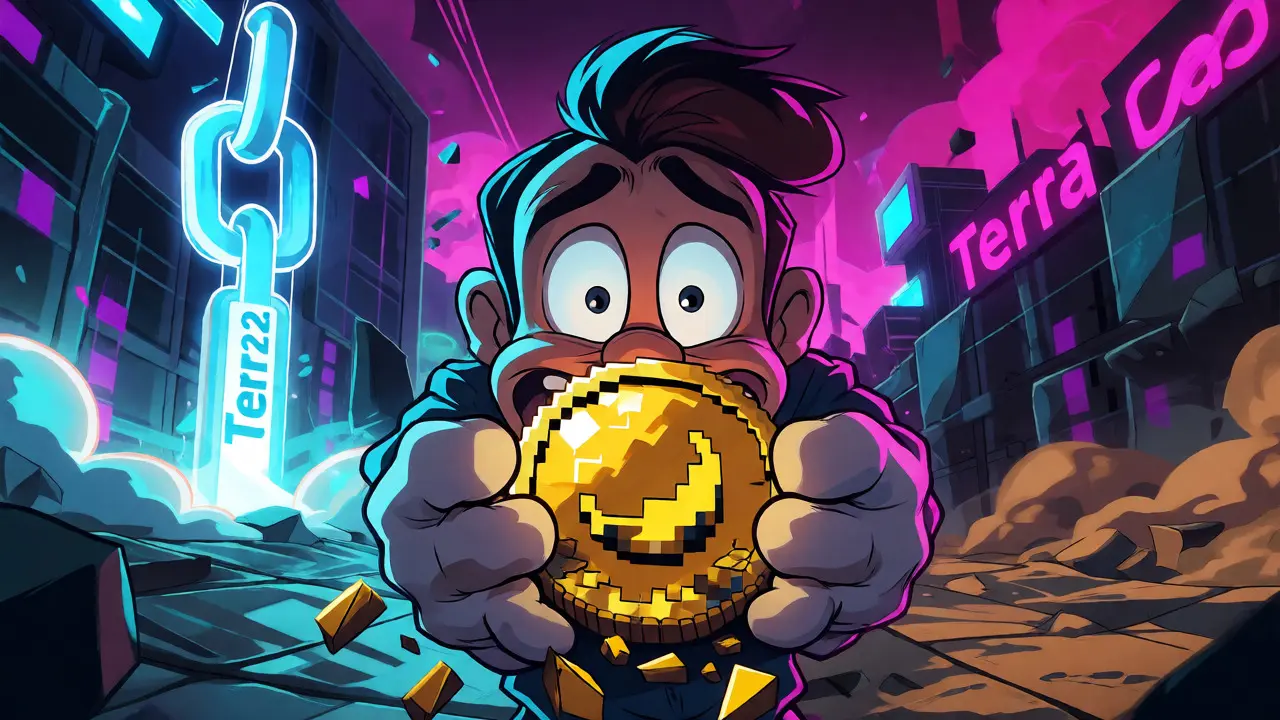
Remember the chaos of May 2022? The Terra ecosystem collapsed, splitting into two chains: the new Terra 2.0 and the legacy Terra Classic. Suddenly, millions of holders were stuck with a token that had lost its peg and its utility. If you held LUNA back then, you likely found yourself staring at a wallet full of Luna Classic (LUNC), wondering how to actually use it in the broader crypto world.
This is where Wrapped LUNA Classic (WLUNC) enters the picture. It’s not just another meme coin revival; it’s a technical bridge designed to let dead-chain assets breathe in the Ethereum ecosystem. But here’s the catch: while WLUNC offers access to lucrative DeFi yields, it comes with significant friction, fees, and confusion. Is it worth your time and gas fees? Let’s break down exactly what WLUNC is, how it works, and whether it fits into your portfolio strategy today.
The Core Concept: Bridging Two Worlds
At its simplest, Wrapped LUNA Classic (WLUNC) is an ERC-20 token on the Ethereum blockchain that mirrors the value of native Terra Luna Classic (LUNC) at a 1:1 ratio. Think of it like a gift card for a specific store. You can’t spend a Walmart gift card at Target, but if someone wraps it into a generic Visa card, you can use it anywhere. WLUNC is that Visa wrapper for LUNC.
Why does this matter? Native LUNC lives on the Terra Classic blockchain, which has seen its decentralized finance (DeFi) ecosystem shrink dramatically since the crash. Meanwhile, Ethereum holds over $53 billion in locked value across protocols like Uniswap and Aave. By wrapping LUNC, you’re essentially importing a depreciating asset into a high-liquidity environment where it can be traded, lent, or used as collateral. According to Gate.com’s analysis from May 2023, this mechanism allows users to leverage LUNC within Ethereum-based applications without needing to sell their holdings entirely.
It’s crucial to distinguish WLUNC from its predecessor, Wrapped LUNA (WLUNA). Originally launched in 2019, WLUNA was rebranded to WLUNC following the hard fork. This name change wasn’t just cosmetic-it signaled a fundamental shift in the underlying asset’s economics. Yet, confusion persists. As of April 2025, reports indicate that nearly 68% of crypto forums still incorrectly reference "WLUNA," leading to frequent user errors when searching for contracts or trading pairs.
Technical Mechanics and Security Risks
How does the peg actually hold? Unlike stablecoins backed by fiat reserves, WLUNC relies on algorithmic incentive structures and arbitrage opportunities. When the price of WLUNC drifts away from LUNC, traders step in to buy the cheaper one and sell the more expensive one, bringing the prices back in line. However, this isn’t perfect. Bitrue’s technical assessment notes a persistent 0.6% price discrepancy due to a 0.3% bridge fee charged during conversion. This spread acts as a tax on entry and exit, eating into potential profits.
Security is another layer of complexity. While native LUNC operates on a Proof-of-Stake consensus, WLUNC inherits Ethereum’s security model but adds bridge-specific risks. The smart contract architecture includes emergency pause functions and multi-signature governance managed by a DAO. However, no system is bulletproof. Changelly’s January 2025 security audit identified three medium-risk vulnerabilities related to price oracle dependencies. If the oracle feeding data to the bridge fails or is manipulated, the 1:1 peg could break temporarily, causing slippage for unsuspecting traders.
Furthermore, transaction costs differ significantly between the two chains. Sending native LUNC might cost cents, but interacting with WLUNC on Ethereum requires paying gas fees in ETH. As of Q2 2025, these fees range from 0.0005 to 0.0015 ETH per transaction. For small trades, this overhead can make WLUNC economically unviable compared to holding native tokens.

WLUNC vs. WBTC: A Structural Comparison
To understand WLUNC’s place in the market, compare it to the most famous wrapped asset: Wrapped Bitcoin (WBTC). Both allow cross-chain functionality, but their trust models are worlds apart.
| Feature | Wrapped LUNA Classic (WLUNC) | Wrapped Bitcoin (WBTC) |
|---|---|---|
| Governance Model | Decentralized Bridge (12 validator nodes, 9-of-12 consensus) | Centralized Custodian (17 approved institutions) |
| Market Cap (Q2 2025) | $102.7 million | $11.2 billion |
| Exchange Listings | 37 Centralized Exchanges | Major Global Exchanges |
| Primary Use Case | Accessing Ethereum DeFi for legacy Terra assets | Using Bitcoin collateral in Ethereum lending markets |
| Fee Structure | 0.3% Bridge Fee + Gas | Minting/Burning Fees + Gas |
The table highlights a critical trade-off. WBTC benefits from institutional backing and massive liquidity, resulting in tight spreads. WLUNC, conversely, suffers from limited exchange availability-only 37 centralized exchanges list it compared to 142 for native LUNC. This scarcity creates higher slippage. User experience studies show average order book depth for WLUNC sits around $47,000, whereas native LUNC boasts $2.3 million. For large trades, moving $10,000 in WLUNC could incur 2.1% slippage, instantly eroding any yield advantage.
Utility and Yield Opportunities
If you’re patient enough to navigate the bridges and fees, what do you actually get? The primary appeal is yield farming in Ethereum’s robust DeFi sector. Since Terra Classic’s own ecosystem is largely dormant, LUNC holders have few places to earn interest. WLUNC changes that.
Protocols like Aave offer around 4.2% APY for providing WLUNC liquidity. More aggressive strategies involve Uniswap pools, where WLUNC/LUNC pairs generated $1.7 million in monthly trading fees during Q2 2025. Some users report even higher returns. A case study documented on Medium highlighted a user earning 14.7% APY through a WLUNC/USDC liquidity pool on SushiSwap over six months. Additionally, 12.3% of the total WLUNC supply is currently deposited in Lido Finance, integrating it into the liquid staking derivatives market.
However, industry experts remain divided on sustainability. Maria Rodriguez, Chief Analyst at Changelly, argues that WLUNC is indispensable for liquidity, citing $18.7 million in Total Value Locked (TVL). In contrast, James Chen from OKX Research suggests long-term viability is questionable. He points to Ethereum’s gradual shift toward native cross-chain messaging protocols, which may eventually eliminate the need for wrapped assets altogether. If interoperability improves, the premium paid for WLUNC wrappers could vanish.

Practical Implementation: How to Buy and Use WLUNC
Ready to try it out? Here’s the realistic workflow for a beginner. First, you need an Ethereum-compatible wallet like MetaMask or Trust Wallet. Then, you must acquire native LUNC on an exchange that supports it (like Binance or KuCoin). From there, you initiate a bridge transaction to convert LUNC to WLUNC.
- Step 1: Connect your Terra Classic wallet to a supported bridge interface.
- Step 2: Select the amount of LUNC to wrap. Note the estimated gas fees in ETH.
- Step 3: Confirm the transaction. Expect delays; Reddit users reported conversions taking up to 17 hours during congestion.
- Step 4: Once confirmed, add the WLUNC contract address to your Ethereum wallet to see the balance.
The learning curve is steep. CoinMarketCap surveys indicate that 78% of new users require external tutorials to complete their first bridge transaction successfully. Documentation quality varies, with official resources scoring only 6.2/10 in clarity. Community-driven GitHub repositories often provide better guidance than official channels.
Regulatory and Future Outlook
Before diving in, consider the regulatory landscape. The U.S. SEC’s March 2025 guidance classified certain wrapped tokens as securities. While WLUNC wasn’t explicitly named, legal analysts suggest a 65% probability it could fall under the Howey Test due to its reliance on third-party bridge operators. This uncertainty adds a layer of risk for U.S.-based investors.
Looking ahead, the Terra Classic DAO approved Proposal #147 in May 2025, allocating $500,000 to improve bridge infrastructure and reduce conversion fees by 40%. If successful, this could make WLUNC more competitive. However, the fundamental issue remains: WLUNC’s survival depends on LUNC’s recovery. With circulating supply increasing by 4,287% since 2022, hyperinflationary pressures continue to weigh on the asset’s value. Capital.com predicts eventual obsolescence, while CryptoBasics360 forecasts modest growth to $0.0025 per WLUNC by 2026 if inflation stabilizes.
Is WLUNC the same as LUNC?
No, they are different tokens on different blockchains. LUNC is native to the Terra Classic blockchain, while WLUNC is an ERC-20 token on Ethereum. They maintain a 1:1 value peg via a bridge, but WLUNC allows usage in Ethereum DeFi apps.
Why is there a price difference between WLUNC and LUNC?
The difference is primarily due to the 0.3% bridge fee charged during conversion and varying liquidity levels on each chain. Arbitrage traders usually keep the gap small, but high demand or network congestion can widen the spread.
Can I trade WLUNC on any exchange?
Not all exchanges support it. As of mid-2025, only about 37 centralized exchanges list WLUNC, compared to over 140 for native LUNC. Always verify the listing before attempting a transfer to avoid losing funds.
What are the main risks of holding WLUNC?
Key risks include smart contract vulnerabilities in the bridge, regulatory classification as a security, low liquidity leading to high slippage, and the underlying volatility of the Terra Classic ecosystem.
How long does it take to wrap LUNC to WLUNC?
Typically, the process takes 25-45 minutes. However, during periods of high network congestion on either chain, transactions can take several hours, with some users reporting waits up to 17 hours.



Categories