
Orca vs Uniswap Fee Calculator
Compare trading costs between Orca (Solana) and Uniswap (Ethereum) for your token swaps. See how much you can save with Orca's sub-$0.00001 fees versus Uniswap's $2-$15 transaction costs.
Your Inputs
Key Facts
Orca: $0.00001 per swap on Solana network.
Uniswap (Ethereum): $2-$15 per swap.
Uniswap (Arbitrum): $0.50-$3 per swap.
Important: You need SOL in your wallet to pay for network fees on Orca, even when swapping other tokens.
Fee Comparison
| Network | Orca | Uniswap (Ethereum) | Uniswap (Arbitrum) |
|---|---|---|---|
| Cost per Swap | $0.00001 | $2-$15 | $0.50-$3 |
| Total Cost | $0.00 | $0.00 | $0.00 |
| Savings | $0.00 | - | - |
| Swaps per $1 | 0 | 0.5 | 2 |
Orca isn’t another crypto exchange you sign up for with an email and password. It doesn’t hold your coins. It doesn’t ask for KYC. It’s a decentralized exchange built entirely on Solana - and that changes everything about how you trade crypto.
If you’ve used Uniswap on Ethereum, you know the drill: slow transactions, $10+ gas fees, and waiting minutes just to swap a token. Orca throws that out the window. On Solana, swaps happen in under a second. Fees? Less than a penny. That’s not marketing fluff - it’s the reality of building on a blockchain designed for speed, not just decentralization.
How Orca Works - No Middleman, Just Smart Contracts
Orca is an automated market maker (AMM). That means there’s no order book. Instead, you trade directly against liquidity pools - pools of tokens locked in smart contracts. When you swap SOL for USDC, you’re not selling to another person. You’re swapping with a pool that has both tokens in it. The price adjusts automatically based on supply and demand.
Here’s the catch: you need a Solana wallet. Phantom, Solflare, or Backpack - pick one. And you need SOL in that wallet, not for trading, but to pay for network fees. Every transaction on Solana costs a tiny bit of SOL. Think $0.00001 per swap. That’s less than the cost of a sticker. But if you don’t have any SOL, you can’t trade at all. That’s the trade-off for speed.
Orca doesn’t store your funds. Ever. Your tokens stay in your wallet. That’s good for security - no exchange hack can steal your coins. But it also means you’re 100% responsible. Lose your private key? No recovery. Send tokens to the wrong address? Gone forever. There’s no customer support line to call.
ORCA Token: More Than Just a Fee Token
Orca has its own token: ORCA. As of December 2025, it’s trading around $1.26 with a market cap of just over $75 million. It’s not a payment token like ETH or SOL. It’s a governance and utility token. Holders can vote on protocol upgrades, propose new features, and earn rewards.
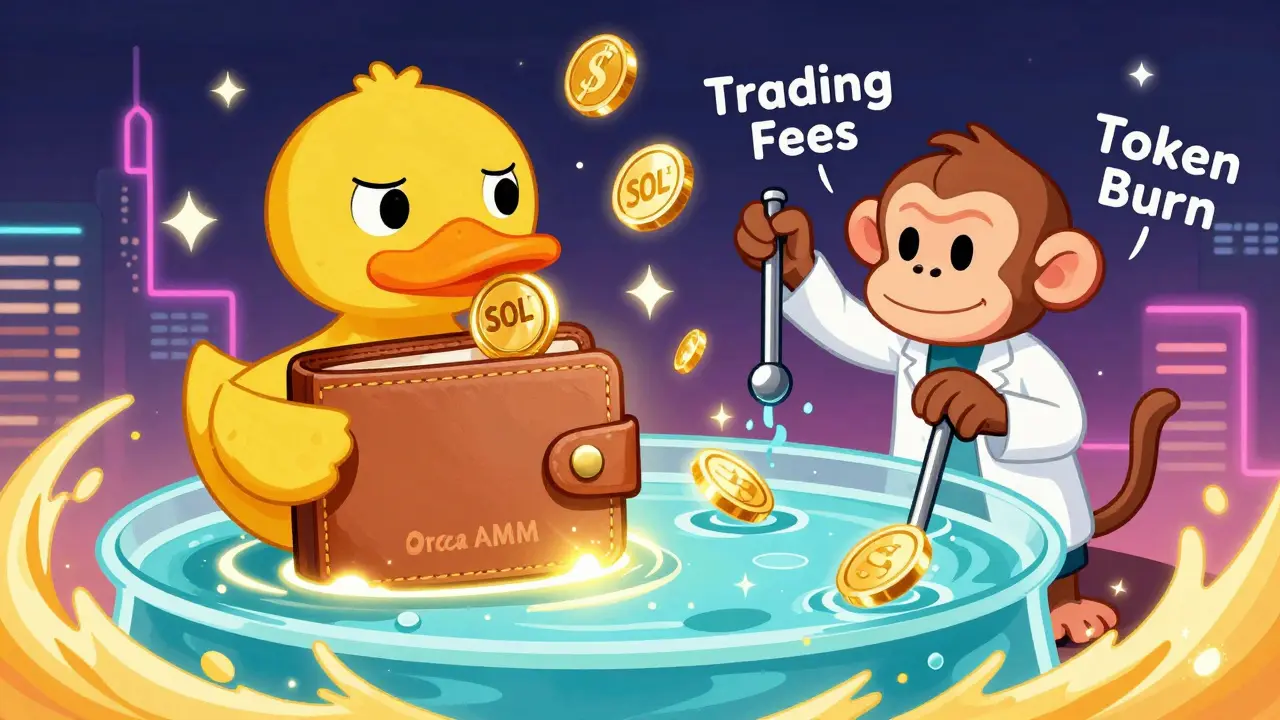
One of the biggest uses for ORCA is liquidity mining. If you add your tokens to an Orca liquidity pool, you earn a share of the trading fees. For example, if you put in a 50/50 pool of ORCA and SOL, you get a cut of every trade made between those two tokens. APYs vary - stablecoin pools might give you 5-7%, while high-risk token pairs can offer 10-15%. But higher yield means higher risk. If the price of one token in the pair moves sharply, you lose value compared to just holding - that’s called impermanent loss.
Orca’s tokenomics are designed to incentivize long-term participation. The team burns a portion of trading fees to reduce the total supply. As of 2025, over 12% of the initial ORCA supply has been burned. That’s a subtle but powerful signal: they’re trying to make ORCA scarcer over time.
Why Orca Beats Ethereum-Based DEXs
Let’s compare Orca to Uniswap, the biggest Ethereum DEX.
- Speed: Orca processes swaps in 400 milliseconds. Uniswap? 15-60 seconds, even on Layer 2.
- Fees: Orca: $0.00001 per swap. Uniswap on Ethereum: $2-$15. Even on Arbitrum, it’s $0.50-$3.
- Throughput: Solana handles 50,000 transactions per second. Ethereum does about 15.
Orca doesn’t just compete - it dominates in speed and cost. For active traders, day traders, or anyone swapping tokens multiple times a day, this isn’t a nice-to-have. It’s essential. A trader doing 50 swaps a day on Ethereum might pay $200 in fees. On Orca? $0.005.
That’s why Orca’s monthly traffic hit nearly 400,000 visits in 2025. Most of those users came from Solana’s growing ecosystem. Orca is the top DEX on Solana after Raydium. It’s not the biggest in the world, but it’s the fastest and cheapest for Solana users.
The Downsides - What Orca Can’t Do
But Orca isn’t perfect.
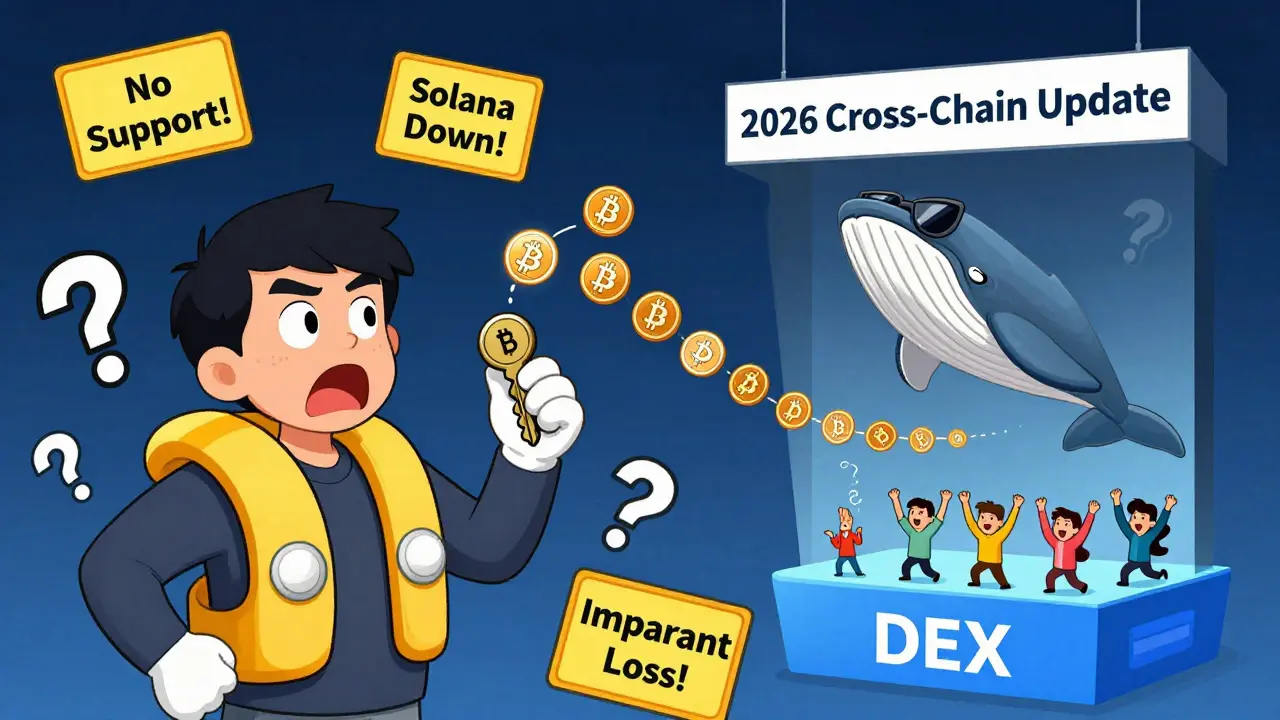
1. It’s locked to Solana. You can’t trade Bitcoin or Ethereum directly on Orca. You need to bridge them in first. That means using a third-party bridge like Wormhole or Portal, which adds steps and risk. If you’re used to trading across chains on platforms like 1inch or Matcha, Orca feels limiting.
2. Solana’s outages hurt Orca. When Solana goes down - and it has, several times since 2021 - Orca goes down too. In mid-2022, during a major network crash, ORCA’s price dropped 50% in hours. That’s not because Orca failed. It’s because the whole chain failed. That’s a systemic risk you can’t avoid.
3. No regulation. No support. Orca is a decentralized protocol. No company owns it. No legal entity backs it. That means no FDIC insurance, no chargebacks, no refund policy. If something goes wrong - a bug, a scam, a bad trade - you’re on your own. There’s no live chat. No email ticket system. Just a Discord server with 45,000 users trying to help each other.
4. UI can confuse beginners. The marine-themed design is cute. But for new users, the interface can feel cluttered. Concentrated liquidity positions, fee tiers, and pool selection aren’t intuitive. It’s not hard to learn - most users get comfortable after 3-5 swaps - but the learning curve is steeper than a centralized exchange like Binance.
Who Should Use Orca?
Orca isn’t for everyone. Here’s who it’s perfect for:
- Solana users: If you already hold SOL, NFTs, or tokens on Solana, Orca is your natural trading hub.
- Active traders: If you swap tokens daily, the fee savings alone make Orca worth it.
- Liquidity providers: If you want to earn yield on your crypto without staking, Orca’s pools are among the best on Solana.
- DeFi enthusiasts: If you believe in permissionless, non-custodial finance, Orca is a clean, fast example of it working.
It’s not for:
- New crypto users: If you don’t know what a wallet is, or how private keys work, start with a centralized exchange first.
- Those who want to trade Bitcoin or Ethereum directly: You’ll need to bridge them in - and that adds complexity.
- People who need customer support: If you panic when something goes wrong, Orca isn’t the place for you.
What’s Next for Orca?
Orca isn’t standing still. In late 2025, the team announced major updates coming in 2026:
- Cross-chain bridging (Q2 2026): Direct swaps from Ethereum, Polygon, and Base - without leaving Orca.
- Limited orders (Q4 2025): Set a price to buy or sell, like on a traditional exchange.
- Firedancer integration: A new Solana validator client that could boost speed and reliability even further.
If they pull this off, Orca could become the first true multi-chain DEX built on Solana’s backbone. Right now, it’s the best AMM on Solana. In 18 months, it could be the best AMM on any chain.
Final Verdict: Fast, Cheap, and Risky
Orca is the fastest, cheapest decentralized exchange on the market - if you’re on Solana. It’s not the biggest. It’s not the most regulated. It’s not the easiest for beginners. But if you care about speed and low fees, and you’re comfortable managing your own wallet, it’s unbeatable.
ORCA’s price has bounced between $1.20 and $1.30 since mid-2025. Some analysts say it could hit $2 by 2030. Others warn it could drop below $1 if Solana loses momentum. The truth? ORCA’s value is tied to Orca’s usage. More trades = more fees = more demand for ORCA. So far, usage is growing. The ecosystem is expanding. And the tech works.
Use Orca if you want to trade crypto without paying a fortune. Don’t use it if you want someone else to fix your mistakes. It’s not a platform for beginners. It’s a tool for those who know what they’re doing - and want to do it fast.
Is Orca a safe crypto exchange?
Orca is safe in the sense that it’s non-custodial - your funds never leave your wallet. But safety here means responsibility. There’s no insurance, no recovery options, and no customer support. If you send tokens to the wrong address or lose your private key, you lose them forever. The platform itself has never been hacked, but it’s only as secure as your wallet and your knowledge.
Do I need SOL to use Orca?
Yes. You need SOL in your wallet to pay for Solana network fees. Even if you’re swapping USDC for SRM, you still need a tiny amount of SOL - around $0.00001 per transaction. You can’t trade on Orca without it. That’s the cost of using Solana’s fast, cheap blockchain.
Can I trade Bitcoin or Ethereum on Orca?
Not directly. Orca only supports tokens native to Solana. To trade Bitcoin or Ethereum, you must first bridge them to Solana using a third-party bridge like Wormhole or Portal. This adds steps and risk - you’re trusting another protocol to move your assets safely. Once bridged, you can trade them on Orca like any other Solana token.
How do I earn rewards on Orca?
You earn rewards by providing liquidity. Pick a trading pair - like ORCA/SOL or USDC/SOL - and deposit equal values of both tokens into a liquidity pool. In return, you get LP tokens, and you earn a share of the trading fees from that pool. APYs range from 5% to 15%, depending on the pair. Higher yield usually means higher risk of impermanent loss.
Is Orca better than Uniswap?
It depends on what you need. If you’re on Ethereum and want the most popular DEX with the deepest liquidity, Uniswap is still the leader. But if you want faster trades, lower fees, and you’re already on Solana, Orca is far better. Orca wins on speed and cost. Uniswap wins on ecosystem size and token variety. For Solana users, Orca is the clear choice.
What happens if Solana goes down?
If Solana’s network goes offline, Orca stops working. You can’t swap, add liquidity, or withdraw. Your funds are still safe in your wallet - but you can’t access them until Solana is back up. This has happened several times since 2021. It’s a known risk of using any app built on a single blockchain. Orca doesn’t control this - Solana does.
Is ORCA a good investment?
ORCA’s value is tied to Orca’s usage. If more people trade on Orca, more fees are generated, more ORCA is burned, and demand rises. As of 2025, usage is growing. The token has held steady around $1.25 despite market volatility. Long-term projections vary: some predict $2 by 2030, others say it could stagnate. It’s not a guaranteed return - but it’s a token with real utility in a fast-growing ecosystem.