
![What Is Pi [IOU] (PI)? Understanding the Difference Between IOUs and Real Pi Coin](/uploads/2026/06/what-is-pi-iou-pi-understanding-the-difference-between-ious-and-real-pi-coin.webp)
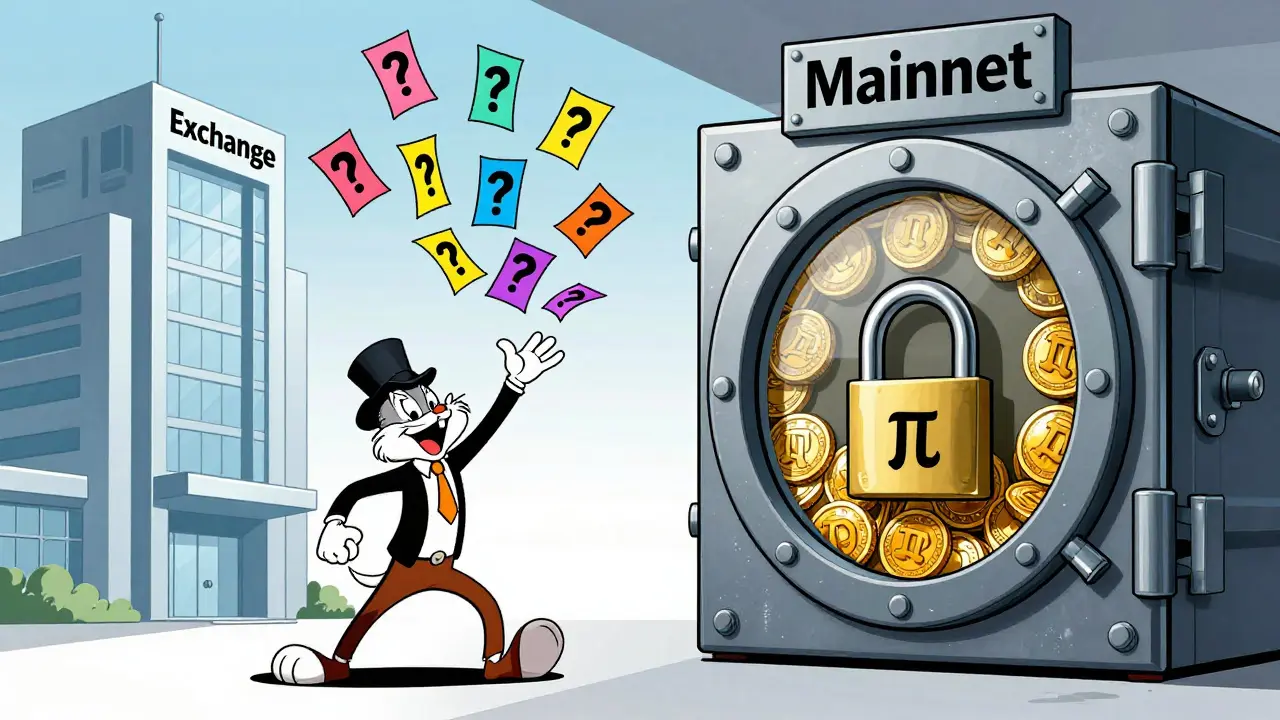
Seeing a price tag for Pi on major exchanges can be confusing. You might see it trading at $0.13 or recall seeing it spike to over $100 in early reports. But here is the catch: that price often belongs to a speculative placeholder called an IOU, not the actual coin you mined on your phone. If you are holding Pi in the official app, you cannot simply withdraw those coins to sell them on Binance or Coinbase right now. The tokens you see trading publicly are Pi [IOU], which are exchange-issued derivative tokens that represent a promise of future value rather than real, transferable Pi coins. Understanding this distinction is critical before you spend money or get your hopes up about cashing out.
The confusion stems from how centralized exchanges operate when a project like Pi Network is a mobile-mined cryptocurrency project operating on a closed mainnet has not yet opened its doors to external wallets. Exchanges like Hotcoin, Bitget, and OKX decided to list PI/USDT pairs anyway. They did this by creating internal accounting entries-IOUs-that users can buy and sell against stablecoins. These IOUs trade freely on these platforms, but they have no direct link to the blockchain balances held by millions of Pioneers worldwide.
How Pi IOUs Work vs. Real Mainnet Pi
To understand why the market behaves the way it does, we need to look at the mechanics behind both instruments. Real Pi exists on the Pi Network blockchain. For years, this network has been in a "closed mainnet" phase. This means that while you can mine Pi using the free mobile app and build your balance, you cannot move those coins off-chain to a hardware wallet or an exchange unless the core team explicitly enables it. The value of real Pi is currently theoretical because there is no open market where everyone can freely supply and demand it.
In contrast, Pi IOU is a centralized liability issued by an exchange, allowing traders to speculate on Pi's price without owning the underlying asset. When you buy Pi IOU on an exchange like Bybit or LBank, you are not receiving a cryptographic key to a specific amount of Pi on the blockchain. Instead, the exchange credits your account with a number that says, "We owe you this much value." If the exchange goes bankrupt, delists the token, or decides not to honor the conversion when the mainnet opens, that IOU could become worthless. It is a bet on the exchange’s willingness and ability to pay up later, not ownership of the digital currency itself.
The Price History: From $135 Spikes to Current Reality
If you looked at Pi prices in late 2022 or early 2023, you might remember headlines quoting prices as high as $135 per coin. Those numbers were driven by thin liquidity on a few exchanges listing IOUs. With very few people selling and many buying into the hype, the price skyrocketed. However, community analysis on forums like Reddit pointed out that such valuations implied a market capitalization larger than Bitcoin’s, which was mathematically unrealistic without massive adoption.
As of June 24, 2026, the reality is quite different. Multiple data trackers including CoinGecko, CoinMarketCap, and OKX show Pi trading around $0.13 USD. This drop reflects a convergence between the speculative IOU markets and a more grounded assessment of the project’s current utility. While daily trading volumes remain significant-with some exchanges reporting over $11 million in turnover-the price stability suggests that the initial euphoria has cooled into a cautious observation phase. Traders are now looking at actual ecosystem growth rather than just speculative potential.
| Feature | Pi [IOU] (PI) | Mainnet Pi (App Balance) |
|---|---|---|
| Nature | Exchange-issued derivative / Liability | On-chain cryptocurrency |
| Tradability | Tradable immediately on listed exchanges | Locked in closed mainnet; not externally tradable yet |
| Risk Profile | High counterparty risk (exchange failure/delisting) | Adoption risk (value depends on future utility) |
| Issuer | Centralized Exchanges (e.g., Hotcoin, Bitget) | Pi Core Team / Blockchain Protocol |
| Redemption | No guarantee of conversion to real Pi | N/A (Already the real asset) |
Where Can You Trade Pi IOU?
Liquidity for Pi IOU is fragmented across several centralized exchanges, primarily those catering to Asian markets or offering high-risk altcoin pairs. Platforms like Hotcoin, CoinW, and Biconomy have historically shown high volume for these instruments. Larger global players like OKX and Bybit also support spot trading for PI/USDT pairs.
However, the landscape is shifting. In 2025, HTX (formerly Huobi) announced it would delist its old PI IOU pair to make way for a new listing intended to represent mainnet Pi once connectivity was established. This move highlights a broader trend: exchanges are trying to clean up their books by replacing ambiguous IOUs with legitimate token listings. If you are looking to trade, you must verify whether the pair you are buying is still labeled as an IOU or if the exchange has migrated to a mainnet-supported contract. Trading legacy IOUs carries the risk of being stuck with an asset that an exchange may decide to retire without warning.

Risks Every Trader Should Know
The primary risk with Pi IOU is counterparty risk. Since these tokens exist only as database entries within an exchange, you are entirely dependent on that company’s solvency and honesty. Unlike Bitcoin or Ethereum, where you hold private keys to your assets, an IOU holder has no control over the underlying collateral. If the exchange faces regulatory pressure, technical issues, or insolvency, your IOU balance could vanish overnight.
Additionally, there is no legal obligation for an exchange to convert IOUs into real Pi even after the mainnet opens. The Pi Core Team has repeatedly stated on social media that they do not endorse these unauthorized listings. They warn users that IOUs cannot be traded for actual Pi held on the official closed mainnet. This disconnect means that even if real Pi gains immense value, IOU holders might not benefit unless the specific exchange they used chooses to honor its informal promises.
Is Pi IOU a Good Investment?
For experienced traders who understand derivatives and are comfortable with high volatility, Pi IOU offers a way to speculate on the project’s success without mining. It allows for quick entry and exit via USDT pairs. However, for the average user who has been mining Pi on their phone for years, expecting the IOU price to reflect their personal wealth is a mistake. Your mined Pi is separate from these markets.
The long-term viability of any Pi-denominated instrument depends on the Pi Network’s ability to transition from a closed ecosystem to an open one where goods and services are actually bought and sold with Pi. Until then, IOU prices will likely remain volatile and disconnected from fundamental utility. Experts suggest waiting for clear announcements from the Pi Core Team regarding open mainnet features and verified exchange integrations before making significant financial commitments based on IOU movements.
Can I withdraw my mined Pi to an exchange to sell it?
No. As of mid-2026, Pi Network operates on a closed mainnet. Coins mined in the app cannot be transferred to external wallets or exchanges. The Pi you see trading on exchanges is an IOU, not your mined balance.
Will Pi IOU convert to real Pi automatically?
There is no guarantee. IOUs are liabilities of the individual exchange. While some exchanges may choose to swap IOUs for real Pi if they gain access to the mainnet, others may delist the IOU entirely. The Pi Core Team does not enforce these conversions.
Why is the price of Pi IOU so low compared to past spikes?
Early prices over $100 were driven by low liquidity and speculation on a few small exchanges. Current prices around $0.13 reflect higher liquidity, more realistic market expectations, and the lack of immediate utility for the token outside of speculative trading.
Which exchanges list Pi IOU?
Pi IOU has been listed on exchanges such as Hotcoin, CoinW, Biconomy, LBank, OKX, and Bybit. However, listings change frequently, and some exchanges like HTX have moved to delist IOUs in favor of mainnet-linked pairs.
Is Pi Network a scam?
Pi Network itself is a legitimate project with a large user base and a functioning closed mainnet. However, the IOU markets are unofficial and highly risky. The project warns users against relying on exchange prices for valuation of their mined coins.


Categories