

Imagine putting your money to work while you sleep. In the world of traditional finance, this might mean a savings account with tiny interest rates. In Decentralized Finance (DeFi), an open financial system built on blockchain technology that operates without central intermediaries like banks, it looks very different. You can earn significant returns by simply providing assets for others to trade against. This process is called Liquidity Mining, a mechanism where users deposit crypto assets into liquidity pools to facilitate trading and earn rewards in return.
If you’ve heard buzzwords like "yield farming" or seen friends talking about passive income from their wallets, you’ve likely encountered liquidity mining. But how does it actually work? Is it safe? And why do platforms pay you just to hold tokens? Let’s break down the mechanics, the risks, and the real-world numbers so you can decide if this strategy fits your portfolio.
How Liquidity Mining Works: The Core Mechanism
To understand liquidity mining, you first need to understand the problem it solves. Decentralized exchanges (DEXs) like Uniswap don’t have human market makers standing behind screens matching buy and sell orders. Instead, they use automated systems called Automated Market Makers (AMMs). These AMMs rely on Liquidity Pools, smart contract-controlled reserves of two or more tokens that enable trading between those assets.
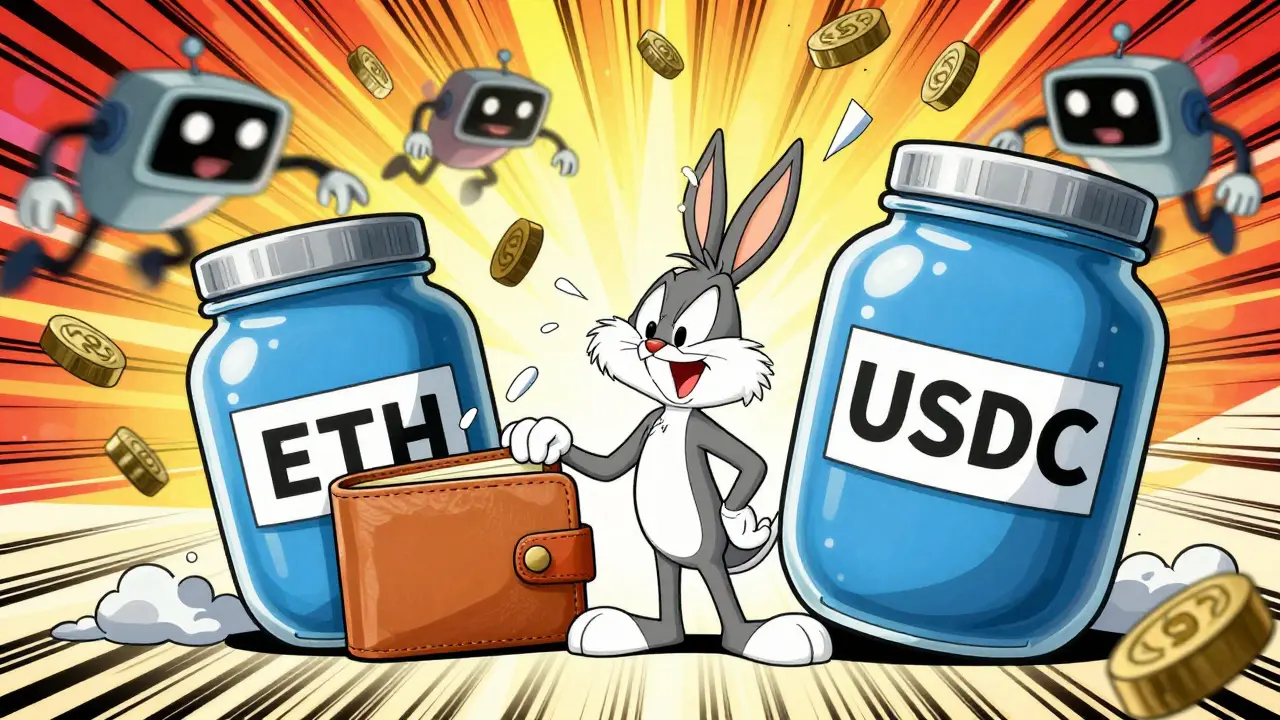
A liquidity pool is essentially a pot of money. For example, an ETH/USDC pool contains Ethereum (ETH) and USD Coin (USDC). When someone wants to swap ETH for USDC, they pull from this pool. Without enough depth in the pool, trades would be slow, expensive, or impossible. That’s where you come in.
When you participate in liquidity mining, you deposit equal values of two tokens into a pool. If ETH is trading at $2,500 and you want to contribute $1,000 worth of liquidity, you deposit 0.2 ETH ($500) and 500 USDC ($500). The smart contract then issues you LP Tokens, digital receipts representing your proportional share of the liquidity pool and your right to claim rewards. These LP tokens are crucial-they act as your proof of stake. You cannot withdraw your original assets or claim rewards without them.
As traders use the pool, they pay small fees (usually 0.05% to 0.3% per trade). These fees accumulate in the pool. Your share of these fees is calculated based on your percentage of the total pool. If you provide 1% of the liquidity, you earn 1% of the trading fees. Additionally, many protocols incentivize participation by rewarding LP token holders with their native governance tokens. This combination of trading fees and token rewards is what makes liquidity mining attractive.
Liquidity Mining vs. Staking and Bitcoin Mining
Newcomers often confuse liquidity mining with other crypto concepts. It’s important to distinguish them clearly because the risk profiles are vastly different.
| Mechanism | Primary Action | Risk Profile | Reward Source |
|---|---|---|---|
| Liquidity Mining | Depositing pairs into DEX pools | High (Impermanent Loss, Smart Contract Risk) | Trading Fees + Token Rewards |
| Staking | Locking single assets to secure network | Medium (Slashing, Price Volatility) | Network Issuance + Transaction Fees |
| Bitcoin Mining | Solving cryptographic puzzles with hardware | Low (Hardware Cost, Energy Cost) | Block Rewards + Transaction Fees |
Staking involves locking up a single asset to help secure a Proof-of-Stake network. You aren’t exposing yourself to the price divergence of two different assets. Bitcoin Mining requires specialized hardware and electricity to validate transactions. Liquidity mining, however, requires capital allocation across volatile assets, introducing unique risks that staking and mining do not carry.
The Hidden Risk: Impermanent Loss Explained
This is the most critical concept you must grasp before depositing a single dollar. Impermanent Loss, the temporary reduction in value of liquidity provider assets compared to holding them individually due to price volatility occurs when the price of one token in your pair changes significantly relative to the other.
Let’s look at a concrete example. Suppose you deposit 1 ETH and 2,000 USDC into a pool when ETH is priced at $2,000. Total value: $4,000.
Two weeks later, ETH surges to $4,000. Arbitrage bots will buy cheap ETH from your pool and sell it on the open market until the pool’s ratio matches the new market price. To maintain balance, the pool sells some of your ETH and buys more USDC. When you withdraw, you now have less ETH than you started with, but more USDC. While your total value has increased, it may be less than if you had simply held 1 ETH and 2,000 USDC in your wallet separately. The difference is the impermanent loss.
Conversely, if ETH crashes, the pool buys more ETH and sells USDC. Again, you end up with a different mix than you started with, potentially underperforming simple holding. Impermanent loss is "impermanent" only if prices revert to their original ratio. If they don’t, the loss becomes permanent upon withdrawal.
User experiences reflect this reality. On Reddit’s r/DeFi community, user u/CryptoYieldHunter reported earning a 12% APY from an ETH/USDC pool on Uniswap over six months. However, during a period of high volatility, impermanent loss reduced their actual net returns by about 3%. Another user, u/StablecoinSaver, documented a 7.5% impermanent loss over three months when providing liquidity for a highly volatile token pair during a market downturn. These examples show that while yields can be high, they are rarely pure profit.
Who Should Try Liquidity Mining?
Liquidity mining isn’t for everyone. It requires technical comfort and a tolerance for complexity. Here’s who benefits most:
- Long-term believers in specific pairs: If you believe ETH and USDC will grow together, providing liquidity allows you to earn fees on top of appreciation.
- Users seeking higher yields than staking: Liquidity mining often offers higher Annual Percentage Yields (APY) than standard staking, though with higher risk.
- Those comfortable with Web3 tools: You’ll need to manage a Web3 Wallet like MetaMask, handle gas fees, and interact directly with smart contracts.
It’s generally not suitable for:
- Beginners unfamiliar with blockchain: The learning curve is steep. Mistakes like sending tokens to the wrong address or approving malicious contracts can lead to irreversible losses.
- Risk-averse investors: If the idea of losing principal due to price fluctuations keeps you up at night, stick to stablecoins or traditional assets.
- Short-term traders: Liquidity mining works best when you’re willing to leave funds in the pool for weeks or months to accumulate meaningful fee revenue.
Top Platforms for Liquidity Mining in 2026
The landscape of liquidity mining has matured since the 2020-2021 boom. Today, several platforms dominate the space, each with distinct features.
Uniswap remains the leader, holding approximately 31.5% of the market share in DeFi liquidity pools as of late 2024. Its V3 protocol introduced concentrated liquidity, allowing providers to allocate capital within specific price ranges. This can increase capital efficiency by up to 4,000%, but it also requires active management to rebalance positions as prices move.
Curve Finance specializes in stablecoin swaps. Because the assets in its pools (like USDC, USDT, and DAI) have similar values, impermanent loss is minimal. This makes Curve a favorite for conservative liquidity providers seeking steady, lower-risk yields.
Balancer offers customizable pools, allowing you to create baskets with unequal weights (e.g., 80% ETH / 20% USDC). This flexibility helps tailor risk exposure to your specific outlook.
Layer 2 solutions like Arbitrum and Optimism are gaining traction. By reducing Ethereum mainnet gas fees, these networks make frequent adjustments and smaller deposits economically viable. Analytics from L2BEAT show 37% higher participation rates in liquidity mining on Layer 2 DEXs compared to Ethereum mainnet.

Getting Started: A Step-by-Step Guide
If you’ve decided to proceed, here’s how to execute your first liquidity mining position safely.
- Set Up a Web3 Wallet: Download MetaMask or another reputable wallet. Secure your seed phrase offline. Never share it.
- Fund Your Wallet: Buy ETH or other base tokens on a centralized exchange and transfer them to your wallet. Keep extra ETH for gas fees.
- Choose a Platform: Start with established platforms like Uniswap or Curve. Avoid new, unaudited protocols offering suspiciously high APYs.
- Select a Pool: Look for pools with high volume and deep liquidity. High volume means more fees; deep liquidity means lower slippage.
- Calculate Deposits: Use the platform’s calculator to determine the exact amount of each token needed. Ensure you deposit equal values.
- Approve and Deposit: Connect your wallet, approve the token spending limits, and confirm the transaction. Double-check all details before signing.
- Monitor and Rebalance: Track your position using dashboards like Zapper.fi or DeBank. If prices move significantly out of your range, consider rebalancing to minimize impermanent loss.
Expect to spend 8-12 hours studying the mechanics before participating safely. Common pitfalls include miscalculating deposit ratios and underestimating gas costs. Using third-party tools to verify ratios can save you from inefficient capital allocation.
Market Context and Future Outlook
As of mid-2024, the total value locked (TVL) in DeFi liquidity pools reached $58.7 billion, a 22.3% year-over-year increase. Liquidity mining accounts for approximately 43% of all DeFi yield strategies. While regulatory uncertainty persists-particularly with warnings from the U.S. Securities and Exchange Commission (SEC) regarding potential security classifications-the core utility of liquidity mining remains robust.
Looking ahead, integration with Layer 2 solutions will likely reduce barriers to entry. Institutional participation, currently around 13%, is growing steadily. Analysts predict a 15-20% annual growth rate for liquidity mining TVL through 2027. However, risks remain. Smart contract vulnerabilities led to $1.2 billion in losses in 2023 alone. Always audit the code or rely on platforms with extensive track records.
Liquidity mining is not a get-rich-quick scheme. It’s a sophisticated financial tool that rewards patience, research, and risk management. By understanding the mechanics of liquidity pools, impermanent loss, and platform selection, you can harness this powerful DeFi primitive to generate meaningful returns.
Is liquidity mining safe?
Liquidity mining carries significant risks, including impermanent loss, smart contract vulnerabilities, and regulatory uncertainty. While the mechanism itself is transparent, the underlying assets can fluctuate wildly. It is safer than many speculative investments if you choose established platforms and stablecoin pairs, but it is never risk-free.
What is the difference between liquidity mining and yield farming?
Liquidity mining is a subset of yield farming. Yield farming encompasses a broader range of strategies, including lending, borrowing, and complex multi-protocol arbitrage. Liquidity mining specifically refers to providing liquidity to decentralized exchange pools to earn trading fees and token rewards.
How do I avoid impermanent loss?
You cannot completely eliminate impermanent loss, but you can minimize it. Provide liquidity for correlated assets (like BTC and ETH) or stablecoins (like USDC and DAI). Avoid pairing highly volatile tokens with stablecoins unless you are prepared for significant price swings. Regular monitoring and rebalancing can also help mitigate losses.
Do I need a lot of money to start liquidity mining?
Not necessarily. While large deposits generate more absolute fees, you can start with small amounts. However, keep in mind that gas fees on Ethereum mainnet can be high, making small deposits less cost-effective. Using Layer 2 solutions like Arbitrum or Optimism reduces these costs, allowing for smaller initial investments.
Can I lose my entire investment in liquidity mining?
Yes, although it is rare. You could lose everything if the smart contract is hacked, if one of the tokens in the pair goes to zero, or if you accidentally send funds to the wrong address. Always use audited platforms and double-check all transactions before confirming.


Categories