
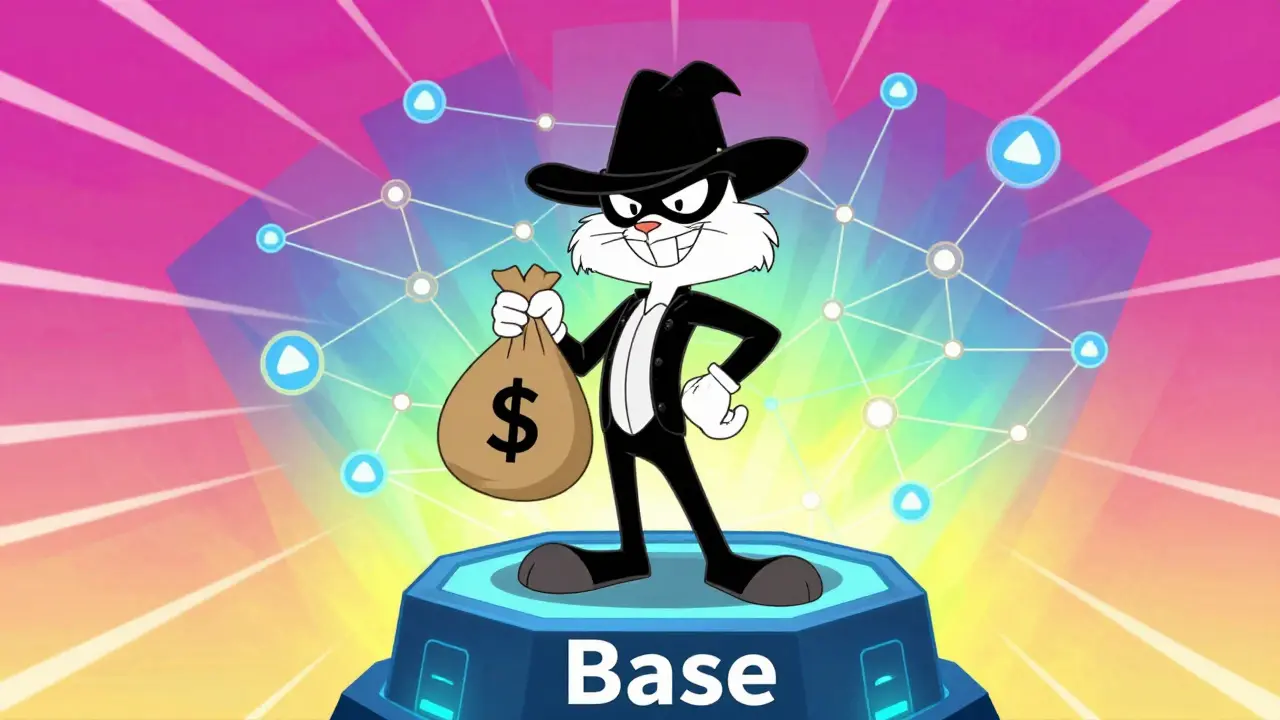
Ever wonder why some crypto tokens look like they’re having fun while others are trying to change the world? That’s exactly where Bandit on Base fits in. It’s not a high-tech protocol or a serious financial tool. Instead, it’s a meme coin built on the Base blockchain, a layer-2 network created by Coinbase that runs on Ethereum. If you’ve stumbled across the ticker $BANDIT and are wondering what it actually does, how much it costs, and whether it’s worth your attention, you’re asking the right questions before putting any money into it.
The short answer: Bandit on Base is a speculative, community-driven token designed for entertainment and social engagement rather than real-world utility. It aims to be the "dominant meme project" on Base, relying on viral marketing, rebellious branding, and the low transaction fees of the Base chain to attract traders. But beneath the playful surface lies a micro-cap asset with extreme volatility, thin liquidity, and significant risks. Let’s break down everything you need to know about BANDIT so you can decide if this bandit belongs in your portfolio-or if it’s best left on the blockchain.
What Exactly Is Bandit on Base?
To understand Bandit on Base, you first have to understand what a meme coin is. Unlike Bitcoin, which was designed as decentralized digital cash, or Ethereum, which powers smart contracts, meme coins derive their value almost entirely from community sentiment, internet culture, and hype. Think of Dogecoin or Shiba Inu-they started as jokes but gained massive followings because people liked the narrative.
Bandit on Base ($BANDIT) follows this exact playbook. According to data from aggregators like CoinMarketCap and MEXC, the project explicitly states it is "not intended as a utility token." There’s no staking mechanism that generates yield, no governance voting rights, and no integration with DeFi protocols that offers unique benefits. Its entire value proposition rests on cultural appeal-specifically, a "rebellious spirit" and the idea of being an underdog or outlaw within the Base ecosystem.
Why Base? The Base blockchain is crucial here. Launched by Coinbase, Base is an Ethereum Layer-2 solution designed to offer fast, cheap transactions. For a meme coin, this matters because trading small amounts of crypto shouldn’t cost more than the trade itself. On mainnet Ethereum, gas fees can eat up tiny trades. On Base, those fees are negligible, making it easier for retail traders to buy, sell, and swap BANDIT without getting crushed by costs. This accessibility is one of the few tangible advantages BANDIT holds over older meme coins stuck on congested networks.
Tokenomics: Supply, Circulation, and Discrepancies
When evaluating any crypto, the numbers tell half the story. With Bandit on Base, however, the numbers are messy-and that’s a red flag you shouldn’t ignore. Different platforms report conflicting data, which is common for micro-cap tokens but dangerous for investors who assume all listings are accurate.
| Platform | Total Supply | Circulating Supply | Market Cap Estimate |
|---|---|---|---|
| CoinMarketCap | 10 Billion | 8 Billion | ~$18.5K - $20K |
| MEXC | 9.69 Billion | 7.87 Billion | $18.59K |
| Binance | 10 Billion | 0 (Unverified) | $0 (Due to missing circ. supply) |
| LBank / BeInCrypto | Not Specified | ~7.87 - 8 Billion | $18.59K |
Notice the discrepancy? Binance lists the circulating supply as zero, rendering its market cap calculation useless. Meanwhile, MEXC and LBank align closely, suggesting a real market capitalization hovering around $18,600 USD. This inconsistency highlights a key risk: BANDIT lacks standardized reporting. There’s no official team publishing verified audits or regular updates. You’re relying on third-party scrapers to track a token that doesn’t seem to prioritize transparency.
The total supply caps at 10 billion tokens. With roughly 80% already in circulation, there isn’t a massive amount of hidden supply waiting to dump on the market-a plus compared to projects where developers hold 50%+ of tokens. However, without knowing who controls the remaining wallets, you can’t rule out insider manipulation.
Price History and Performance: From Hype to Stagnation
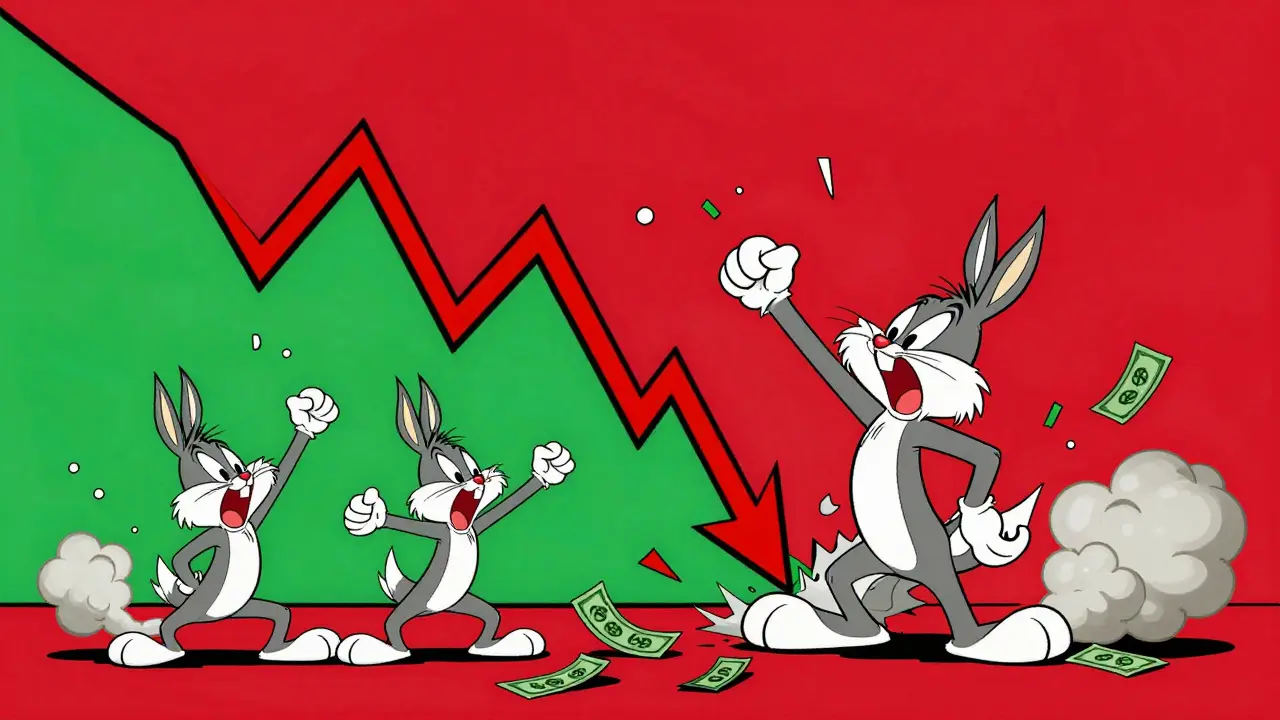
If you bought BANDIT at its peak, you’re likely still hurting. The token reached its all-time high (ATH) of $0.0001303 on January 14, 2025. Fast forward to mid-2026, and the price sits between $0.00000233 and $0.00000236. That’s a decline of approximately 98%. In crypto terms, this is a classic "blow-off top" followed by a long, slow bleed.
Here’s what the recent performance looks like based on Bybit data from April 2026:
- 24-Hour Change: +0.47%
- 7-Day Change: +12.32%
- 14-Day Change: +5.28%
- 30-Day Change: -11.59%
While the weekly gains might look tempting, they’re meaningless in context. When a token has dropped 98% from its high, a 12% bounce is just noise. More concerning is the trading volume. Yahoo Finance and Crypto.com report near-zero 24-hour volume, sometimes listing it as $0.00. What does this mean for you? It means liquidity is dangerously thin. If you try to sell a large position, you could crash the price yourself because there aren’t enough buyers on the other side. Slippage-the difference between the expected price and the executed price-will eat into your returns significantly.
How Does BANDIT Compare to Other Base Meme Coins?
You don’t have to choose BANDIT. The Base ecosystem is crowded with meme coins, and most of them are doing better. To put BANDIT in perspective, let’s compare it to established players like Brett, Degen, and Toshi.
| Feature | Bandit on Base (BANDIT) | Brett / Degen / Toshi |
|---|---|---|
| Market Cap | ~$18.6K (Micro-Cap) | Millions to Billions (Large/Mid-Cap) |
| Liquidity | Extremely Low (Near Zero Volume) | High (Active Trading Pairs) |
| Exchange Listings | 2 Active Markets (Bitget, Bybit, etc.) | Multiple Tier-1 CEXs & Major DEXs |
| Utility | None (Meme Only) | None (Meme Only), but stronger communities |
| Risk Level | Extreme (High chance of total loss) | High (But lower probability of rug pull) |
The difference is stark. Brett, for instance, became the de facto mascot of Base, benefiting from early adoption and massive community support. Degen capitalized on the gambling culture inherent in crypto trading. These tokens have deep liquidity pools, meaning you can enter and exit positions easily. BANDIT, by contrast, is trapped in obscurity. It trades on only two active markets according to Yahoo Finance and LBank. Without major exchange listings or a viral resurgence, it remains a niche curiosity rather than a viable investment.
Security and Smart Contract Risks
Is BANDIT safe? Technically, yes-but with major caveats. The token contract is deployed on Base and verified on BaseScan, the block explorer for the Base network. The contract address is 0xe0f96f025ebb27950718ebd787b69c325cf045c0. Verification means the code is public and matches what users see, which prevents basic obfuscation tricks.
However, verification is not an audit. There is no record of a third-party security firm (like CertiK or Hacken) reviewing the code for vulnerabilities such as hidden minting functions, blacklist capabilities, or excessive owner privileges. In the meme coin world, "verified" often just means "the developer didn’t hide the code," not "the code is secure."
Additionally, because BANDIT operates on Base, it inherits Ethereum’s security model. This is good news-you won’t lose funds due to a chain collapse. But bad news if the token contract itself has flaws. Since there’s no named founder or corporate entity behind BANDIT, accountability is nonexistent. If the developers decide to abandon the project or drain liquidity pools (a "rug pull"), there’s no legal recourse. Given the current stagnation, abandonment seems more likely than a malicious hack, but both outcomes result in total loss for holders.
How to Buy Bandit on Base (If You Still Want To)
Despite the risks, some traders are drawn to the potential of a 100x comeback from rock-bottom prices. If you fall into that category, here is how you acquire BANDIT. Note that this process requires familiarity with crypto wallets and exchanges.
- Choose an Exchange: BANDIT is listed on smaller centralized exchanges like Bitget and Bybit. It is also available via decentralized swaps on Base through tools like Uniswap or Base-specific DEXs.
- Fund Your Account: Deposit USDT or ETH into your exchange account. For DEX trading, you’ll need ETH bridged to the Base network.
- Buy BANDIT: On a CEX, search for the BANDIT/USDT pair and execute a market or limit order. On a DEX, connect your wallet (MetaMask or Coinbase Wallet recommended), paste the BANDIT contract address, and swap your ETH for BANDIT.
- Withdraw to a Wallet: For safety, move your tokens to a non-custodial wallet. Ensure your wallet supports the Base network to avoid sending tokens to the wrong chain and losing them forever.
Keep in mind: Buying on a CEX is easier but may involve higher spreads due to low volume. Buying on a DEX gives you direct access but requires paying Base gas fees (which are cheap, usually less than $0.01). Always double-check the contract address before swapping.
Who Should Avoid BANDIT?
Let’s be blunt. If you are looking for passive income, long-term stability, or a technology-backed investment, BANDIT is not for you. It is a lottery ticket, not an asset. Specifically, avoid BANDIT if:
- You cannot afford to lose 100% of your investment.
- You need liquidity to exit quickly during a downturn.
- You prefer projects with transparent teams, audited code, and clear roadmaps.
- You are new to crypto and don’t understand slippage, gas fees, or wallet security.
The crypto market is full of opportunities, but most of them don’t require gambling on a token with a $18k market cap and zero daily volume. Projects like Ethereum, Solana, or even larger Base memes like Brett offer exposure to the ecosystem with significantly lower risk profiles.
Future Outlook: Will BANDIT Make a Comeback?
Predicting the future of a meme coin is akin to reading tea leaves. However, we can look at historical patterns. Meme coins often experience cyclical hype. A dormant token can suddenly spike if a celebrity tweets about it, if a new trend emerges on X (Twitter), or if the broader Base ecosystem sees a surge in activity.
As of mid-2026, there are no signs of renewed interest in BANDIT. No partnerships, no new features, no major influencer endorsements. The project appears to be coasting on residual awareness. For BANDIT to recover from its 98% drawdown, it would need a catalyst that brings fresh capital into the pool. Without that, it will likely continue to drift sideways or slowly decay as holders give up and sell off remaining positions.
BeInCrypto and other prediction engines treat BANDIT as a high-risk speculative asset with negligible fundamental value. Their models suggest that any price movement will be driven purely by sentiment shocks, not organic growth. If you’re holding BANDIT, you’re betting on chaos. If you’re thinking about buying, ask yourself: Why now? What has changed since January 2025 that makes today different? If you can’t answer that, you probably shouldn’t buy.
Is Bandit on Base a scam?
There is no evidence that Bandit on Base is a deliberate scam in the sense of a fraudulent scheme designed to steal funds directly. The contract is verified on BaseScan, and the token exists on legitimate exchanges. However, it exhibits many characteristics of high-risk assets: anonymous developers, lack of utility, extreme volatility, and thin liquidity. While not a "scam" by definition, it carries a high risk of total loss due to market dynamics and potential abandonment by creators.
Where can I buy BANDIT tokens?
You can buy BANDIT on centralized exchanges like Bitget and Bybit, or via decentralized exchanges (DEXs) on the Base network using wallets like MetaMask or Coinbase Wallet. Always verify the contract address (0xe0f96f025ebb27950718ebd787b69c325cf045c0) before purchasing to ensure you are getting the correct token.
What is the maximum supply of BANDIT?
The maximum supply of Bandit on Base is 10 billion tokens. Approximately 8 billion tokens are currently in circulation, according to CoinMarketCap and MEXC data. Some platforms show slight variations in circulating supply due to differing methodologies for counting locked or burned tokens.
Does BANDIT have any utility?
No. Bandit on Base is explicitly marketed as a meme-inspired token with no functional utility. It does not offer staking rewards, governance rights, or integration with DeFi protocols beyond basic trading and swapping. Its value is derived solely from community sentiment and speculative trading.
Why is the price of BANDIT so low?
The price of BANDIT is low because it is a micro-cap meme coin with extremely low liquidity and minimal trading volume. After reaching an all-time high in early 2025, the token experienced a 98% drop in value. With near-zero daily trading volume, there is little demand to push the price up, and sellers can easily impact the market due to the shallow order book.
Is BANDIT safer than other meme coins?
BANDIT is not inherently safer than other meme coins. While it runs on the secure Base blockchain, the token itself lacks third-party security audits and has an anonymous development team. Compared to larger, more liquid meme coins like Brett or Degen, BANDIT carries higher risks due to its tiny market cap and difficulty exiting positions. All meme coins should be considered high-risk investments.
Categories