
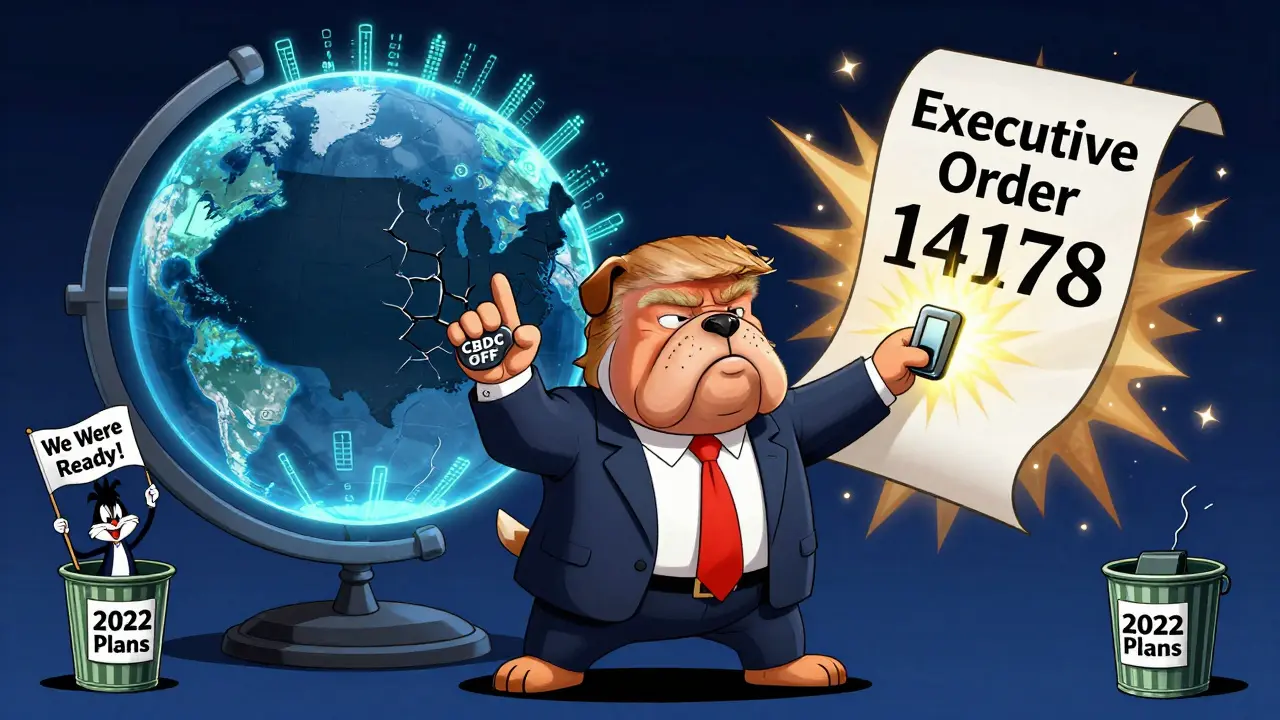
The United States used to be on track to launch a digital dollar. Not just a theory, not just a pilot - real, government-backed digital cash that could’ve changed how money moves in America. But in 2025, everything stopped. President Donald Trump signed Executive Order 14178, a directive that immediately ended all federal efforts to develop a central bank digital currency (CBDC), commonly called the digital dollar or FedCoin.
This wasn’t a slow fade. It was a hard stop. Just two years earlier, under President Biden, the U.S. had launched an entire interagency task force to design the digital dollar. The Treasury, the Federal Reserve, the White House, the National Security Council - all of them were working together. Nellie Liang, then a top Treasury official, said the goal was to shape global standards and make sure the U.S. didn’t get left behind. Now? Zero progress. Zero funding. Zero plans.
And it’s not just symbolic. Federal Reserve Chair Jerome Powell made it clear: he won’t issue a CBDC while he’s still in charge. That’s not a delay. That’s a permanent exit.
What Was the Digital Dollar Supposed to Do?
The digital dollar wasn’t meant to replace cash. It was meant to modernize the system. Think of it like digital cash issued directly by the Fed - not through banks, not through apps, but as a secure, government-backed form of money you could hold on your phone or card. It would’ve worked like cash, but with digital benefits: instant transfers, no fees, and no middlemen.
Central banks around the world are chasing CBDCs for five big reasons:
- Financial inclusion - 62% of central banks say it’s their top reason. Millions in the U.S. are underbanked or unbanked. A digital dollar could’ve reached them directly.
- Payment efficiency - Right now, sending money between banks can take days. A CBDC settles in seconds.
- Modernizing infrastructure - The U.S. still relies on systems built in the 1970s. A digital dollar would’ve replaced outdated tech.
- Competing with stablecoins - Companies like Circle and Tether are already issuing dollar-backed tokens. The U.S. government wanted its own version to stay in control.
- Programmability - Imagine automatic stimulus payments that only activate if you’re unemployed, or tax rebates that expire if not spent on groceries. That’s possible with a CBDC.
The U.S. had already tested this. The Federal Reserve ran multiple pilot programs. Banks, tech firms, and even local governments were involved. The infrastructure was ready. The research was done. Then, the order came down.
How the U.S. Compares to the Rest of the World
While the U.S. shut its doors, the rest of the world kept going.
As of early 2025, 134 countries and currency unions are actively working on CBDCs. That’s up from 114 just two years ago. Fifty-three countries are running live pilots. Eleven have already launched full CBDCs - including Nigeria, Jamaica, and the Bahamas. The European Central Bank is pushing ahead with its digital euro, aiming to settle transactions using distributed ledger technology by late 2026.
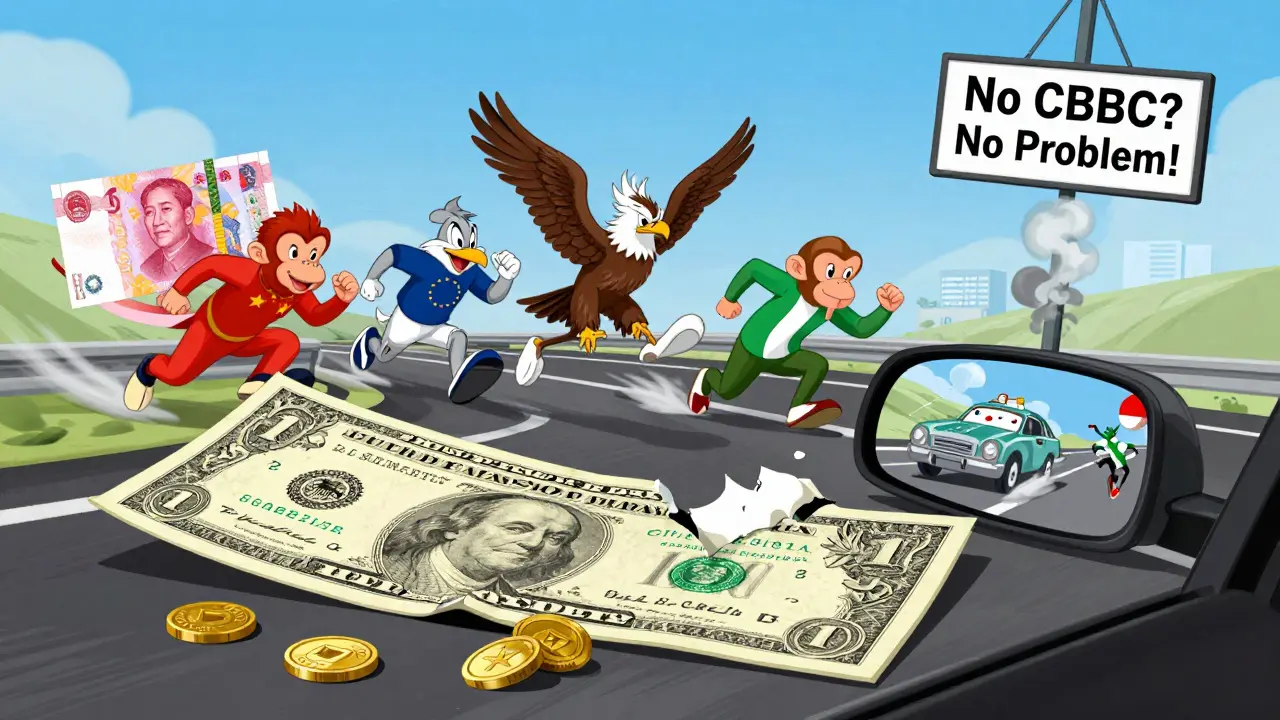
Even among the G-20 - the world’s biggest economies - only the U.S. has fully walked away. Every other G-20 nation is either testing, developing, or planning a CBDC. China’s digital yuan is already handling billions in daily transactions. India, Brazil, South Africa, Japan, Turkey - all of them are moving forward.
The global value of CBDC transactions is projected to hit $213 billion in 2025. The U.S. isn’t even on the scoreboard.
Why Did the U.S. Stop?
Officially, the administration says it wants to focus on regulating private digital assets instead. The message is clear: let companies like Coinbase or Fnality International build the future - not the government.
But there’s more beneath the surface.
One major factor is surveillance. The U.S. already has one of the most invasive financial monitoring systems in the world. In 2022 alone, banks filed over 26 million reports on customer activity - everything from large cash deposits to unusual wire transfers. A CBDC would’ve made that even easier. Every transaction, every dollar, could’ve been tracked in real time.
For some policymakers, that’s a dealbreaker. The fear isn’t just about privacy - it’s about power. If the government can track every digital dollar, it can also freeze accounts, restrict spending, or cut off access to money without a court order. That’s not theoretical. It’s already happening with asset forfeiture laws.
The decision also reflects a broader ideological shift: distrust of government tech, and faith in private markets. The new administration believes innovation will come from Silicon Valley, not Washington. So instead of a digital dollar, we might get a digital ecosystem built by private stablecoins - like USDC or a new dollar-backed token from Fnality International, backed by State Street and other big banks.
What This Means for Businesses and Consumers
For everyday Americans, the immediate impact is small. Cash and credit cards still work. But for businesses, especially those in fintech, the gap is growing.
State Street, one of the world’s largest financial services firms, says having a sovereign digital dollar is key to scaling institutional investment in tokenized assets. Without it, U.S. companies will struggle to compete globally. Imagine a European firm settling a $10 million bond trade in digital euros - instantly, with no fees. A U.S. firm? It’s stuck using slower, costlier systems.
Private stablecoins might fill the gap, but they come with risks. They’re not backed by the Fed. They’re not legal tender. If a company like Circle goes under, your USDC might not be worth anything. A CBDC would’ve been risk-free - like cash, but digital.
And for international trade? The U.S. dollar is still king. But if other countries start settling trade deals in digital yuan, digital euro, or digital rupee - and the U.S. has no digital alternative - the dollar’s dominance could erode over time. Not tomorrow. Not next year. But in 10 years? That’s when the real cost shows up.
The Long-Term Risk: Losing the Digital Financial Race
The U.S. used to lead in financial innovation. From credit cards to online banking, it set the global standard. Now, it’s opting out of the next big thing.
By walking away from a CBDC, the U.S. isn’t just missing out on a payment tool. It’s ceding influence over the rules of the next financial system. Who sets the standards for cross-border digital payments? Who defines security protocols? Who controls the infrastructure?
If China, the EU, or even India builds the future of digital money - and the U.S. only watches - American companies will have to adapt to foreign rules. That’s not speculation. It’s what happened with 5G and semiconductors.
The U.S. still has the world’s largest economy: $25.7 trillion in GDP. But without a digital dollar, it risks becoming a late adopter - not a leader - in the next phase of finance.
What’s Next?
There’s no plan to restart CBDC work. Not now. Not under this administration. The doors are closed.
That means private companies will step in. Stablecoins will grow. Tokenized assets will rise. Wall Street will find ways to move money digitally - but without the safety net of government backing.
For now, the digital dollar is dead. And the world is moving on without it.