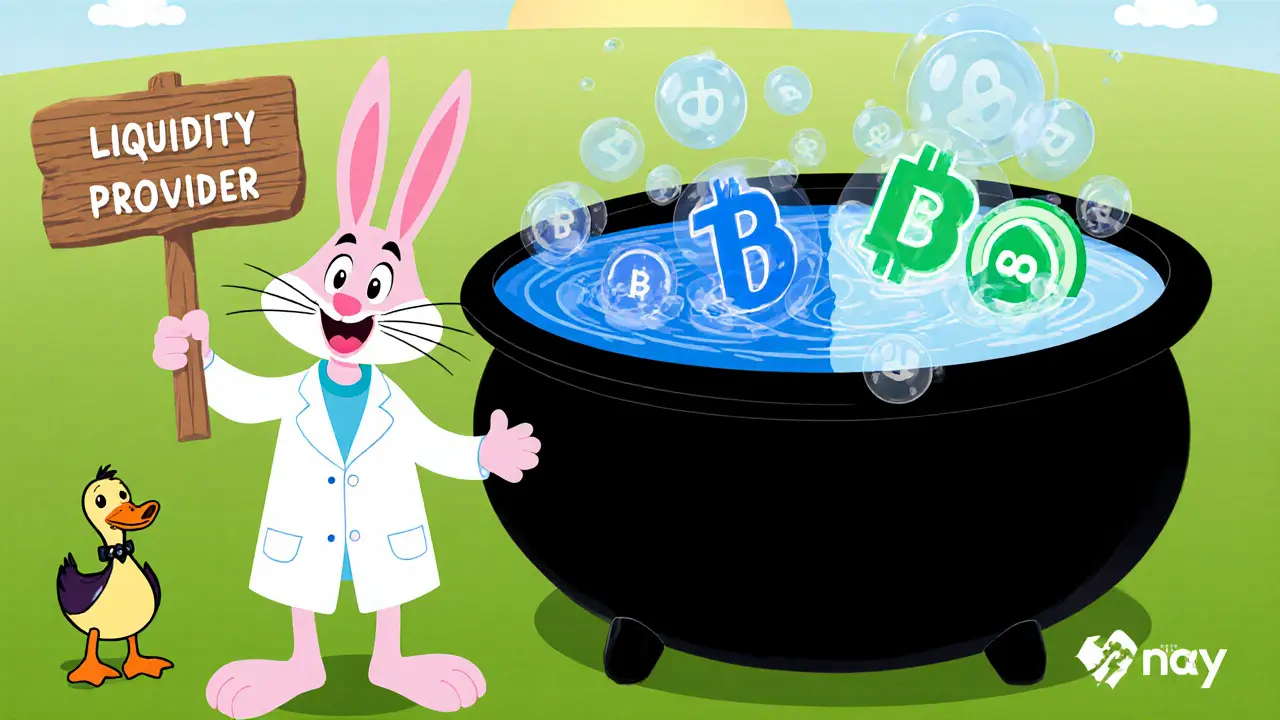
Understanding Impermanent Loss in DeFi: Risks, Calculations, and Mitigation
Posted On June 26, 2025 15Learn what impermanent loss is, how it happens in DeFi AMM pools, how to calculate it, and practical ways to reduce the risk while earning fees.

When looking at trading fees, the charges applied each time you execute a trade on a market, you’ll also encounter exchange fees, the cost set by a specific platform for using its order book and transaction fees, the network‑level payment required to confirm a move on the blockchain. Together, these three concepts shape how much you actually keep after a trade. Trading fees can eat into profits faster than you expect if you don’t understand them.
The first semantic link is simple: trading fees encompass exchange fees. Whether you trade Bitcoin on a centralized exchange (CEX) or swap tokens on a decentralized exchange (DEX), the platform adds a markup. That markup is usually expressed as a percentage of the trade size, but some venues charge a flat fee per order. Knowing the exact rate lets you calculate the real cost of each position before you click "buy".
Two major fee models dominate the market: the maker‑taker system and flat‑rate pricing. In a maker‑taker model, exchange fees influence trading profitability by rewarding liquidity providers (makers) with lower rates and charging takers a bit more for removing liquidity. This incentivizes tighter spreads and healthier order books. Flat‑rate pricing, on the other hand, is easier to predict—every trade costs the same, regardless of whether you add or take liquidity.
Another important entity is blockchain fees, often called gas fees. Transaction fees are driven by network congestion; when many users try to move assets at once, miners or validators raise the price to prioritize transactions. On Ethereum, gas fees can spike to several dollars, turning a tiny trade into an expensive maneuver. Understanding this dynamic helps you pick the right time to trade or choose a layer‑2 solution with lower fees.
Beyond the headline numbers, hidden costs can sneak in. Withdrawal fees, for example, are charged when you move crypto off an exchange to a personal wallet. Some platforms also levy deposit fees for certain fiat methods. These are separate from the core trading fees but still affect your net return. By adding up all the individual charges, you get a true picture of the total cost of ownership for each trade.
Volume discounts are a common perk for high‑frequency traders. Exchanges often tier their fee schedules: the more you trade in a 30‑day window, the lower your percentage fee becomes. This creates a feedback loop where active traders benefit from cheaper fees, encouraging even more activity. If you’re an occasional trader, you might stay in the highest‑fee tier, so it’s worth checking whether a different platform offers a better flat‑rate for low volume.
Decentralized exchanges bring a different fee structure. DEXes usually charge a small protocol fee that goes to liquidity providers, plus a modest network fee for the underlying blockchain. Because there’s no middleman, you often see lower overall costs, but you also face higher gas fees during peak usage. Some DEXes bundle fees into a single “swap fee,” simplifying the calculation for users.
When comparing platforms, consider the fee‑to‑service ratio. A low fee is attractive, but you also need reliable execution, strong security, and good customer support. Some cheap exchanges compromise on these aspects, leading to slippage or delayed withdrawals that can cost you more than the fee itself. Look at the overall user experience, not just the headline percentage.
Finally, there are strategies to reduce fees without sacrificing speed. Using limit orders instead of market orders can qualify you as a maker, unlocking lower rates. Trading on less congested networks, such as Binance Smart Chain or Polygon, cuts down gas costs. Some users batch multiple trades into a single transaction using smart contracts, spreading the network fee across several moves.
All of these factors—exchange fees, transaction fees, blockchain fees, volume discounts, and hidden charges—interact to shape the real price you pay when you trade. Below you’ll find a curated list of articles that dive deeper into each of these topics, from detailed exchange reviews to step‑by‑step guides on optimizing your fee structure. Armed with this context, you’ll be ready to pick the right platform and trade smarter.
Learn what impermanent loss is, how it happens in DeFi AMM pools, how to calculate it, and practical ways to reduce the risk while earning fees.

In-depth One Trading crypto exchange review covering regulation, fees, speed, security, and how it compares to other platforms for traders.

A concise review of TWCX crypto exchange highlighting missing fee, security and regulatory info, comparison with Kraken and Crypto.com, and a due‑diligence checklist for 2025.




Categories