
When you hear "zero-fee crypto trading," your first thought might be: too good to be true. That’s exactly what Cube Exchange is selling - and it’s working for some people. But here’s the catch: it’s not regulated, it doesn’t offer many coins, and if you lose your private key, your money is gone forever. No one’s coming to help you. This isn’t your grandma’s bank. This is crypto - raw, fast, and unforgiving.
What Is Cube Exchange?
Cube Exchange launched in 2023 as a hybrid crypto platform that mixes centralized speed with decentralized security. It doesn’t hold your coins. Instead, it uses Multi-Party Computation (MPC) a security technology that splits private keys across multiple devices so no single point can be hacked. You sign trades using your own device, and the exchange only matches orders off-chain - then settles them on-chain. That means faster trades, lower fees, and you keep control of your wallet.
As of late 2025, Cube Exchange supports 46 cryptocurrencies. That includes Bitcoin, Ethereum, Solana, Dogecoin, Tether, and Sui. Not bad for a newcomer. But compare that to Binance’s 350+ or Coinbase’s 200+, and you start to see the gap. If you’re trading altcoins like Arbitrum, Polygon, or new Solana memecoins, you’ll be disappointed. Cube Exchange doesn’t list them.
Zero Fees - But What’s the Catch?
The biggest draw? Zero fees on spot trading. Maker and taker fees are both 0.00%. That’s rare. Even major exchanges like Kraken and KuCoin charge at least 0.1%. Cube Exchange makes money through other channels - mainly its staking and borrowing services. You can earn interest on your holdings or borrow against them. That’s where their real revenue lives.
But here’s what’s not said out loud: there are withdrawal fees. You can’t avoid them. Withdraw Bitcoin? You’ll pay a small network fee. Same with Ethereum or Solana. These aren’t set by Cube - they’re blockchain fees. But the platform doesn’t hide them. You’ll see them before you confirm. Transparency is good. But if you thought "zero fee" meant free everything, you’re in for a surprise.
Security: Non-Custodial, But Risky
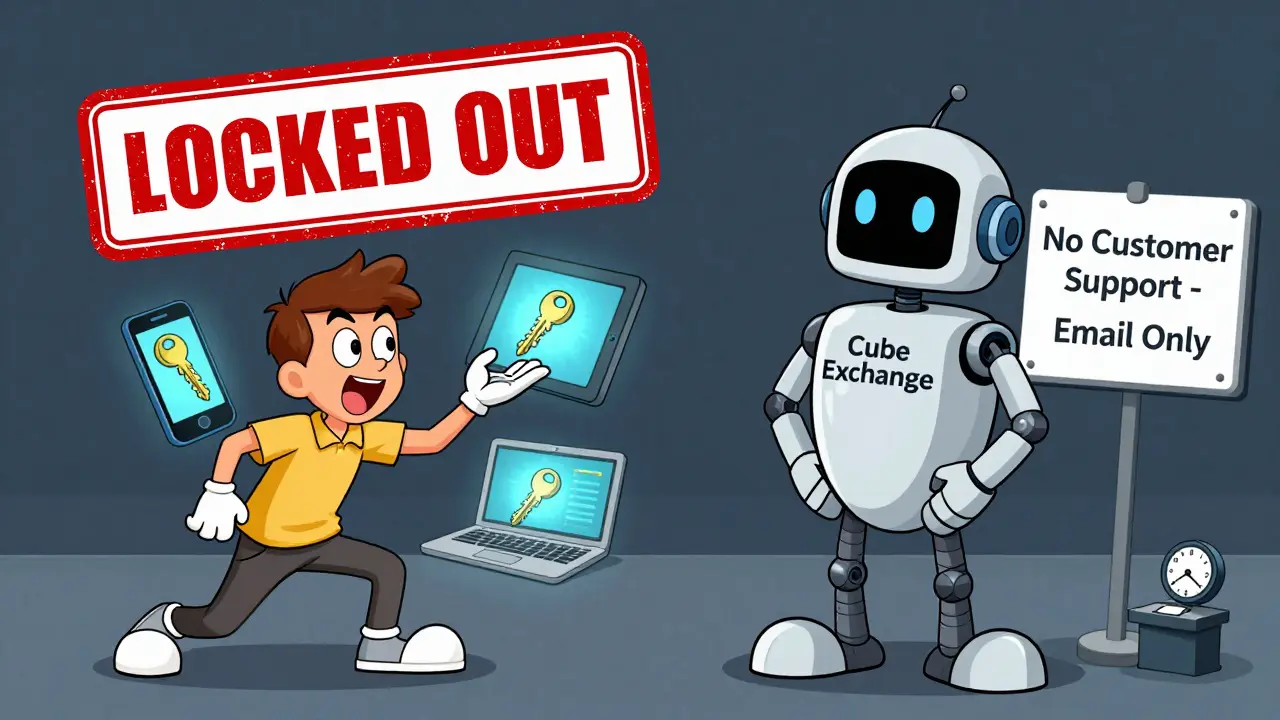
Cube Exchange calls itself "non-custodial." That’s true. They don’t hold your keys. But that also means you are 100% responsible for your recovery phrase. If you lose it. If you forget it. If your phone gets stolen - your funds are gone. No reset. No customer service rescue.
The MPC system helps. Instead of one key, you have three encrypted fragments stored on different devices. To sign a trade, you need two of them. It’s smarter than a single seed phrase. But it’s also more complex. New users often get confused. One Reddit user in October 2025 wrote: "I thought I set up MPC right, but I forgot I needed my tablet to approve trades. Got locked out for 3 days."
Other security features? Two-factor authentication (2FA), encrypted data storage, and blockchain-based settlement records. All solid. But here’s the real problem: no government oversight. FxVerify’s September 2025 report confirms Cube Exchange isn’t regulated by any authority. Not the SEC. Not the FCA. Not even a minor jurisdiction like Malta or Singapore. That means if the platform vanishes tomorrow - or gets hacked - you have zero legal recourse.
Performance and Usability
The app is clean. The web interface is fast. Charts load quickly. Order execution is near real-time. Slippage is low on BTC and ETH trades. The mobile app (iOS App Store ID 6736371827) has a 4.3-star rating from 187 reviews. Users praise the "glassy" UI updates and smoother animations from the October 2025 update.
But it’s not perfect. Customer support? Email only. No live chat. No phone. Response time averages 24-48 hours. One user reported waiting 72 hours to ask about a failed withdrawal. Another said they got a template reply that didn’t solve anything.
Education? Cube Exchange has a decent knowledge base. It explains order types, slippage, funding rates, and how MPC works. But it’s all text. No videos. No walkthroughs. If you’re new to crypto, you’ll need to Google half the terms before you even start trading.
Who Is This For?
Cube Exchange isn’t for everyone. Here’s who it works for:
- You want to trade Bitcoin, Ethereum, or Solana without paying fees
- You’re comfortable managing your own keys and understand MPC
- You don’t need 200 altcoins - you just want to move fast
- You’re okay with zero regulatory protection
Here’s who should avoid it:
- You trade lesser-known tokens (like Shiba Inu, Doge, or new DeFi coins)
- You expect customer support to save you when things go wrong
- You live in the U.S., EU, or UK - where regulation is expected
- You’re not confident backing up your recovery phrases
According to Cube Exchange’s internal data, 68% of users are between 25 and 44. Most have traded before. They’re not beginners. They’re looking for efficiency, not hand-holding.

How It Compares
| Feature | Cube Exchange | Binance | Coinbase |
|---|---|---|---|
| Trading Fees (Spot) | 0.00% | 0.10% | 0.50% |
| Supported Coins | 46 | 350+ | 200+ |
| Regulation | None | Multiple jurisdictions | U.S. regulated |
| Custody Model | Non-custodial (MPC) | Custodial | Custodial |
| Monthly Traffic | 35,125 | 189M | 72M |
| Support Channels | Email only | Live chat, phone, email | Live chat, email |
| Staking & Borrowing | Yes | Yes | Yes |
Bottom line: Cube Exchange trades speed and fees for safety and choice. It’s a niche tool. Not a replacement.
The Regulatory Elephant in the Room
The biggest red flag? No regulation. Not even a license from a minor jurisdiction. That’s not normal. Even obscure exchanges like Bybit or Gate.io have some form of compliance. Cube Exchange doesn’t. FxVerify says it outright: "This company does not appear to be regulated by any government authority at this time." Why does that matter? Because if regulators crack down - and they will - Cube Exchange could be shut down overnight. No warning. No notice. Your funds? Locked. No appeal. No refund.
And it’s not just a risk - it’s a legal barrier. The U.S. SEC has made it clear: unregulated exchanges are targets. Even if Cube Exchange says "US" is a detected region, it doesn’t mean it’s legal to operate there. Many users in America still sign up - but they’re doing so at their own risk.
Final Verdict
Cube Exchange is a bold experiment. It’s fast. It’s cheap. It’s well-designed. But it’s also unregulated, limited, and unforgiving. If you’re a seasoned trader who values self-custody and hates fees - it’s worth a try. Deposit a small amount. Test the system. See how the app feels. Learn the MPC flow. Then decide.
But if you’re new to crypto. If you want to trade 100 different coins. If you need help when things go wrong - look elsewhere. There are safer, more supported platforms out there. Cube Exchange isn’t one of them.
It’s not a scam. But it’s not a safe haven either. It’s a high-speed race car with no seatbelts. You’ll go fast. But if you crash - you’re on your own.
Is Cube Exchange safe to use?
Cube Exchange uses strong security tech like MPC wallets and 2FA, so technically, yes - it’s secure. But safety isn’t just about tech. It’s about regulation. Since Cube Exchange isn’t licensed by any government, you have no legal protection. If the platform gets hacked or shuts down, you can’t sue them. Your money is gone. Only use funds you can afford to lose.
Does Cube Exchange really have zero trading fees?
Yes, for spot trading - maker and taker fees are 0.00%. That’s confirmed by multiple sources including FxVerify and user reports. But withdrawal fees still apply. These are blockchain network fees, not set by Cube Exchange. You’ll pay them when you send crypto out of the platform. There are no hidden trading fees, but there are unavoidable network costs.
How many cryptocurrencies does Cube Exchange support?
As of late 2025, Cube Exchange supports 46 cryptocurrencies. This includes major coins like Bitcoin, Ethereum, Solana, Dogecoin, Tether, and Sui. But it lacks hundreds of altcoins found on larger exchanges like Binance or Kraken. If you’re trading newer or obscure tokens, you won’t find them here.
Can I use Cube Exchange if I live in the United States?
Technically, yes - the platform allows U.S. users to sign up. But legally, it’s risky. The U.S. SEC has cracked down on unregulated exchanges, and Cube Exchange has no licensing in any U.S. state. Using it means you’re trading without legal protection. Many users do, but they’re aware of the risks. If you want full compliance, choose a U.S.-regulated exchange like Coinbase or Kraken.
What happens if I lose my recovery phrase?
If you lose your recovery phrase - or the devices holding your MPC fragments - you permanently lose access to your funds. Cube Exchange doesn’t store your keys. They can’t reset your password. They can’t recover your wallet. This is how non-custodial exchanges work. It’s a core feature - not a bug. Back up your data. Store it offline. Double-check your setup before depositing anything.
Is Cube Exchange better than Binance or Coinbase?
It depends on your needs. Cube Exchange wins on fees and self-custody. Binance and Coinbase win on coin selection, customer support, and regulation. If you want to trade 350+ coins, get help 24/7, and feel protected by law - go with Binance or Coinbase. If you want zero fees, fast trades, and full control - and you’re okay with no safety net - Cube Exchange might be better for you. But it’s not a replacement. It’s a complement.
Does Cube Exchange offer staking or borrowing?
Yes. Cube Exchange lets you stake your coins to earn rewards or use them as collateral to borrow other assets. These services are built into the platform and work similarly to those on Binance or Kraken. Interest rates vary by coin and market conditions. Always check the current APY before locking up funds.
How fast is customer support on Cube Exchange?
Support is slow. There’s no live chat or phone number. You can only contact them via email. Most users report responses within 24-48 hours. Some wait up to 72 hours. If you need urgent help - like a failed withdrawal or hacked account - you’re on your own. This is one of the biggest weaknesses of the platform.