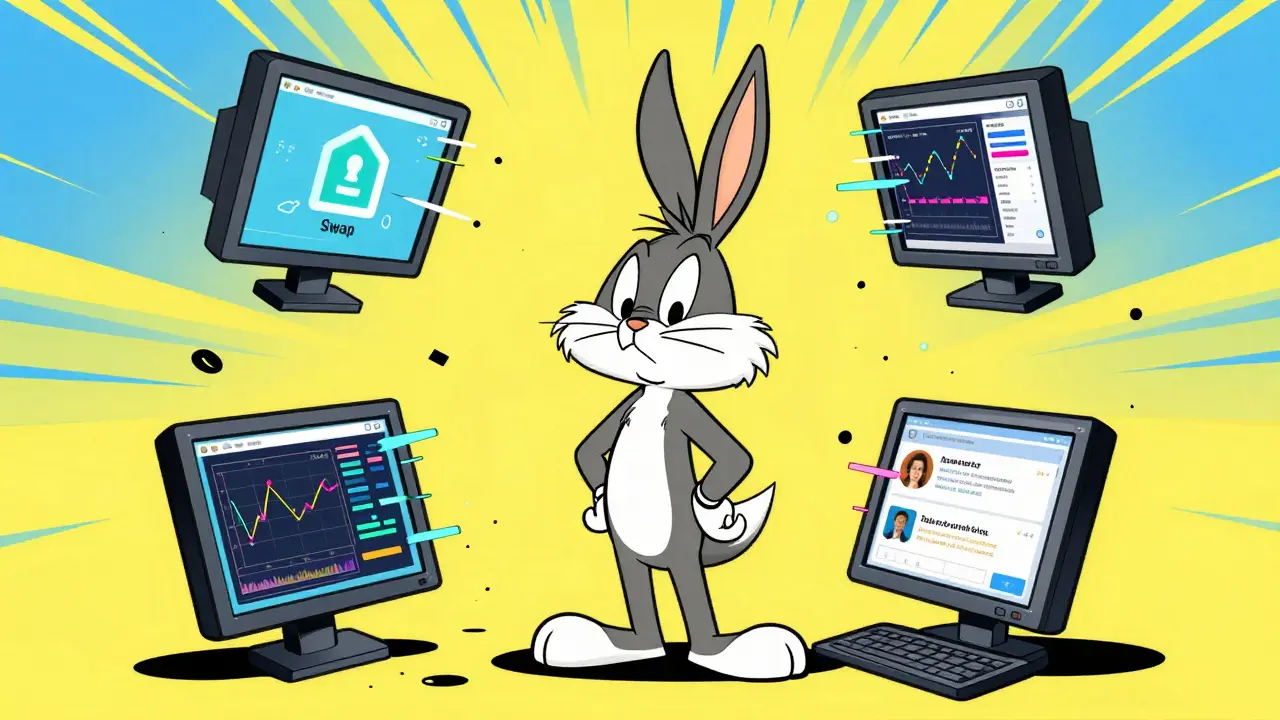
Have you ever felt overwhelmed by the need to jump between five different websites just to swap a token, check your perpetual futures position, and see what your friends are trading? That fragmentation is exactly what THENA FUSION aims to fix. Launched in 2023 as a native liquidity layer on BNB Chain, THENA positions itself not just as another decentralized exchange (DEX), but as a comprehensive DeFi SuperApp.
But does it actually deliver on that promise, or is it just more complex software hiding behind fancy marketing? In this review, we’ll break down the architecture, the costs, the user experience, and whether THIS platform fits into your current trading strategy. We’ll look at the hard data from CoinGecko and MEXC, analyze real user feedback, and determine if THENA is a tool for pros or a trap for beginners.
What Exactly Is THENA FUSION?
To understand THENA, you first have to understand the problem it solves. Traditional DeFi has always been fragmented. You use Uniswap for swaps, GMX for perps, and maybe Discord for social signals. THENA FUSION integrates these functions into a single ecosystem built on BNB Smart Chain (now BNB Chain) and its Layer-2 solution, opBNB.
The platform consists of three primary components that work together:
- THENA Spot DEX: This is your standard token swapping interface, but with advanced routing technology designed to reduce slippage. It supports concentrated liquidity, which means your capital works harder for you compared to older AMM models.
- ALPHA Perpetuals DEX: This module offers leveraged trading across 270+ crypto pairs. It uses an intent-based model powered by SYMMIO, allowing users to access up to 60x leverage without interacting with multiple isolated protocols.
- ARENA: A gamified social trading layer where users can compete in trading competitions and follow strategies, adding a community element often missing from pure finance apps.
The core innovation here is the FUSION pool technology. Developed in collaboration with Gamma Strategies and Algebra, FUSION pools support six distinct liquidity provider (LP) strategies: wide, narrow, manual, pegged price, correlated, and stable. This modularity addresses one of the biggest pain points in DeFi: impermanent loss. By offering tailored strategies, THENA attempts to minimize risk while maximizing yield for liquidity providers.
Trading Experience: Fees, Speed, and Slippage
When you’re trading, fees and speed are everything. Let’s look at how THENA stacks up against competitors like PancakeSwap or Trader Joe.
THENA’s fee structure is dynamic. For the newer FUSION pools and manual range pools, fees are adjustable based on market conditions. However, for those sticking to the legacy V1 pools, the rates are fixed at 0.01% for stable pools and 0.02% for variable pools. These rates are competitive, especially when compared to Ethereum-based DEXs where gas fees can eat up profits entirely.
| Feature | THENA FUSION | PancakeSwap v3 | Uniswap v3 |
|---|---|---|---|
| Base Chain | BNB Chain / opBNB | BNB Chain | Ethereum / L2s |
| Max Leverage | Up to 60x (via ALPHA) | Spot Only (mostly) | Spot Only |
| LP Strategies | 6 Types (Wide, Narrow, Stable, etc.) | Concentrated Liquidity | Concentrated Liquidity |
| Social/Gamification | Yes (ARENA) | No | No |
| Avg. Gas Cost | Low (Sub-cent on opBNB) | Low | High (on Mainnet) |
One standout feature is the integration of limit orders and TWAP (Time-Weighted Average Price) functionality through dLIMIT and dTWAP protocols, powered by Orbs. Most DEXs force you to use third-party tools like 1inch or Matcha for these features. Having them natively integrated saves time and reduces the risk of smart contract interaction errors.
In terms of volume, THENA holds an 84th percentile ranking among DEXs. As of late 2023, it processed over $13.6 million in 24-hour volume. While this isn’t top-tier global volume, it’s significant for a specialized platform on BNB Chain, where it ranks as the third-largest DEX behind PancakeSwap and Biswap.
Liquidity Depth: The Elephant in the Room
Here’s where things get tricky. A common criticism of mid-tier DEXs is liquidity fragmentation. CoinGecko data reveals that 87% of THENA’s volume concentrates on the BSC-USD/USDC pair. That’s $11.9 million out of $13.6 million total volume.
What does this mean for you? If you’re trading major pairs like ETH/USDT or BTC/BNB, you’ll likely find decent depth and low slippage. But if you’re trying to trade a smaller altcoin listed on THENA, you might face wider spreads or higher slippage because the liquidity isn’t evenly distributed across all 44 trading pairs.
This is a classic trade-off in DeFi. THENA excels in scenarios requiring sophisticated tools for major assets, but it may struggle to provide deep liquidity for niche tokens compared to giants like Uniswap or Curve. Always check the pool depth before executing large trades on less popular pairs.

User Interface and Learning Curve
Let’s talk about usability. THENA is powerful, but power comes with complexity. User surveys conducted by MEXC indicate that experienced DeFi users take about 2-3 hours to become proficient with the full feature set. Complete beginners? Expect to spend 8-10 hours learning the ropes.
On Reddit’s r/DeFi community, user 'CryptoTrader89' noted in June 2023: "THENA's FUSION pools have significantly reduced my impermanent loss compared to standard AMMs-I've seen up to 35% better returns on stablecoin pairs since migrating." This suggests that once you overcome the initial hurdle, the payoff can be substantial.
However, 'DeFiNewbie2023' reported on CoinGecko forums: "The UI took me about 3 hours to fully understand compared to 30 minutes for Uniswap, but the integrated perps and spot trading are worth the learning curve." This highlights a key insight: THENA is not for casual swappers. It’s for traders who want a centralized-exchange-like experience on-chain.
The documentation quality is rated 4.2/5 by users, which is solid. But be warned: the guides for basic trading are excellent, while explanations for advanced FUSION pool strategies are less detailed. You’ll need to do some independent research or rely on the community for help with complex LP setups.
Security and Tokenomics
Security is paramount in DeFi. Gate.com’s analysis acknowledges THENA’s comprehensive feature set but cautions that "the complexity of managing multiple integrated services could potentially create security vulnerabilities if not properly audited." Always verify the latest audit reports from firms like CertiK or Trail of Bits before depositing significant funds.
The ecosystem is governed by the THE token. Here’s how the distribution breaks down:
- Users and Protocols: 44%
- Team: 18%
- Reserve Fund: 20%
- Community Rewards: 18%
This allocation is relatively user-friendly, with only 18% held by the team, which is lower than many other DeFi projects. THE token powers governance, staking rewards, and fee discounts. As of November 2023, THE was listed on major exchanges like MEXC with daily trading volumes exceeding $5 million, providing good liquidity for the governance token itself.

Who Should Use THENA FUSION?
THENA isn’t for everyone. Here’s a quick decision tree to help you decide:
Use THENA if:
- You already trade on BNB Chain and want to avoid high Ethereum gas fees.
- You want to combine spot trading and perpetual futures in one interface.
- You’re an experienced LP looking to minimize impermanent loss using advanced strategies like pegged prices or correlated assets.
- You enjoy gamified trading and social competition features.
Avoid THENA if:
- You’re a complete beginner to DeFi. The learning curve is steep.
- You primarily trade on Ethereum or Solana. THENA is heavily integrated with BNB Chain, creating limitations for cross-chain users.
- You need deep liquidity for obscure micro-cap tokens. Stick to larger aggregators for those trades.
Future Roadmap and Market Position
Looking ahead, THENA’s roadmap includes AI integration for trading insights, cross-chain expansion beyond BNB Chain, and mainstream user onboarding features. Reflexivity Research projects that if this cross-chain expansion succeeds, THENA could capture 5-7% of the total DEX market share by 2025.
However, Serenity Research cautions that "continued innovation will be critical as competitors rapidly adopt similar multi-functional DEX models." The DeFi landscape moves fast. Platforms like Jupiter on Solana and Kyber Network are also pushing towards unified experiences. THENA needs to maintain its technological edge to stay relevant.
Current developments show momentum. The platform reported a 23.57% volume increase in the 7-day period ending November 10, 2023, reversing previous declines. With 45,000+ active members across Telegram and Discord, the community support is robust, which is crucial for troubleshooting and staying updated on new features.
Is THENA FUSION safe to use?
Like any DeFi protocol, THENA carries inherent smart contract risks. While it has undergone audits and uses established technologies like Gamma Strategies for liquidity management, no system is 100% immune to exploits. Always start with small amounts, verify contract addresses yourself, and never invest more than you can afford to lose. Check for recent audit reports from reputable firms before engaging with new pools.
What is the minimum amount to start trading on THENA?
There is no strict minimum deposit enforced by the protocol. However, due to gas fees on BNB Chain (even though they are low), it’s practical to start with at least $10-$20 worth of BNB to cover transaction costs. For perpetual futures via ALPHA, you’ll need enough collateral to meet margin requirements, which vary by asset and leverage level.
How does THENA compare to PancakeSwap?
PancakeSwap is the largest DEX on BNB Chain with deeper overall liquidity and a simpler interface. THENA differentiates itself by offering integrated perpetual futures, advanced LP strategies (FUSION pools), and social trading features. Choose PancakeSwap for simple, high-volume swaps; choose THENA if you want a more comprehensive trading suite with leverage and yield optimization tools.
Can I use THENA on mobile devices?
Yes, THENA’s website is responsive and works well on mobile browsers. You can connect wallets like MetaMask or Trust Wallet directly from your phone. However, the complex nature of LP strategies and chart analysis is generally easier to manage on a desktop screen for optimal experience.
What happens to my impermanent loss on FUSION pools?
Impermanent loss cannot be completely eliminated in AMMs, but THENA’s FUSION pools aim to mitigate it significantly. By offering strategies like 'pegged price' or 'stable' pools, the protocol locks in price ranges that reduce volatility exposure. User reports suggest up to 35% better returns on stablecoin pairs compared to standard AMMs, thanks to these optimized liquidity mechanisms.