

Remember when blockchain was just a buzzword for buying pizza with Bitcoin? Those days are long gone. By mid-2026, the narrative has shifted completely. We aren't talking about speculative coins anymore; we are talking about the backbone of global financial infrastructure. The technology that started as a peer-to-peer cash system in 2008 is now powering trillions of dollars in transactions, settling trades in seconds, and rewriting the rules of banking.
The shift wasn't gradual-it was explosive. Early 2024 marked the turning point when the U.S. Securities and Exchange Commission approved multiple Bitcoin ETFs. That regulatory green light didn't just validate crypto; it opened the floodgates for traditional finance to integrate digital assets into their core operations. Fast forward to January 2025, and giants like Citigroup, Fidelity, JPMorgan, and Visa were offering crypto products directly to consumers. You could buy, sell, and hold digital assets alongside your savings account without leaving your banking app. This isn't niche tech anymore; it's mainstream utility.
Speed and Scale: The Technical Leap
If you tried using early blockchain networks, you remember the pain. Slow speeds, high fees, and constant network congestion. That friction is what kept institutions on the sidelines. But the technical landscape of 2025 looks nothing like 2021. Enterprise blockchain platforms have achieved transaction speeds of 50,000 to 100,000 transactions per second (TPS). To put that in perspective, that’s a 100x improvement over early implementations. Settlement times have dropped to under two seconds.
How did they get there? It’s not magic; it’s hybrid engineering. Most enterprise systems now use a mix of Proof-of-Stake mechanisms combined with Byzantine Fault Tolerance elements. This balances security with raw performance. Interoperability is also no longer a bottleneck. Protocols like Polkadot’s Cross-Chain Message Passing and Cosmos’ Inter-Blockchain Communication have reached 95% compatibility across major financial networks. Assets can move seamlessly between siloed systems, which was previously a logistical nightmare.
| Feature | Traditional Systems (SWIFT/Legacy) | Enterprise Blockchain (2025+) |
|---|---|---|
| Transaction Speed | 2-5 business days | 4-8 seconds |
| Cost per Transaction | $25-$35 | $0.03 |
| Settlement Finality | T+2 days | <2 seconds |
| Fraud Reduction | Standard protocols | 83% reduction via multi-layered security |
Security has also matured. With quantum computing on the horizon, 78% of institutional deployments now use quantum-resistant cryptography. Major banks report an 83% drop in fraud incidents compared to traditional systems. And it’s cheaper than ever to run. Deploying an enterprise node on standard cloud infrastructure costs around $1,200 monthly-down from $5,000 in 2022. The barrier to entry has collapsed.
Asset Tokenization: Unlocking Illiquid Markets
While faster payments are nice, the real revolution is happening in asset tokenization. This is where blockchain shines brightest. Tokenization allows you to split ownership of physical or illiquid assets-like real estate, art, or private equity-into digital tokens. This creates liquidity where there was none before.
The numbers are staggering. The tokenized asset market hit $1.2 trillion in 2025. Real estate leads the pack at $480 billion, followed by private equity at $320 billion. Boston Consulting Group projects this sector will reach $16.1 trillion by 2030. Imagine buying a fraction of a commercial building in London or a share in a startup without needing millions in capital. That’s the power of fractional ownership enabled by blockchain.
Mary-Claire Delaney, Director of Financial Innovation at the IMF, put it best in her March 2025 keynote: "Blockchain's true value in finance isn't replacing existing systems but creating entirely new markets through asset tokenization and programmable money." She’s right. We’re not just moving money faster; we’re changing what money can represent.

The Regulatory Game Changer: The GENIUS Act
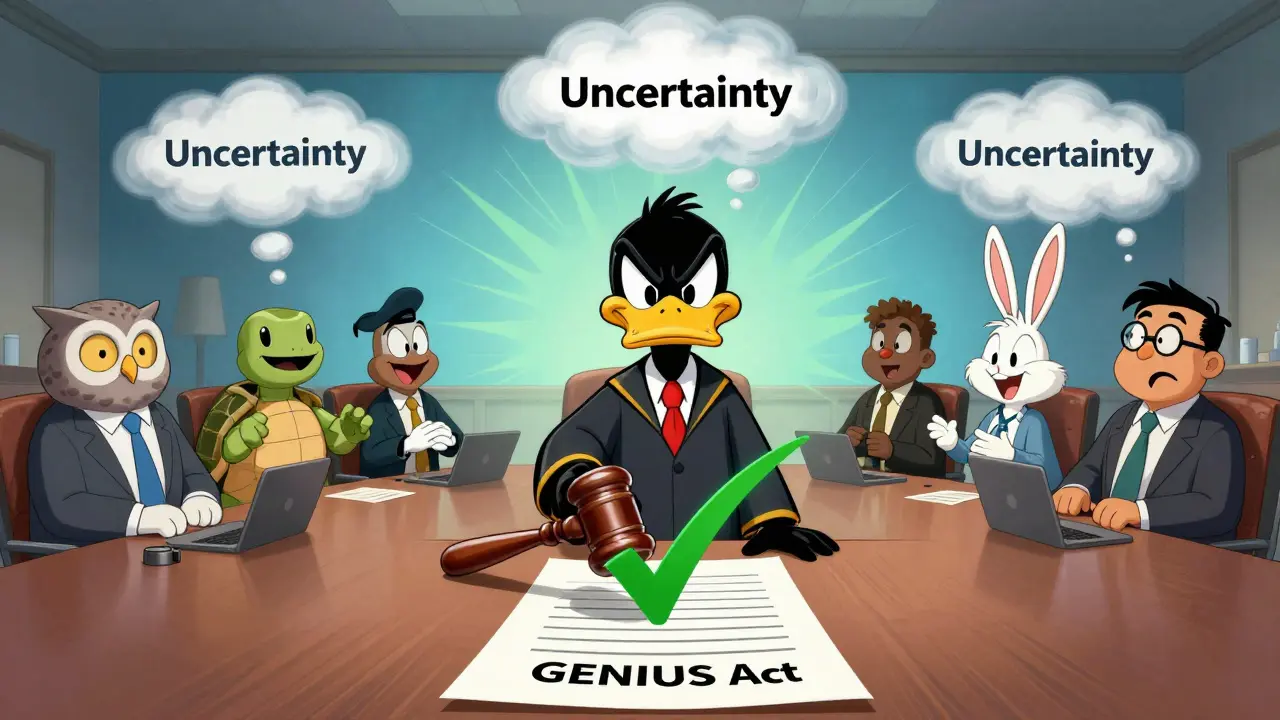
For years, regulators were the wild card. Uncertainty stifled innovation. Then came July 2025. The passage of the bipartisan GENIUS Act provided the first comprehensive U.S. regulatory framework for stablecoins. This wasn’t just paperwork; it was a signal to Wall Street that the government had a plan.
The impact was immediate. SEC filings mentioning stablecoins jumped 64% within three months. Circle’s $1.2 billion IPO in April 2025 further legitimized the space. Ben Horowitz of a16z Crypto called 2025 "the year crypto went mainstream," and the data backs him up. By Q3 2025, 68 countries had established comprehensive digital asset regulations, up from just 22 in 2022. Regulatory clarity reduced compliance mapping challenges by 40%, making it easier for banks to adopt blockchain solutions.
However, caution remains. Dr. Susan Athey of Stanford University warned in May 2025 that while blockchain solves trust problems, it introduces complexity that can outweigh benefits for simple transactions. The Financial Stability Board identified excessive leverage in DeFi protocols as a systemic risk, noting that 67% of lending protocols lack sufficient collateralization during market stress. Regulation isn’t just about permission; it’s about preventing the next crisis.
DeFi vs. TradFi: A Nuanced Reality
Decentralized Finance (DeFi) has grown from a fringe experiment to a significant player. By Q1 2025, DeFi platforms captured 12.7% of the global derivatives market, up from a mere 0.3% in 2022. Total value locked in blockchain-based financial applications reached $142 billion by Q3 2025.
But it’s not all smooth sailing. High-frequency trading still favors centralized systems due to latency advantages (0.0001 milliseconds vs. blockchain’s 0.1-1.0 milliseconds). User feedback reveals mixed experiences. On Reddit’s r/FinTech community, JPMorgan compliance officers praised blockchain for reducing documentation errors by 76% in trade finance. Yet, other users complained that smart contract limitations created more reconciliation issues during cross-border pilots.
Gartner Peer Insights shows enterprise blockchain solutions averaging 4.2/5 stars. Security and auditability score high (4.7 and 4.6 respectively), but integration ease lags behind (3.1). For small businesses, blockchain payment solutions cut international transaction costs by 89%, but 63% cited excessive identity verification requirements as a major hurdle. The technology works, but the user experience needs polish.
Implementation Challenges: What Banks Are Facing
Adopting blockchain isn’t a plug-and-play process. Successful enterprise implementations take 12-18 months from assessment to full deployment, costing an average of $2.3 million for mid-sized institutions. The learning curve is steep. Financial professionals need 140-200 hours of specialized training, compared to 40-60 hours for traditional software.
Legacy system integration remains the biggest headache, cited by 72% of implementations. Talent acquisition is another bottleneck, with 65% of firms struggling to find skilled blockchain developers. However, specialized integration firms are helping bridge this gap, reducing these hurdles by 40% year-over-year. Documentation quality varies wildly too. Enterprise solutions like Hyperledger Fabric score 4.5/5 for completeness, while many DeFi protocols lag at 2.8/5.
Looking Ahead: AI and Central Bank Digital Currencies
The future isn’t just blockchain; it’s blockchain plus AI. Early implementations combining AI for fraud detection show 92% accuracy in identifying fraudulent transactions, compared to 78% for traditional systems. This synergy is becoming the next frontier for risk management.
Meanwhile, Central Bank Digital Currencies (CBDCs) are gaining traction. Eighteen countries representing 76% of global GDP already have active pilot programs. Fifteen central banks are projected to issue digital currencies by 2030. This isn’t about replacing fiat; it’s about modernizing it. As Gartner projects, blockchain will add over $360 billion in business value by 2026 and more than $3.1 trillion by 2030. The growth drivers are clear: trade finance (32% CAGR), asset management (28% CAGR), and cross-border payments (25% CAGR).
The skepticism is fading. 87 of the top 100 global banks now run blockchain initiatives, up from 29 in 2021. The question is no longer "if" blockchain will transform finance, but "how fast" it will happen. For those watching from the sidelines, the window for early advantage is closing.
Is blockchain actually faster than traditional banking?
Yes, significantly. While traditional SWIFT transfers take 2-5 business days, modern enterprise blockchain systems settle transactions in 4-8 seconds. This speed comes from hybrid consensus mechanisms and improved interoperability protocols that allow instant finality.
What is asset tokenization and why does it matter?
Asset tokenization converts rights to an asset into a digital token on a blockchain. It matters because it unlocks liquidity for illiquid assets like real estate and private equity. In 2025, the tokenized asset market reached $1.2 trillion, allowing fractional ownership and easier trading of complex assets.
How has regulation changed for blockchain in 2025?
Regulation has become much clearer. The passage of the GENIUS Act in July 2025 provided a comprehensive framework for stablecoins in the U.S. Globally, 68 countries had established digital asset regulations by Q3 2025, reducing uncertainty for institutions and accelerating adoption.
Are big banks really using blockchain?
Absolutely. By 2025, 87 of the top 100 global banks were running blockchain initiatives. Institutions like JPMorgan expanded its JPM Coin network to 450 corporate clients, and Citigroup launched its Citicoin platform for institutional payments. It’s no longer experimental; it’s operational.
What are the main challenges in implementing blockchain?
The biggest challenges are legacy system integration (cited by 72% of firms), talent acquisition (65%), and regulatory compliance mapping (78%). Implementation takes 12-18 months and requires significant training, though specialized firms are helping reduce these barriers.
Is DeFi safe for institutional investors?
It’s improving, but risks remain. While DeFi captured 12.7% of the global derivatives market by Q1 2025, the Financial Stability Board warns of systemic risks like excessive leverage. Smart contract vulnerabilities are still a primary concern for 43% of financial regulators worldwide.




Categories