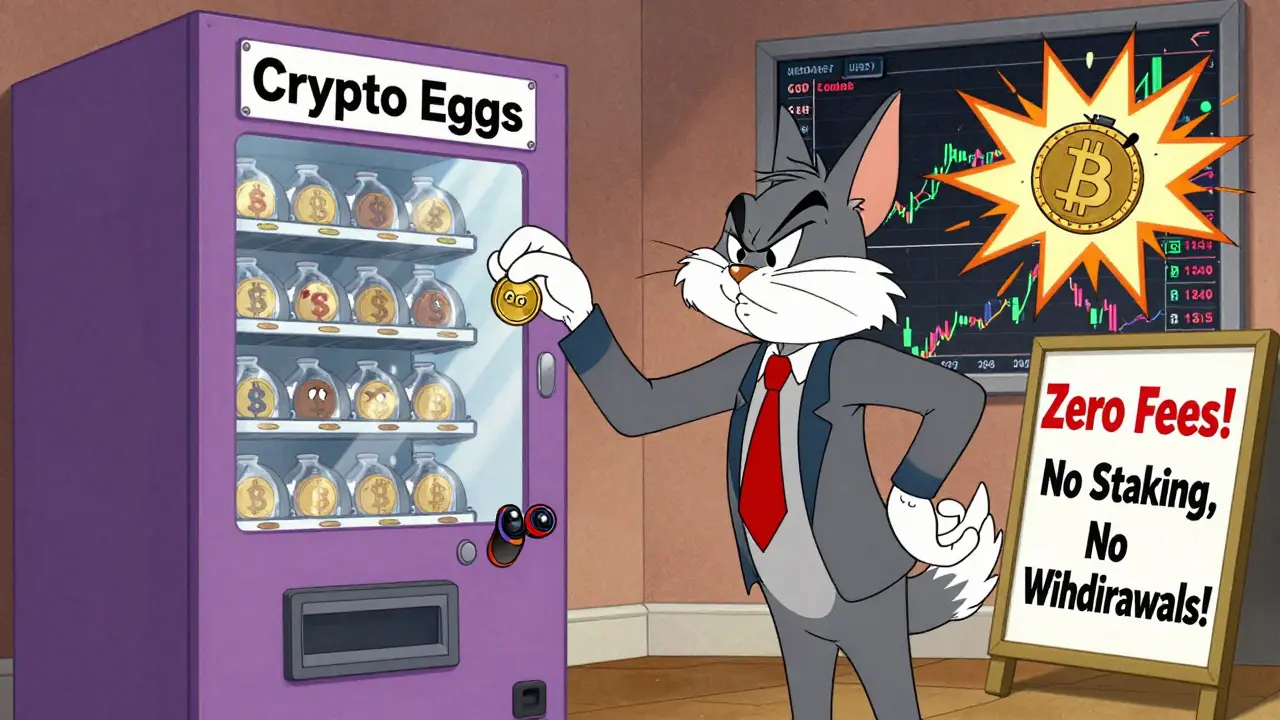
Robinhood made waves when it launched crypto trading in 2018-not because it offered the most coins, but because it charged zero fees. Today, in 2025, that no-fee model still stands. If you’re new to crypto and already use Robinhood for stocks, adding Bitcoin or Ethereum feels like tapping a button. But if you’re looking to trade altcoins, stake your holdings, or swap ETH for Solana? You’ll hit walls fast.
What Robinhood Actually Lets You Do
Robinhood isn’t a crypto exchange like Coinbase or Kraken. It’s a brokerage that lets you buy and sell crypto-just like stocks. You can trade 15 to 22 cryptocurrencies, including Bitcoin, Ethereum, Dogecoin, and Solana. All trades are commission-free. No hidden markups. No trading fees. That’s rare. Even big names like Coinbase now charge spreads on crypto trades. Robinhood doesn’t. You get the real market price, no extra cost.But here’s the catch: you can’t trade crypto for crypto. You can’t swap Bitcoin for Cardano. You can only buy or sell crypto using U.S. dollars or euros (if you’re in the EU). That means if you want to move from one coin to another, you have to cash out first, then buy again. That’s slow. It’s also expensive in practice-because you’re paying price slippage twice.
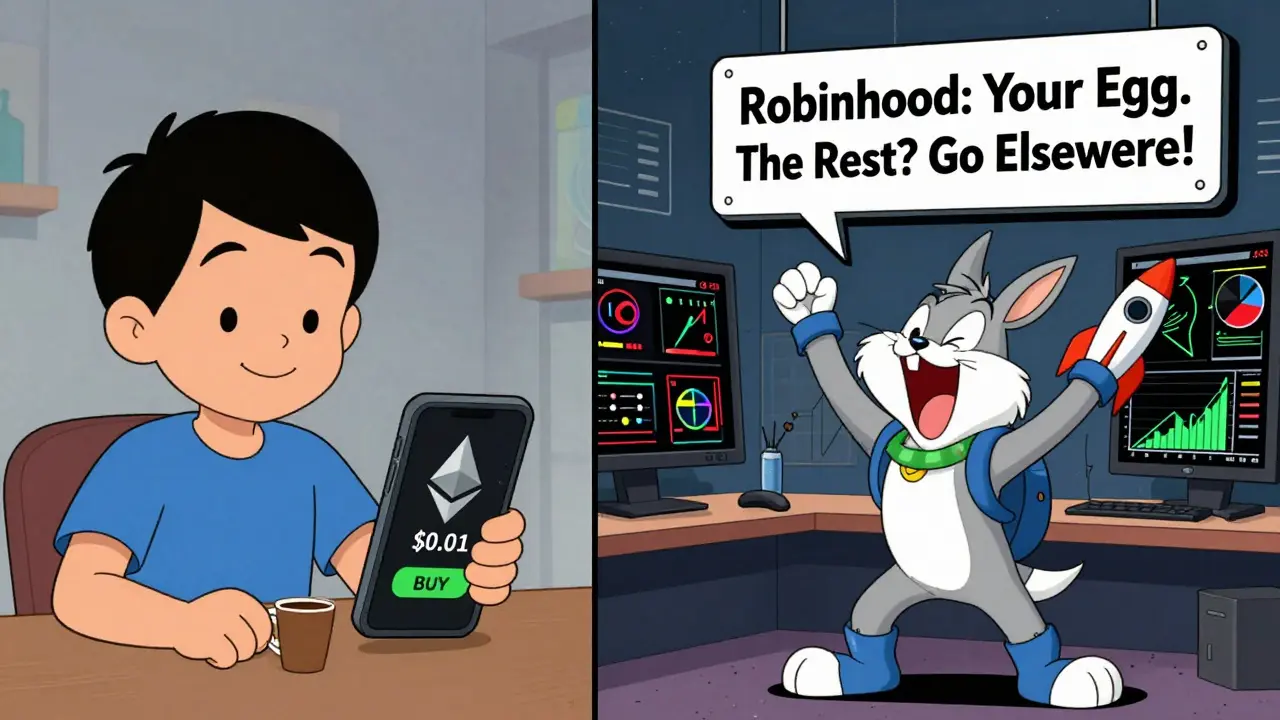
Minimum trades? As low as $0.01. You can buy a fraction of a Bitcoin for less than the cost of a coffee. Fractional shares work the same way for crypto. That’s great for beginners dipping their toes in. No need to wait until you have $500 to buy one Bitcoin.
Why Robinhood Feels Different from Other Crypto Platforms
Most crypto apps feel like command centers-charts everywhere, order types you don’t understand, wallet addresses you need to copy-paste. Robinhood feels like your phone’s home screen: simple, clean, predictable.The same search bar finds stocks, ETFs, and crypto. The same portfolio view shows your Apple shares next to your Ethereum. No switching apps. No juggling logins. That’s the whole point. Robinhood built this for people who want to invest in everything with one app. If you’re already tracking your 401(k) and Tesla stock on Robinhood, adding Dogecoin doesn’t feel like a leap. It feels like an afterthought.
That’s why NerdWallet calls it “best for no-fee crypto trading” and “existing Robinhood customers who want to dabble.” It’s not for crypto enthusiasts. It’s for people who want crypto as part of their broader portfolio-not the center of it.
What’s Missing? The Real Limits
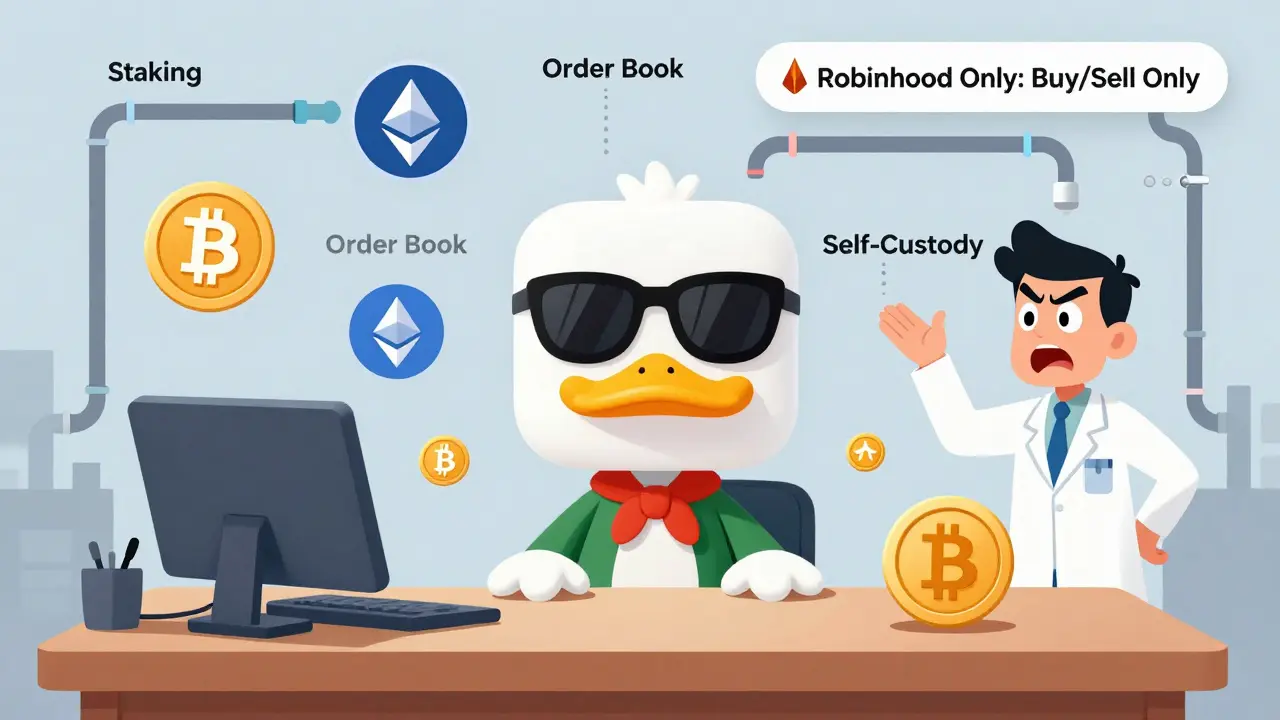
If you’ve used a real crypto exchange before, you’ll notice what’s not here:- No staking. You can’t earn interest on your Ethereum, Cardano, or Solana. That’s a big deal-staking can earn 3% to 6% annually on some coins. Robinhood doesn’t offer it.
- No advanced orders. No limit orders with time-in-force, no stop-losses, no trailing stops. You can only place market or simple limit orders.
- No market depth. You can’t see the order book. No bids or asks stacked up. Just a price and a buy/sell button.
- No charting tools. The charts are basic. No indicators, no volume profiles, no Fibonacci retracements. If you’re trying to analyze trends, you’re out of luck.
- No self-custody. Your crypto lives in a Robinhood wallet. You can’t send it to your own Ledger or MetaMask. That’s a red flag for anyone serious about security.
These aren’t small omissions. They’re core features on every major crypto platform. For advanced traders, Robinhood feels like driving a Prius when you need a Porsche. It gets you there, but you won’t enjoy the ride.
How Robinhood Compares to the Competition
Let’s put Robinhood side-by-side with the big players:| Feature | Robinhood | Coinbase | Kraken | eToro |
|---|---|---|---|---|
| Cryptocurrencies offered | 15-22 | 250+ | 180+ | 20+ |
| Crypto-to-crypto trading | No | Yes | Yes | Yes |
| Staking | No | Yes | Yes | Yes |
| Advanced order types | No | Yes | Yes | Yes |
| Trading fees | $0 | Spread-based | Spread-based | Spread-based |
| Self-custody (withdraw to wallet) | No | Yes | Yes | No |
| Best for | Beginners, stock investors | Active traders, long-term holders | Experienced traders, low fees | Social trading, copy investors |
Here’s the real test: if you bought $100 of Ethereum on each platform on December 1, 2025, how much ETH would you actually get?
According to third-party data from August 2025, Robinhood gives you 0.002290 ETH. Coinbase gives you 0.002246 ETH. Kraken gives you 0.002248 ETH. That means Robinhood’s price is actually better than most. Not by much-but it’s better. Only Crypto.com and Coinbase Advanced come close.
So yes, Robinhood gives you a better rate than most. But you pay for it in flexibility.
Who Should Use Robinhood for Crypto?
You should use Robinhood for crypto if:- You already trade stocks on Robinhood and want to add crypto without learning a new app.
- You’re new to investing and want to start with small, affordable amounts.
- You don’t care about staking, advanced charts, or swapping coins.
- You want the simplest possible way to buy Bitcoin or Ethereum with no fees.
You should NOT use Robinhood for crypto if:
- You want to hold crypto long-term and earn passive income through staking.
- You plan to trade altcoins like Polygon, Chainlink, or Avalanche.
- You need to send crypto to your own wallet for security or DeFi use.
- You’re serious about technical analysis or trading with stop-losses.
Security and Regulation
Robinhood is regulated by the SEC and FINRA, not as a crypto exchange, but as a broker-dealer. That means your funds are protected under SIPC insurance up to $500,000-but only for cash and securities. Crypto holdings are NOT covered by SIPC. That’s a key difference from platforms like Coinbase, which holds crypto in cold storage and offers its own insurance.Robinhood has faced regulatory fines and data breaches in the past. In 2022, the SEC fined them $65 million for misleading customers about order routing. That’s a red flag. But they’ve improved since then. Their app is secure, with two-factor authentication and biometric login. Just don’t assume your crypto is as safe as cash in a bank.
Customer Support and Experience
Robinhood offers 24/7 phone support for logged-in users. That’s better than most crypto platforms, which rely on chatbots or email. But don’t expect deep crypto knowledge. Support reps are trained to handle stock trades first. Crypto questions often get passed to specialists-or left unanswered.The app is fast. It loads instantly. The interface doesn’t lag. That’s a win. But if you need help understanding how to withdraw crypto? Good luck. The help center has basic instructions, but no live chat or detailed guides.
Future Outlook: Where Robinhood Is Headed
Robinhood expanded into the European Union in December 2023. They’re planning to enter Asia by late 2025, starting with Singapore. That’s a big move. They’re not just staying in the U.S. anymore.They’re adding new coins slowly-only mainstream ones like Bitcoin, Ethereum, and Dogecoin. No memecoins. No obscure DeFi tokens. That’s intentional. They’re not chasing hype. They’re building for mass adoption.
But they’re not innovating. No staking. No NFTs. No DeFi integration. They’re waiting. And that’s okay-if you’re not looking for the future. If you just want to buy Bitcoin without paying fees, Robinhood is still the easiest way.
Final Verdict
Robinhood isn’t the best crypto exchange. It’s the best crypto add-on for stock investors.If you’re a beginner, or you want to buy crypto with zero fees and no hassle, Robinhood wins. It’s simple, fast, and cheap.
If you want to trade, stake, swap, or store crypto securely? Go to Coinbase, Kraken, or Binance. Robinhood isn’t built for that.
Think of it this way: Robinhood is like a grocery store that sells eggs. Great if you just need eggs. But if you want to bake a cake, you’ll need flour, sugar, and an oven. Robinhood gives you the egg. Everything else? You’ll have to go elsewhere.
Can you stake crypto on Robinhood?
No, Robinhood does not offer staking for any cryptocurrency. You cannot earn interest on Ethereum, Solana, Cardano, or any other coin held on the platform. If you want to stake, you’ll need to use a different exchange like Coinbase, Kraken, or Binance.
Can you send crypto from Robinhood to your own wallet?
No, Robinhood does not allow users to withdraw cryptocurrency to external wallets. Your crypto is held in a custodial wallet owned by Robinhood. This means you don’t control the private keys. If you want full ownership of your crypto, Robinhood is not the right platform.
Is Robinhood crypto trading really free?
Yes, Robinhood charges $0 in trading fees for crypto. There are no commissions, markups, or hidden costs. However, Robinhood still makes money through the spread-the difference between the buy and sell price. In practice, you often get a slightly worse price than the market rate, but third-party tests show Robinhood’s spreads are often better than competitors like Coinbase and Kraken.
How many cryptocurrencies does Robinhood support?
Robinhood supports between 15 and 22 cryptocurrencies, depending on your region. The most popular include Bitcoin (BTC), Ethereum (ETH), Dogecoin (DOGE), Solana (SOL), Polygon (MATIC), and Shiba Inu (SHIB). They add new coins slowly and only focus on high-demand assets.
Is Robinhood safe for crypto trading?
Robinhood uses standard security measures like two-factor authentication and encryption. However, because you don’t control your private keys, your crypto is vulnerable if Robinhood is hacked or faces regulatory issues. SIPC insurance does not cover crypto holdings. For maximum safety, use a self-custody wallet if you plan to hold large amounts long-term.
Can you trade crypto on Robinhood outside the U.S.?
Yes. Robinhood launched crypto trading in the European Union in December 2023. Users in the EU can trade the same cryptocurrencies as U.S. users, using euros. Robinhood plans to expand into Asia by late 2025, starting with Singapore, but no other regions are confirmed yet.
Does Robinhood offer advanced trading tools for crypto?
No. Robinhood only offers basic market and limit orders. There are no stop-losses, trailing stops, conditional orders, or margin trading. Charts are simplified and lack indicators like RSI, MACD, or volume profiles. This makes Robinhood unsuitable for active or technical traders.
What’s better than Robinhood for crypto trading?
For beginners who want more features: Coinbase. For advanced traders: Kraken or Binance. For staking and DeFi: Coinbase or Kraken. For lower fees and more coins: Crypto.com. Robinhood wins only on simplicity and zero trading fees-but loses on control, flexibility, and tools.