
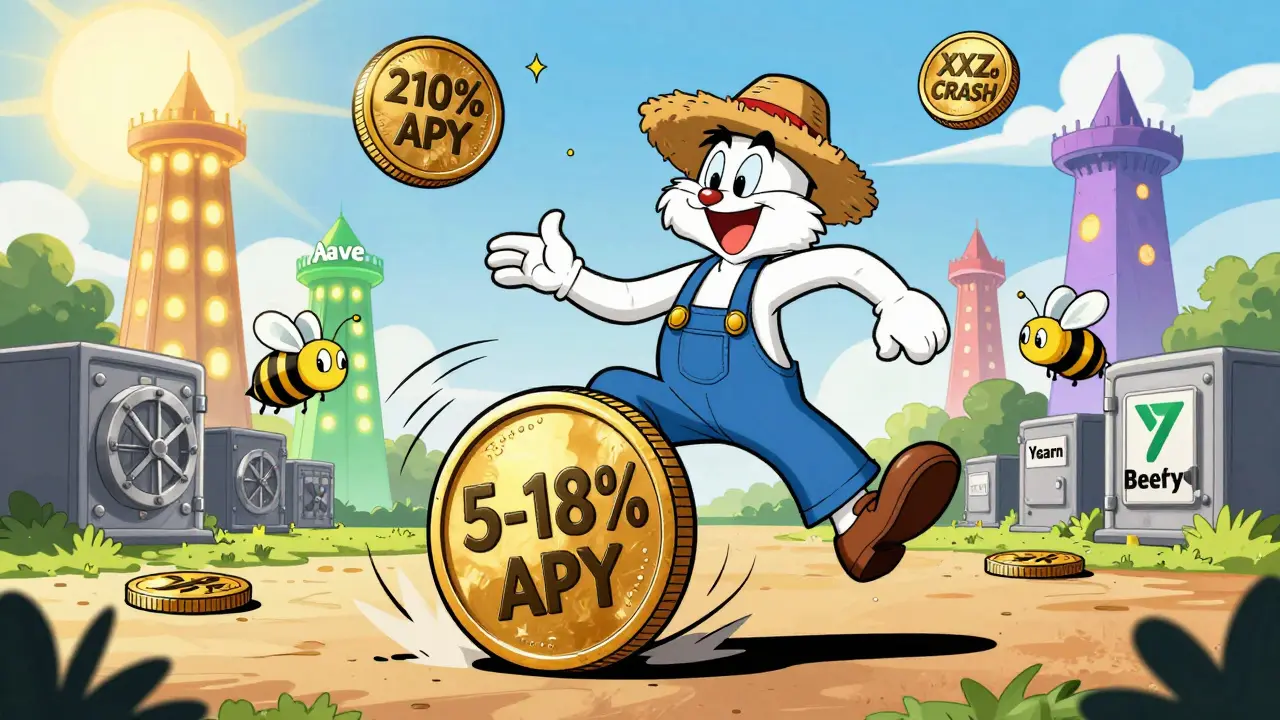
Yield farming in 2025 isn’t about chasing 500% APYs anymore. That era is over. The farms that promised insane returns in 2021 are gone-many collapsed, others got hacked, and regulators stepped in. Today, the smartest yield farmers aren’t gambling. They’re building steady, repeatable income. If you’re still chasing the next moonshot token, you’re already behind. The real winners in 2025 are those who focus on yield farming with discipline, automation, and risk control.
Forget High APYs-Focus on Sustainable Returns
The biggest mistake new farmers make is looking at the highest APY on DeFiLlama and jumping in. That’s how you lose money. In 2025, yields above 30% are red flags. They usually mean one thing: the reward token is being dumped fast. Take the example from last year-farmers earned 210% APY on a token called XYZ. Within 10 days, that token crashed from $1.20 to $0.18. Even with daily compounding, they lost 85% of their value. That’s not a win. That’s a trap. The real sweet spot in 2025 is 5-18% APY. That’s where the money stays. Protocols like Aave, Curve Finance, and Lido offer these kinds of returns consistently. Why? Because they’re built on real demand. Aave lends real assets. Curve handles billions in stablecoin swaps. Lido lets you stake ETH and earn both staking rewards and farming yields. These aren’t gimmicks. They’re infrastructure.Use Automated Vaults-Don’t Do It Manually
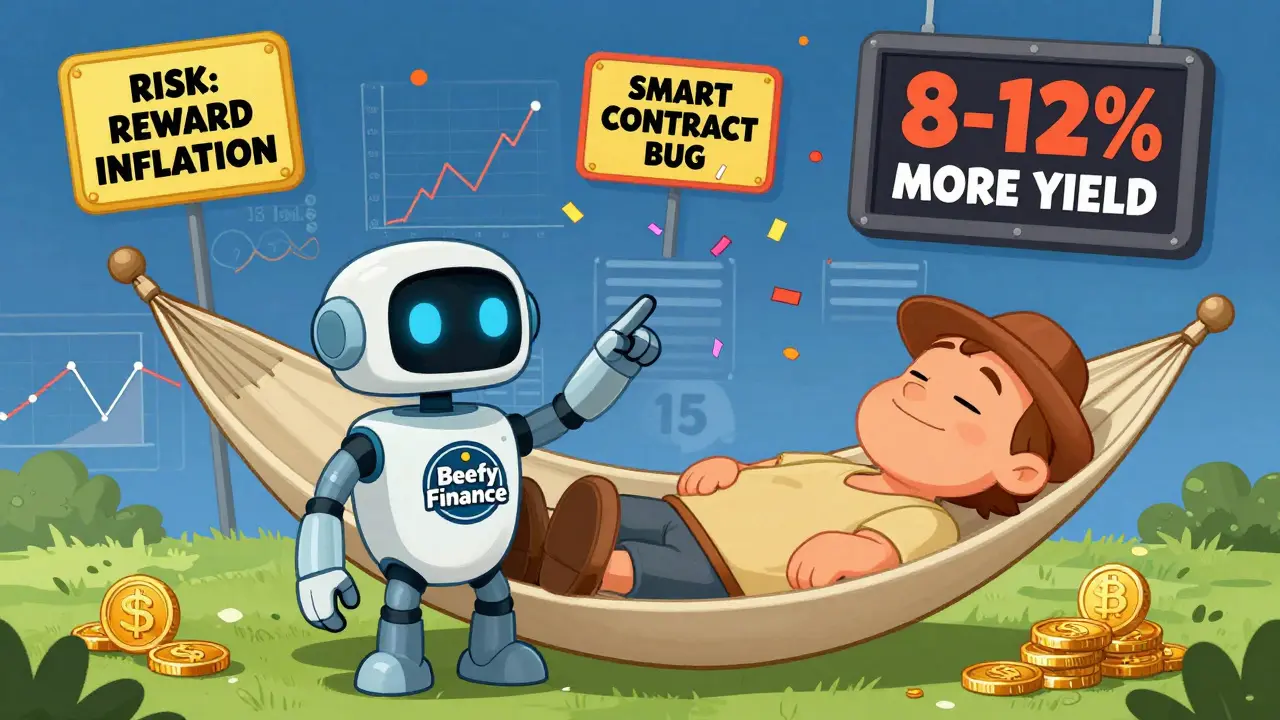
Spending hours checking APYs every day? You’re wasting time. In 2025, manual farming is obsolete. The top performers use automated vaults that rebalance for them. Yearn Finance’s V3 vaults, launched in late 2024, shift your funds between protocols every few hours based on real-time yield data. They cut gas costs by 37% compared to doing it yourself. And they don’t sleep. While you’re resting, they’re moving your capital to the highest-yielding, safest pool. Beefy Finance is another key player. It auto-compounds rewards every 15 minutes across 12 blockchains. That means if you’re farming on Solana or Arbitrum, your earnings are reinvested instantly. That small tweak adds 8-12% to your annual return. Compare that to manual compounding once a week-you’re leaving money on the table. Don’t think you need to be a coder to use these. Most platforms have simple interfaces. You deposit your ETH, USDC, or WBTC, pick a vault, and hit confirm. That’s it. The rest is handled by smart contracts.Multi-Chain Diversification Is Non-Negotiable
Putting all your money on Ethereum? You’re paying too much in gas. A $5,000 deposit on Ethereum might net you 12% APY-but $1,200 of that goes to gas fees. That’s a 24% loss right there. The smart move? Spread your capital across chains. In 2025, the top five chains for yield farming are:- Arbitrum - Low fees, high liquidity, great for stablecoin farms
- Solana - Near-zero gas, fast transactions, ideal for small deposits ($500+)
- Sui - New but growing fast, low-risk pools with 7-12% APY
- Ethereum - Only use for large deposits ($5,000+), stick to proven protocols
- BNB Chain - High yields, but avoid single-token farms. Stick to stablecoin pairs
Stablecoins Are Your Best Friend
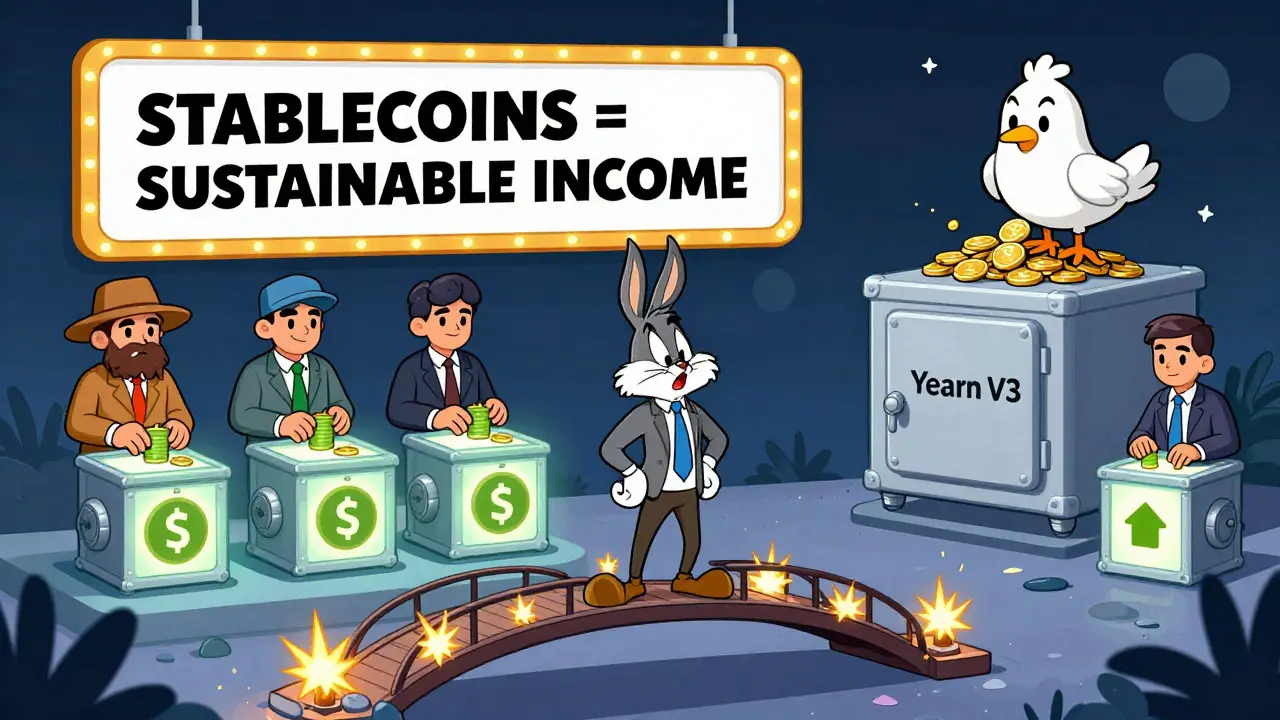
Farming with volatile tokens like SOL or AVAX? That’s not yield farming-it’s trading with extra steps. The most reliable returns come from stablecoins: USDC, DAI, USDT, and FRAX. Curve Finance dominates here. With over $18.7 billion locked in stablecoin pools, it’s the gold standard. Why? Its automated market maker (AMM) is designed specifically for stable assets. That means almost no impermanent loss. You earn 2.5-8% APY, and if you lock your CRV tokens, you can boost that up to 2.5x. Aave is another top pick. You deposit USDC or DAI, and you earn 4.2-9.7% APY. The interest rate adjusts every 15 seconds based on how much people are borrowing. When demand spikes, your yield goes up. No guesswork. Just steady income. Even better? You can stake your stETH or rETH (from Lido) in Aave and earn both staking rewards (3.5-5.2%) and lending yields (4.8-7.3%). That’s 8-12% total-without touching your ETH.Watch Out for These Three Hidden Risks
Not all yield farms are created equal. Here are the three risks that wiped out most beginners in 2024:- Reward Token Inflation - 74% of all losses in 2024 came from this. If a farm pays you in a new token that’s being dumped, your rewards become worthless fast. Always sell volatile rewards to stablecoins within 24 hours. Don’t hold them.
- Smart Contract Bugs - Even audited protocols can fail. The Hyperlend exploit in 2024 lost farmers $47 million. Stick to platforms with bug bounties over $1 million and audits from OpenZeppelin or Quantstamp.
- Liquidation Risk - If you’re using leverage (borrowing to farm), a 25% drop in ETH price can trigger a liquidation. Avoid leveraged farms unless you’re an expert. Even then, only use 1.5x max leverage.
Tools You Need to Succeed in 2025
You don’t need 10 apps. Just these three:- DefiLlama - Track APYs across 200+ protocols. Sort by chain, asset, and risk level.
- Zapper.fi - Manage all your farming positions in one dashboard. See your total returns, fees, and token exposure.
- Etherscan or Solana Explorer - Verify every transaction. Check contract addresses before depositing. Never trust a link-always paste the address manually.
Start Small. Test First.
Don’t throw $10,000 into a new vault. Start with $500. Test the interface. See how long it takes to withdraw. Check the gas fees. Watch how the rewards are paid. Wait a week. If everything works smoothly, then scale up. Beginners who skip this step lose money fast. One Reddit user lost $3,200 because they deposited into a new farm without checking its contract. The team vanished two days later. It wasn’t a rug pull-it was negligence.What’s Next? The Future of Yield Farming
The next big shift? Institutional-grade farming. Fidelity and Coinbase now offer permissioned yield pools for accredited investors. These pay 4.5-7.5% APY with FDIC-insured stablecoins backing. No smart contract risk. Just regulated, safe income. By 2027, experts predict only 3-5 major yield platforms will survive. The rest will vanish. That’s why sticking with proven names like Yearn, Aave, and Curve isn’t just safe-it’s strategic. The goal in 2025 isn’t to get rich overnight. It’s to build a reliable income stream. One that keeps paying even when the market crashes. That’s the real win.Is yield farming still worth it in 2025?
Yes, but only if you’re smart about it. The days of 1,000% APY are gone. Today, sustainable yields of 5-18% are the norm. Farmers using automated vaults, multi-chain strategies, and stablecoins are making consistent returns. The key is avoiding high-risk pools and focusing on protocols with real usage, not just hype.
What’s the safest yield farming strategy in 2025?
The safest approach is depositing stablecoins like USDC or DAI into Aave or Curve Finance on Arbitrum or Solana. Use an automated vault like Yearn or Beefy to handle compounding. Avoid single-token farms and new protocols with no audits. Sell volatile rewards immediately. This strategy minimizes impermanent loss, gas fees, and smart contract risk while delivering 7-12% annual returns.
How much do I need to start yield farming?
You can start with as little as $500 on Solana or Sui. On Ethereum, you’ll need at least $5,000 to make sense of it-gas fees eat up too much of smaller deposits. Most beginners start with $1,000-$2,000 across two chains to test the waters. The goal isn’t to max out returns right away-it’s to learn the system safely.
Can I lose money in yield farming?
Absolutely. You can lose money from reward token crashes, smart contract exploits, or liquidations. In 2024, over 60% of new farmers lost capital because they chased high APYs without understanding the risks. The key to avoiding losses is sticking to stablecoin farms, using trusted platforms, and never holding volatile reward tokens for more than 24 hours.
Do I need to pay taxes on yield farming rewards?
Yes. In most countries, including the U.S., Canada, Australia, and the EU, yield farming rewards are taxed as income when you receive them-even if you don’t sell them. The value at the time of receipt is your taxable amount. Keep detailed records of every deposit, withdrawal, and reward claim. Use crypto tax tools like Koinly or CryptoTaxCalculator to stay compliant.
What’s the difference between staking and yield farming?
Staking means locking your crypto to support a blockchain’s security (like staking ETH on Lido) and earning rewards. Yield farming means providing liquidity to a DeFi protocol (like depositing USDC into a Curve pool) and earning fees plus tokens. Staking is simpler and lower risk. Yield farming offers higher returns but involves more complexity and risk like impermanent loss and smart contract bugs.