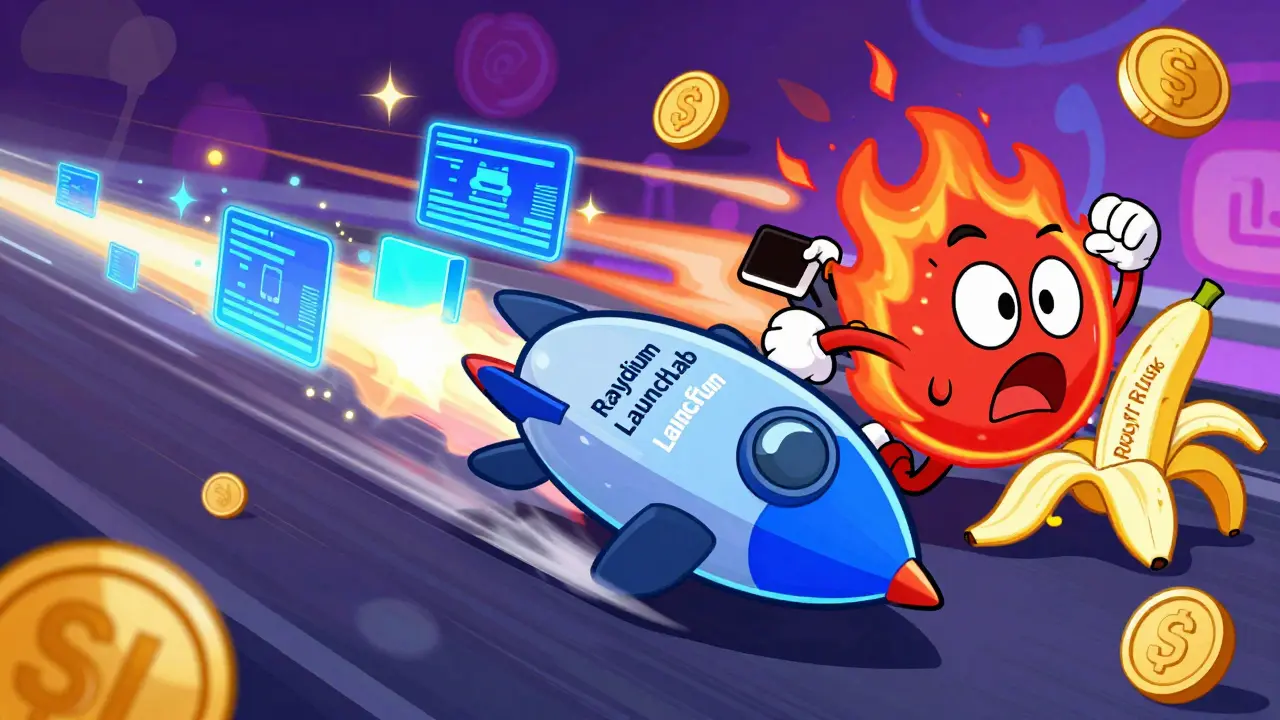
Remember when launching a meme coin on Solana felt like pulling teeth? You had to worry about liquidity pools, smart contract audits, and getting scammed by rug pulls. Then Pump.fun came along and made it stupidly simple. But in March 2025, the plot twisted. Pump.fun cut ties with Raydium and launched its own DEX, leaving a massive gap in the ecosystem. Enter Raydium LaunchLab, introduced in April 2025 as the direct answer to that void. It’s not just a copycat; it’s a strategic move by Raydium, Solana’s leading decentralized exchange (DEX), to reclaim control over token launches.
If you are looking to launch a micro-cap token or trade early-stage memes, you need to know if LaunchLab is worth your time. This review breaks down how it works, how it compares to the competition, and whether it actually delivers on its promises.
What Exactly Is Raydium LaunchLab?
Raydium LaunchLab is a no-code token creation platform built directly into the Raydium ecosystem. Think of it as a factory for new tokens. Instead of writing complex Solidity or Rust code, creators use a visual interface to set up their token. The platform uses bonding curves-a pricing mechanism where the price adjusts based on demand-to manage initial trading. Once a token raises enough capital, it automatically graduates to a permanent liquidity pool on Raydium.
The core promise here is simplicity combined with security. By integrating directly with Raydium’s infrastructure, LaunchLab ensures that successful tokens don’t just disappear into a black hole. They get real, locked liquidity on one of the most trusted exchanges in the Solana space. Since its launch, the platform has processed over 900,000 token creations. However, only about 1% of those have successfully graduated to full AMM status. That statistic alone tells you something important: most tokens fail quickly, and LaunchLab makes that failure fast and cheap.
Two Ways to Launch: JustSendit vs. LaunchLab Mode
One thing I appreciate about LaunchLab is that it doesn’t force everyone into the same box. It offers two distinct modes depending on how much control you want.
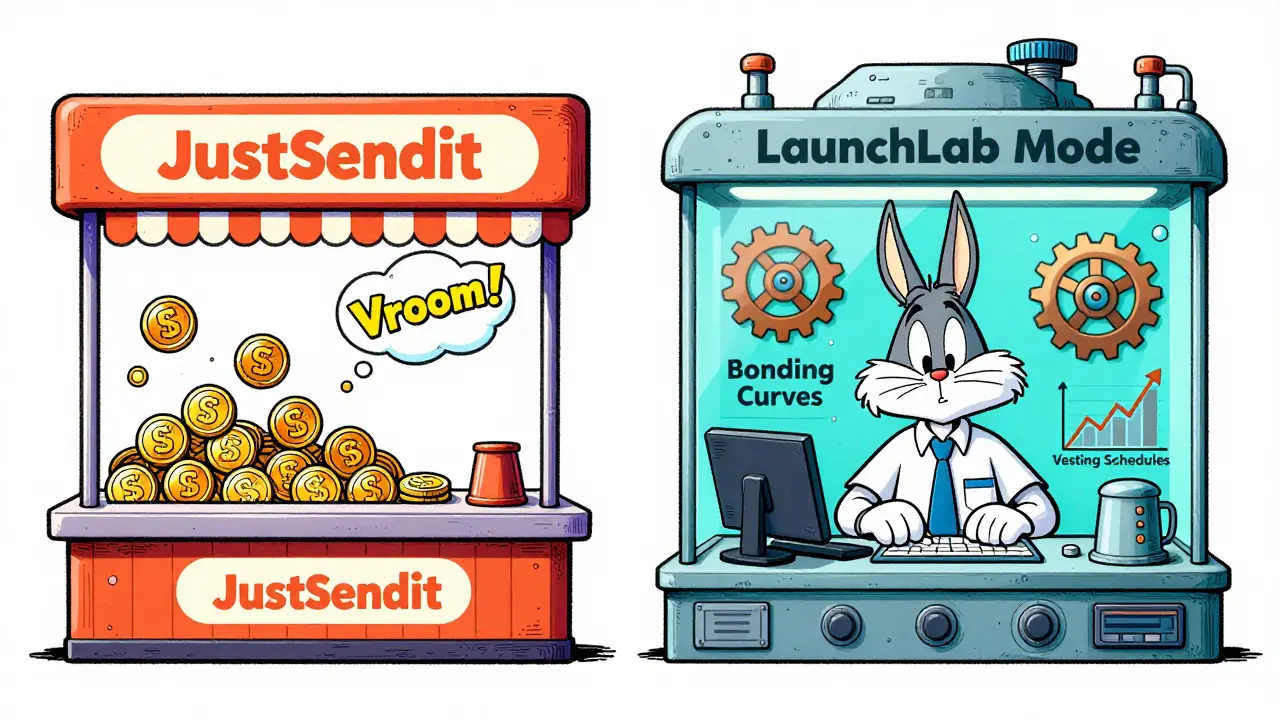
JustSendit Mode is exactly what it sounds like. You want to launch a joke coin or a quick experiment? This mode uses default settings. You enter the name, ticker, and image, and boom-you’re live. There is no configuration of bonding curves or supply caps. It is designed for speed and accessibility, lowering the barrier to entry to almost zero.
LaunchLab Mode is for the serious builders. Here, you get granular control over tokenomics. You can adjust the bonding curve parameters, setting linear, exponential, or logarithmic pricing models. You can also configure vesting schedules with cliff periods, which helps prevent immediate dumps by developers. If you are building a project with actual utility or a long-term roadmap, this mode lets you structure the launch to protect both you and your early investors.
How the Graduation Process Works
The magic of LaunchLab happens at the graduation threshold. When a token is launched, it trades on a bonding curve. As people buy, the price goes up. The goal is to reach a minimum raise of 85 SOL. Once that target is hit, the platform automatically migrates the liquidity to a permanent Raydium Automated Market Maker (AMM) pool. Crucially, the Liquidity Provider (LP) tokens are burned immediately. This means the liquidity is locked forever, eliminating the risk of a rug pull where the creator drains the pool.
This automatic migration is a huge deal. In the past, moving from a launchpad to a DEX required manual steps, which were prone to error and exploitation. LaunchLab removes that friction. For traders, it means that once a token graduates, it is ready for serious volume on Raydium’s main engine.
Fee Structure: Where Does Your Money Go?
Transparency in fees is critical in DeFi. LaunchLab charges a flat 1% base fee on trades during the bonding curve phase. But unlike some platforms that pocket all the profit, Raydium distributes this fee across three buckets:
- 50% goes to the Community Pool, rewarding users and contributors.
- 25% is used for RAY token buybacks, creating deflationary pressure on the native governance token.
- 25% funds infrastructure and operational costs.
Additionally, creators can earn a 10% share of the liquidity provider trading fees after their token graduates, thanks to Raydium’s Burn & Earn system. There is also a referral program where users can earn 0.1% of referred trades in SOL. These incentives align the interests of creators, traders, and the protocol itself.
Raydium LaunchLab vs. Pump.fun: The Real Comparison
You cannot talk about LaunchLab without comparing it to Pump.fun. They are direct competitors, but they serve slightly different needs. Let’s look at the data.
| Feature | Raydium LaunchLab | Pump.fun |
|---|---|---|
| Quote Tokens | Multiple (SOL, USDC, etc.) | SOL Only |
| Bonding Curves | Customizable (Linear, Exponential, Logarithmic) | Fixed Standard Curve |
| Liquidity Destination | Raydium AMM (Integrated) | PumpSwap / Raydium (Historically) |
| Creator Fee Share | Yes (10% via Burn & Earn) | No |
| Vesting Controls | Available in LaunchLab Mode | Limited/None |
The biggest differentiator is flexibility. Pump.fun is a blunt instrument-it works great for viral memes that need to move fast, but it lacks nuance. LaunchLab supports multiple quote tokens, meaning you can pair your new token with USDC or other stablecoins, not just SOL. This opens up trading pairs and reduces volatility for certain types of projects. Furthermore, the ability to customize bonding curves allows for more sophisticated economic modeling. If you are launching a token that isn’t a pure meme, LaunchLab gives you tools that Pump.fun simply doesn’t offer.

User Experience and Security Considerations
From a user experience standpoint, LaunchLab feels polished. The interface is clean, and the process is straightforward. To create a token, you connect your wallet (preferably Phantom or Solflare), upload your assets (images should be 128x128 pixels for best results), and add social links. The verification step requires you to sign a message to prove wallet ownership, which adds a layer of accountability.
Security-wise, the integration with Raydium is a major plus. Raydium processes over 65,000 transactions per second with fees fractions of a cent. This high-throughput infrastructure ensures that even during hype cycles, the platform remains responsive. However, remember that while the *platform* is secure, the *tokens* launched on it are not vetted. LaunchLab does not audit the legitimacy of every project. You still need to do your own due diligence. Just because a token graduated to an AMM pool doesn’t mean it has value. The 1% graduation rate is a harsh filter, but it’s not a quality guarantee.
Who Should Use LaunchLab?
LaunchLab isn’t for everyone. If you are a casual trader looking to ape into the next big dog coin, you might still prefer the sheer volume and community hype found on Pump.fun. However, if you are a developer or community leader looking to launch a token with specific mechanics, LaunchLab is superior. The customizable curves and vesting options allow for better long-term sustainability. Additionally, if you value having your liquidity integrated directly into Raydium’s deep order book, LaunchLab provides a smoother path to institutional-grade liquidity.
For investors, LaunchLab offers a transparent view of early-stage tokens. The data is public, the fees are clear, and the graduation criteria are objective. You can track which tokens are close to hitting the 85 SOL mark and position yourself accordingly. It’s a tool for informed speculation, not just blind gambling.
Final Thoughts on the Ecosystem Impact
Raydium LaunchLab represents a maturation of the Solana launchpad space. It moves beyond the "wild west" mentality of early meme coins toward a more structured, feature-rich environment. By offering advanced controls and deeper integration with existing DeFi infrastructure, it sets a new standard for what a launchpad should be. While Pump.fun will likely remain popular for pure virality, LaunchLab is positioning itself as the professional choice for token creation on Solana. As the ecosystem grows, we may see more platforms adopt similar hybrid models, blending ease of use with technical depth.
Is Raydium LaunchLab free to use?
Yes, launching a token on Raydium LaunchLab is free. There are no upfront costs to create a token. The platform earns revenue through a 1% trading fee applied during the bonding curve phase, which is distributed among the community, RAY buybacks, and infrastructure funding.
What is the graduation threshold for LaunchLab tokens?
The minimum graduation threshold is 85 SOL. Once a token raises this amount through purchases on the bonding curve, it automatically migrates to a permanent Raydium AMM pool, and the LP tokens are burned to lock liquidity.
Can I customize the bonding curve on LaunchLab?
Yes, but only if you use LaunchLab Mode. JustSendit Mode uses default settings. In LaunchLab Mode, you can choose between linear, exponential, and logarithmic pricing models and adjust supply percentages to fit your tokenomics strategy.
How does LaunchLab compare to Pump.fun?
LaunchLab offers more features than Pump.fun, including support for multiple quote tokens (not just SOL), customizable bonding curves, and creator fee shares. Pump.fun is simpler and focused purely on speed and virality, while LaunchLab provides more control and integration with Raydium’s broader ecosystem.
Do creators earn fees from their tokens on LaunchLab?
Yes. After a token graduates to a Raydium AMM pool, creators can earn 10% of the liquidity provider trading fees through Raydium’s Burn & Earn system. This provides a continuous revenue stream for successful projects.


Categories