
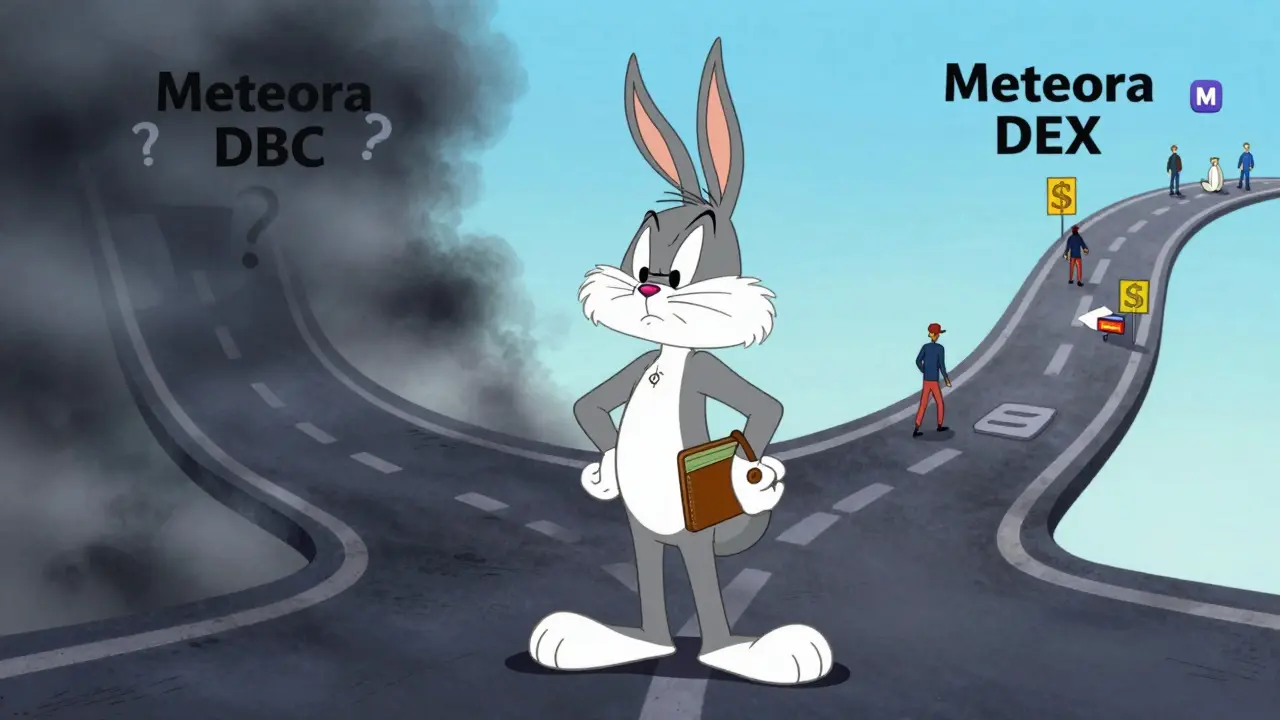
There is a major confusion in the crypto space right now regarding "Meteora." If you are looking for a review of Meteora DBC, you need to pause and verify exactly what platform you are accessing. Most users searching for this term are actually looking for Meteora DEX, which is a leading decentralized liquidity protocol on the Solana blockchain. These are two different entities, and mixing them up could lead to security risks or wasted time.
The internet currently shows very little credible information about an entity called "Meteora DBC" as a standalone centralized exchange. There are scattered data points showing a trading volume of around $11 million and website traffic, but no clear regulatory filings, team disclosures, or technical audits. In contrast, Meteora DEX is a well-documented, high-volume DeFi protocol with over $800 million in Total Value Locked (TVL). This article will clarify the difference, review the actual Meteora ecosystem, and help you decide where your funds are safe.
The Identity Crisis: Meteora DBC vs. Meteora DEX
Before we dive into features, we must separate fact from fiction. The name "Meteora" is most strongly associated with Meteora DEX. However, search results occasionally surface references to "Meteora DBC" with vague metrics. Here is why this distinction matters for your wallet.
| Feature | Meteora DBC (Reported Data) | Meteora DEX (Verified Protocol) |
|---|---|---|
| Type | Unclear / Possibly Centralized Interface | Decentralized Exchange (DEX) / Liquidity Layer |
| Chain | Not Specified | Solana |
| 24h Volume | ~$11 Million (Isolated Data Point) | $200+ Million Daily Swaps |
| Security/Audits | No Public Audit Records Found | Audited Smart Contracts, Open Source |
| Community | Discord Channel Exists | Large Developer & User Base, Twitter/X Presence |
| Regulatory Status | Unknown | Non-Custodial (User Controls Keys) |
If you are being directed to a site claiming to be "Meteora DBC" that asks you to deposit funds into a custodial wallet, proceed with extreme caution. The lack of transparent team information and audit trails is a red flag in the crypto industry. Conversely, Meteora DEX operates on the Solana blockchain, meaning you never give up custody of your assets; you interact directly with smart contracts.
Deep Dive: Meteora DEX (The Real Powerhouse)
Since Meteora DEX is the legitimate, widely used protocol behind the brand, let’s review its actual capabilities. Meteora DEX is not just a simple swap interface like early Uniswap versions. It functions as a liquidity layer for Solana, integrating deeply with aggregators like Jupiter.
Dynamic AMM Pools
Traditional Automated Market Makers (AMMs) often leave capital idle. Meteora’s Dynamic AMM pools solve this by allowing liquidity providers (LPs) to earn yield on their idle assets through lending protocols while still providing liquidity. This means your tokens aren’t just sitting there waiting for a trade; they are working harder. For traders, this translates to deeper liquidity and potentially lower slippage on large orders.
DLMM: Concentrated Liquidity Done Right
The standout feature of Meteora DEX is its Dynamic Liquidity Market Maker (DLMM) pools. Unlike standard pools that spread liquidity across all price ranges, DLMM allows LPs to concentrate their capital in specific price bins. This offers:
- Zero-Slippage Bins: Traders can execute swaps at exact prices within these bins.
- Dynamic Fees: Fees adjust based on volatility. When the market is wild, fees go up to compensate LPs for risk. When it’s calm, fees drop to attract traders.
- Capital Efficiency: LPs can use less capital to provide the same amount of liquidity compared to traditional models.
This model is particularly popular among advanced DeFi users who want to optimize their returns without constantly rebalancing positions manually.
Integration with Solana Ecosystem
Meteora DEX does not operate in a silo. It is built to plug into the broader Solana DeFi landscape. Its seamless integration with Jupiter, the largest DEX aggregator on Solana, ensures that trades routed through Meteora get the best possible execution price. If you are trading on Solana, you are likely already interacting with Meteora’s liquidity under the hood, even if you don’t realize it.

Security and Trust Factors
When reviewing any crypto platform, security is non-negotiable. Let’s look at how Meteora stacks up against the unknowns of "Meteora DBC" and competitors like Raydium.
Meteora DEX Security: As a decentralized protocol, Meteora relies on smart contract security. The code is open-source, allowing independent auditors and developers to inspect it for vulnerabilities. While no system is 100% hack-proof, the transparency of DeFi protocols generally offers more trust than opaque centralized exchanges. Users retain control of their private keys, eliminating the risk of exchange insolvency (the fear that the platform runs away with your money).
The Risk of "Meteora DBC": Without public audits, clear team identities, or regulatory compliance statements, an entity operating under the name "Meteora DBC" poses significant risks. In the crypto world, anonymity combined with custodial services is a classic warning sign for potential scams or poorly managed platforms. Always verify the URL. Official Meteora resources will direct you to their DEX interface, not a generic login portal demanding deposits.
User Experience: Who Is This For?
Meteora DEX caters to two main groups: sophisticated liquidity providers and everyday Solana traders.
For Traders: The experience is smooth. You connect your Solana wallet (like Phantom or Solflare), select the token pair, and swap. Because Meteora integrates with Jupiter, you often see better prices than swapping directly on smaller DEXs. The interface is clean, though it may have a slight learning curve for those new to DeFi concepts like slippage tolerance and gas fees.
For Liquidity Providers: Meteora shines here. The ability to create custom DLMM pools gives you granular control. You can set narrow price ranges for volatile meme coins or wide ranges for stable pairs. The dynamic fee structure helps protect your profits during turbulent market swings. Compared to Raydium, which is older and has a wider variety of trading pairs, Meteora is often preferred for its innovative pool structures and higher efficiency for active LPs.

Fees and Costs
In DeFi, costs come from two sources: protocol fees and network gas fees.
- Protocol Fees: Meteora charges a small fee on swaps, which goes to liquidity providers. The rate varies by pool type. DLMM pools have dynamic fees that change based on market conditions.
- Gas Fees: Since Meteora runs on Solana, transaction fees are typically fractions of a cent. This makes it highly cost-effective for frequent traders compared to Ethereum-based DEXs, where gas can spike to dollars per transaction.
Be wary of any platform claiming to be "Meteora DBC" that charges hidden withdrawal fees or high spreads. Legitimate DeFi protocols display all fees clearly before you confirm a transaction.
Verdict: Should You Use Meteora?
If you are looking for a safe, efficient way to trade on Solana, Meteora DEX is an excellent choice. It is a top-tier liquidity provider with strong community support, innovative technology, and deep integration into the Solana ecosystem. It is ideal for users who want to maximize yields on their idle assets or execute trades with minimal slippage.
However, if you encountered a site specifically branded as "Meteora DBC" that asks for centralized deposits, KYC documents, or promises guaranteed returns, avoid it. The lack of verifiable information suggests it is either a scam, a defunct project, or a mislabeled interface. Stick to the official Meteora DEX website and always double-check URLs.
Is Meteora DBC a scam?
While we cannot definitively label every entity using the name "Meteora DBC" as a scam without more data, the lack of transparency, audits, and clear team information makes it highly risky. Most users searching for this term are likely confused with Meteora DEX, which is a legitimate and secure decentralized protocol. Always prioritize verified, open-source DeFi platforms over obscure centralized ones.
What is the difference between Meteora DEX and Raydium?
Raydium is one of the oldest and largest DEXs on Solana, offering a vast number of trading pairs. Meteora DEX is newer but focuses on advanced liquidity tools like DLMM (Dynamic Liquidity Market Maker) pools. Meteora is often preferred by liquidity providers seeking higher capital efficiency, while Raydium remains a go-to for general trading due to its depth and variety.
Do I need to do KYC to use Meteora DEX?
No. Meteora DEX is a decentralized application (dApp). You only need a Solana-compatible wallet (like Phantom or Solflare). There is no central authority, so no Know Your Customer (KYC) verification is required. You maintain full control of your private keys.
How do I access Meteora DEX safely?
Always navigate to the official Meteora website via trusted sources like their verified Twitter/X account or CoinGecko listing. Bookmark the correct URL to avoid phishing sites. Never click on links from unsolicited Discord messages or emails claiming to be "Meteora Support" or "Meteora DBC Admins."
What are DLMM pools?
DLMM stands for Dynamic Liquidity Market Maker. These are concentrated liquidity pools that allow providers to allocate capital to specific price ranges. This increases capital efficiency and allows for dynamic fee adjustments based on market volatility, benefiting both traders and liquidity providers.





Categories