
Have you ever stared at a complex DeFi dashboard, wondering if the yield is worth the headache? Most vote-escrowed (ve) decentralized exchanges demand hours of reading whitepapers just to understand how voting power works. Kyo Finance V3 is a decentralized exchange on the Soneium blockchain that simplifies ve-tokenomics by removing epochs and NFT requirements. It promises to make liquidity provision as easy as staking, while allegedly compensating for impermanent loss through aligned arbitrageurs. But does it actually work, or is it just another shiny new protocol with empty promises?
In this review, we cut through the marketing hype. We look at the real numbers, the technical claims, and the risks involved in using Kyo Finance V3 today. Whether you are an Astar Network veteran or a curious DeFi explorer, here is what you need to know before connecting your wallet.
The Core Promise: Simplified ve-Tokenomics
Traditional ve-tokenomics models, like those used by Curve Finance, are notoriously difficult for newcomers. You lock tokens, wait for epochs to pass, calculate voting power, and manage NFTs. It’s a barrier to entry that keeps many users away. Kyo Finance V3 aims to fix this by stripping away the complexity.
According to its introduction on the Astar Network forum, the platform implements a "real-time staking-like mechanism." Instead of waiting for weekly voting periods, rewards and influence are updated continuously. The mission statement is blunt: "simplify and optimize until you can't do it anymore." For users tired of complex interfaces, this sounds appealing. However, simplicity often comes at the cost of transparency. How exactly does the protocol determine reward distribution without the traditional voting mechanisms? The documentation offers high-level explanations but lacks deep technical audits or open-source contract details that independent developers could verify.
Trading Volume: A Tale of Two Numbers
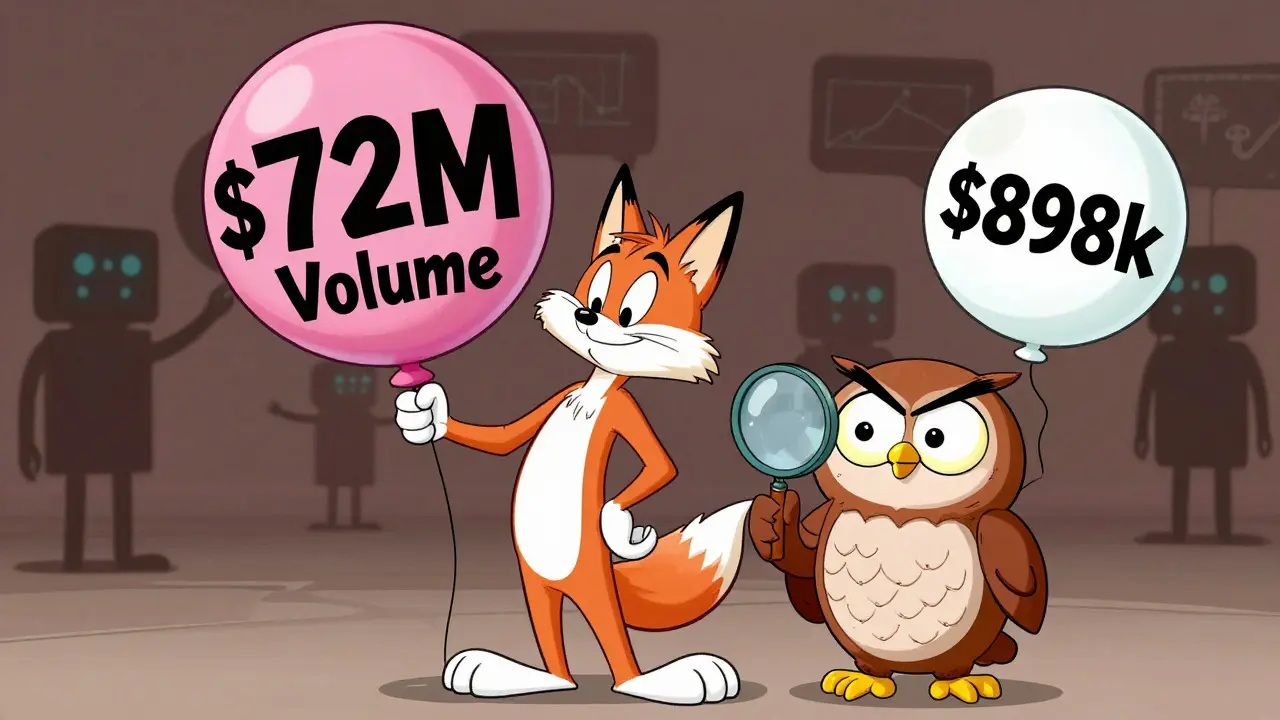
When evaluating any exchange, volume is king. It indicates liquidity, trust, and activity. Here is where Kyo Finance V3 gets confusing. Data from late 2025 shows a massive discrepancy between tracking platforms.
| Platform | Reported 24h Volume | Change Trend |
|---|---|---|
| CryptoMarketCap.com | $72.8 million | +28.96% |
| CoinGecko | $898,270 | -58.19% |
| CoinMarketCap | $1.05 million (Spot) + $2.96 million (DEX) | N/A |
A difference of over 80x between major trackers is not normal. In the DeFi world, this usually points to one of two things: flawed data aggregation methods or artificial volume inflation (wash trading). Community analysts have raised red flags about this specific issue. If the true volume is closer to the CoinGecko figure of under $1 million, Kyo Finance V3 holds a negligible market share compared to giants like Curve Finance, which processes over $1 billion daily. Before providing significant liquidity, ask yourself: who is actually trading on this platform, and why do the numbers not match?
Liquidity and Token Selection
Kyo Finance V3 operates primarily within the Soneium ecosystem, a Layer 2 solution associated with Astar Network. As of late 2025, the platform lists only 16 cryptocurrencies across 25 trading pairs. This is extremely limited compared to established DEXs that support hundreds of assets.
The bulk of the activity revolves around stablecoins and native tokens:
- USDT0/WETH: The most active pair, with over $1 million in daily volume.
- USDC.E/WETH: Another major stablecoin-to-ether pair.
- ASTR derivatives: Pairs involving Astar Token and vASTR dominate the remaining volume.
If you hold niche altcoins, you likely won’t find them here. The platform is optimized for users deeply embedded in the Astar/Soneium ecosystem. For general crypto traders looking for broad market access, Kyo Finance V3 is not a viable option. Its value proposition is strictly niche: efficient swapping for Soneium-native assets.
The Impermanent Loss Compensation Claim
One of the boldest claims made by Kyo Finance V3 is its "sustainable LP yield" mechanism. The team states they cooperate with "aligned arbitrageurs" to compensate liquidity providers for impermanent loss (IL). IL is the primary risk in providing liquidity to AMMs; when token prices diverge, LPs lose value compared to simply holding the assets.
However, skepticism is high. Independent DeFi analysts on Reddit have pointed out that without seeing the actual smart contracts governing these arbitrage partnerships, this claim remains unverified. As one analyst noted, "Without seeing the actual arbitrage partnership contracts and revenue sharing structure, this sounds like marketing hype rather than a viable economic model." In DeFi, if it isn’t on-chain and verifiable, it doesn’t exist. Until Kyo Finance publishes transparent audit reports detailing how this compensation is funded and executed, treat this feature with extreme caution.
User Experience and Support
Getting started with Kyo Finance V3 requires intermediate DeFi knowledge. There is no mobile app, and the interface is web-only. You will need a Web3 wallet like MetaMask connected to the Soneium network. Bridging assets to Soneium is a prerequisite, adding friction for users accustomed to Ethereum Mainnet or Arbitrum.
Support is minimal. The platform relies on a Telegram channel and basic tooltips. There is no help center, email support, or comprehensive educational guides. Early feedback from the Astar Network forum describes the dApp as "user-friendly," but this is likely due to its stripped-down interface rather than advanced UX design. Beginners may struggle with wallet connection issues, particularly if they use non-MetaMask wallets, which have been reported as problematic in community threads.
How It Compares to Competitors
To understand where Kyo Finance V3 stands, we must compare it to the leaders in the ve-tokenomics space. The competition is fierce, dominated by protocols with years of development and billions in total value locked (TVL).
| Feature | Kyo Finance V3 | Curve Finance | Aerodrome Finance |
|---|---|---|---|
| Primary Chain | Soneium | Ethereum/Multi-chain | Base |
| Voting Complexity | Low (Real-time staking) | High (Epochs/NFTs) | Medium |
| Token Selection | 16 Assets | 350+ Assets | 100+ Assets |
| Daily Volume | $0.9M - $72M (Disputed) | $1.14 Billion | $133 Million |
| IL Compensation | Claimed (Unverified) | No | No |
Kyo Finance V3 cannot compete on scale. Its market share is effectively zero compared to Curve Finance. Its advantage lies solely in its promise of simplicity and its integration with the growing Soneium ecosystem. If you believe Soneium will become a major hub for DeFi, Kyo might be an early play. If you want proven stability and deep liquidity, stick with the incumbents.
Risks and Red Flags
Before depositing funds, consider these critical risks:
- Volume Inflation: The massive discrepancy in reported volume suggests potential manipulation or poor data hygiene. Low real volume means higher slippage for traders.
- Lack of Audits: No major security firms have published public audit reports for Kyo Finance V3’s core contracts. In DeFi, unaudited code is a gamble.
- Centralization Risks: While marketed as decentralized, the reliance on "aligned arbitrageurs" introduces a centralized element. Who are these arbitrageurs? What happens if they exit the market?
- Ecosystem Dependency: Kyo’s success is tied entirely to the adoption of Soneium and Astar Network. If these chains fail to gain traction, Kyo becomes irrelevant.
Verdict: Who Should Use Kyo Finance V3?
Kyo Finance V3 is not for everyone. It is a specialized tool for a specific audience. If you are an early adopter of the Soneium blockchain, hold ASTR tokens, and want to experiment with simplified ve-tokenomics, it is worth testing with small amounts. The interface is clean, and the concept of real-time rewards is innovative.
However, for the average DeFi user seeking reliable yields and deep liquidity, Kyo Finance V3 currently falls short. The lack of transparency regarding its impermanent loss compensation and the questionable volume metrics suggest it is still in its infancy. Wait for third-party audits, clearer documentation, and consistent volume data before committing significant capital. In the world of crypto, patience is often the most profitable strategy.
What is Kyo Finance V3?
Kyo Finance V3 is a decentralized exchange (DEX) built on the Soneium blockchain. It uses a simplified version of ve-tokenomics, allowing users to stake tokens for rewards without the complex voting epochs and NFTs found in other platforms like Curve Finance.
Is Kyo Finance V3 safe to use?
Safety in DeFi is relative. While the platform appears functional, it lacks public smart contract audits from major security firms. Additionally, discrepancies in trading volume data raise concerns about transparency. Users should exercise caution and start with small amounts.
Why are there different volume numbers for Kyo Finance V3?
Different data aggregators use different methods to calculate volume. CryptoMarketCap.com reports significantly higher volumes than CoinGecko. This large gap often indicates either methodological errors or potential wash trading, where bots create fake trades to inflate volume statistics.
Does Kyo Finance V3 compensate for impermanent loss?
The platform claims to compensate liquidity providers for impermanent loss through partnerships with "aligned arbitrageurs." However, this mechanism has not been independently verified or audited, so users should treat this claim with skepticism until more evidence is provided.
Which tokens can I trade on Kyo Finance V3?
Kyo Finance V3 supports a limited selection of 16 cryptocurrencies, primarily focused on the Astar Network ecosystem. Key tokens include ASTR, USDT, USDC.E, WETH, and various ASTR derivatives. It is not suitable for trading a wide range of altcoins.
Do I need an NFT to use Kyo Finance V3?
No. One of the main selling points of Kyo Finance V3 is that it eliminates the need for NFTs to participate in governance or earn boosted rewards. It uses a real-time staking mechanism instead.
How do I connect my wallet to Kyo Finance V3?
You need a Web3 wallet like MetaMask. Ensure your wallet is configured to interact with the Soneium network. Visit the official Kyo Finance website and click the connect button. Note that some non-MetaMask wallets may experience connection issues.




Categories