
By 2026, Russian citizens face some of the strictest crypto access rules in the world. It’s not that crypto is illegal - you can still own Bitcoin or Ethereum. But if you’re not part of a small elite, getting in, trading, or cashing out has become nearly impossible through legal channels. The government didn’t just tighten rules - it built a wall. One side lets the wealthy and sanctioned businesses move crypto across borders. The other side locks out regular people. And the result? Millions are stuck in a gray zone, using offshore apps, P2P platforms, and VPNs just to hold digital assets.
How Russia’s Crypto Rules Changed After 2022
Before the war in Ukraine, Russia’s stance on crypto was confusing but not hostile. In 2020, Law No. 259-FZ made it legal to own and trade cryptocurrency, but banned using it to pay for goods or services inside the country. That meant you could buy Bitcoin, but you couldn’t use it to buy groceries. The goal was to keep the ruble stable while letting people speculate. Everything changed after February 2022. Western sanctions cut Russia off from SWIFT, blocked access to global banking, and froze assets. Suddenly, crypto looked like a lifeline - but only for the right people. The government responded by creating the Experimental Legal Regime (ELR) a special legal pathway created in 2023 that allows vetted Russian companies to use digital currencies exclusively for international trade. Think of it as a sanctioned tunnel: only companies with government approval can use crypto to pay for oil, metals, or machinery abroad. No ordinary citizen is allowed in.Meanwhile, the Central Bank of Russia started treating everyday crypto users like criminals. In June 2023, they issued a warning: if you’re doing frequent small trades on P2P platforms, your bank account could get frozen. That’s not a suggestion - it’s policy. Banks now monitor every transaction for signs of crypto activity. A $50 transfer from a crypto wallet? That’s a red flag. A $200 top-up via LocalBitcoins? Risky. The message was clear: if you’re not rich, don’t touch crypto.
Who Can Still Trade Legally?
The only Russians who can legally access crypto exchanges today are those who meet the highly qualified investor a regulatory category defined by the Central Bank of Russia requiring either a portfolio worth at least 100 million rubles ($1.1M USD) or annual income over 50 million rubles ($550K USD) threshold. That’s not a small group. To qualify, you need to have over a million dollars in assets or earn half a million a year. Less than 0.1% of Russian households meet that standard.This isn’t about protecting investors - it’s about control. The government doesn’t want ordinary people moving money outside the system. But for the ultra-rich, crypto is still a tool. They use it to buy foreign real estate, invest in offshore funds, or pay for services abroad without triggering sanctions. Some even use it to pay employees working in countries that still allow Russian transactions. The system is designed to serve the state’s interests, not the public’s.
What Happens When You Try to Use Binance or Coinbase?
If you’re a Russian citizen trying to use Binance, Coinbase, or any major exchange, you’ll hit roadblocks fast. Most platforms comply with global sanctions. As of October 2025, Coinbase has frozen over 25,000 Russian accounts. Binance now requires Russian users to submit proof of address from outside Russia - something most people can’t provide. Many users report being asked for foreign ID cards, utility bills from other countries, or even bank statements from non-Russian institutions.Trustpilot reviews tell the story. Coinbase has a 2.1/5 rating from Russian users. The top complaints? "Account frozen without warning," "KYC rejected even with valid documents," and "no way to withdraw funds." Binance fares slightly better at 2.8/5, but users still complain about being blocked if their wallet holds more than €10,000. The platforms aren’t being arbitrary - they’re following international sanctions. But for Russian users, it feels like punishment.

How Russians Are Bypassing the Restrictions
With official channels closed, Russians have turned to underground methods. The most common? peer-to-peer (P2P) trading a method of buying and selling cryptocurrency directly between individuals, often through apps like LocalBitcoins or Paxful, without using a centralized exchange. Platforms like LocalBitcoins and Paxful have seen a 217% increase in Russian activity between 2022 and 2025, according to Chainalysis.Here’s how it works: someone in Turkey or Kazakhstan sends rubles to a Russian bank account. In return, the Russian user sends Bitcoin to their wallet. No exchange is involved. No KYC. No traceable paper trail. But it’s risky. The Central Bank has warned that repeated P2P activity can lead to bank account freezes. And scammers are everywhere. A 2025 survey by Coincub found that 68% of Russian users failed identity checks on P2P platforms, and 41% had accounts hacked or funds stolen.
Another workaround? Using VPNs to access foreign exchanges under fake addresses. Some users rent apartments abroad just to get a utility bill. Others use relatives living in Armenia, Serbia, or Turkey to complete KYC. It’s expensive, complicated, and legally shaky - but it’s the only option left for many.
Why This System Is Failing
The Russian government claims its crypto restrictions protect financial stability and prevent sanctions evasion. But the numbers tell a different story. In 2022, Russia had around 17.7 million crypto owners - the 8th largest population in the world. By Q3 2025, trading volume on global exchanges dropped by 83%. That’s not because people stopped caring. It’s because they can’t trade legally.Now, 87% of all crypto transactions in Russia happen outside regulated channels. That means money flows through unmonitored P2P networks, decentralized wallets, and anonymous bridges. The government loses control - not gains it. And while the ELR lets a few corporations move crypto for trade, it does nothing to stop ordinary Russians from using it as a store of value or hedge against inflation.
Experts agree: this approach is unsustainable. The Bitcoin Policy Institute says, "Bitcoin won’t save Russia from Western sanctions," because large transactions are still visible on the blockchain. Norton Rose Fulbright adds that crypto monitoring firms now use AI to track suspicious flows in real time. So the system isn’t fooling anyone - it’s just making life harder for regular people.
The Future: More Underground, Not More Legal
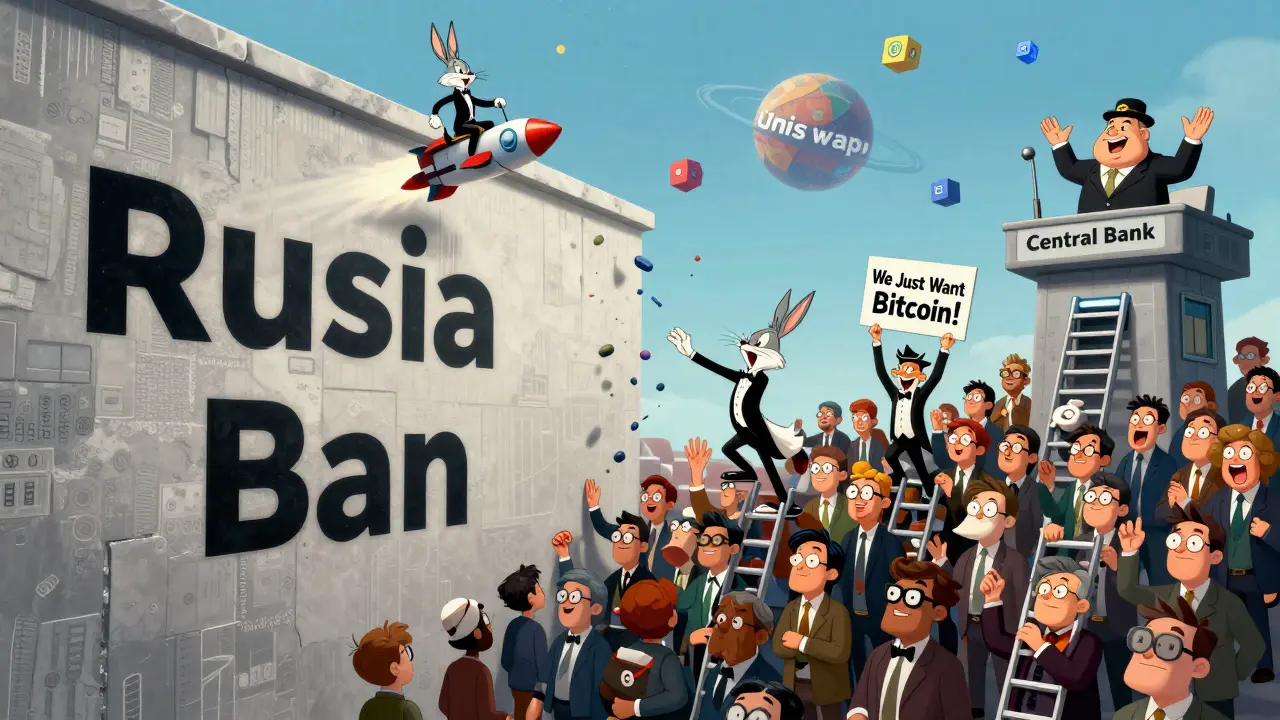
In October 2025, the Central Bank announced banks could finally enter the crypto sector - but with a catch. They can only hold up to 1% of their capital in digital assets. No retail services. No wallets for normal users. Just institutional play. Meanwhile, the Finance Ministry hinted at lowering the "highly qualified investor" threshold, but gave no details.What’s coming next? More DeFi. More anonymous bridges. More Russian users turning to Uniswap, Curve, or Chainlink to swap tokens without a middleman. The government can ban exchanges, but it can’t stop blockchain. Decentralized finance doesn’t need banks. It doesn’t need KYC. It just needs an internet connection.
By 2028, analysts at Bernstein predict Russia’s crypto market will remain split: a tiny, sanctioned elite with legal access, and a massive underground network of everyday users doing whatever it takes to survive. The state’s goal was control. But instead, it created a black market that’s harder to police than ever.
Can Russian citizens legally own cryptocurrency in 2026?
Yes, owning cryptocurrency is not illegal in Russia. You can hold Bitcoin, Ethereum, or other digital assets in a personal wallet. However, using crypto to pay for goods or services inside Russia remains banned, and accessing exchanges through legal banking channels is restricted to a small group of wealthy investors.
Why can’t Russian users use Binance or Coinbase anymore?
Major exchanges like Binance and Coinbase comply with international sanctions imposed on Russia after 2022. They have frozen tens of thousands of Russian accounts and now require strict proof of non-Russian residency or identification to open accounts. Most Russian users fail these checks, leading to blocked access or frozen funds.
What is the "highly qualified investor" rule in Russia?
To legally trade crypto through approved channels, you must be classified as a "highly qualified investor." This requires either a financial portfolio worth at least 100 million rubles ($1.1 million USD) or an annual income exceeding 50 million rubles ($550,000 USD). Less than 0.1% of Russian citizens meet this standard.
Is peer-to-peer (P2P) crypto trading safe for Russians?
P2P trading is the most common way Russians access crypto today, but it’s risky. The Central Bank warns that frequent small P2P transactions can lead to bank account freezes. Scams are widespread, and there’s no legal recourse if funds are stolen. While it’s the only option for many, users face high financial and legal exposure.
Can Russian banks now offer crypto services?
In late 2025, the Central Bank allowed banks to operate in the crypto sector, but only with strict limits. Banks can hold up to 1% of their capital in digital assets and must avoid making crypto a "dominant" business. They are still prohibited from offering retail services, wallets, or trading to ordinary citizens.
What’s the difference between Russia’s crypto rules and the EU’s?
The EU targets crypto used to evade sanctions - it bans specific Russian-linked wallets and transactions. Russia, however, targets its own citizens. While the EU regulates and licenses exchanges under MiCA, Russia bans most retail access and creates special loopholes only for sanctioned corporations. Russia’s system is about control; the EU’s is about enforcement.
Will crypto help Russians bypass sanctions?
No. Large-scale sanctions evasion through crypto is extremely difficult. Blockchain is transparent - every transaction is recorded. Major exchanges cooperate with law enforcement, and laundering millions through crypto is costly and visible. Experts agree Bitcoin won’t save Russia’s economy from sanctions - it just pushes ordinary people into risky underground networks.