
You might have stumbled across CroSwap while searching for low-fee trading on the Cronos network. The promise of cheap swaps and high yields sounds tempting. But before you connect your wallet, you need to look at the hard numbers. In this review, we are going to cut through the marketing fluff and see if this platform is actually usable or just another ghost town in the DeFi world.
The short answer? As of mid-2026, CroSwap is not a viable option for serious traders. It suffers from near-zero liquidity, a lack of community trust, and an operational scale that makes it statistically invisible compared to major competitors. If you are looking for a place to park significant capital or execute large trades, you will likely lose money to slippage or get stuck entirely.
What Exactly Is CroSwap?
To understand why CroSwap struggles, you first need to know what it is. It is a Decentralized Exchange (DEX). Unlike centralized platforms like Binance or Coinbase, there is no company holding your funds. You connect your own wallet-like MetaMask or the Crypto.com DeFi Wallet-and trade directly against liquidity pools.
CroSwap runs on the Cronos Network, a blockchain developed by Crypto.com. Its native utility token is called CROS. The platform claims to offer some of the lowest fees on the network, specifically advertising a flat 0.2% trading fee. On paper, that looks cheaper than many competitors. However, a low fee means nothing if you cannot find anyone to trade with.
The Liquidity Crisis: Why Your Trades Will Fail
This is the most critical part of this review. In crypto trading, liquidity is king. Liquidity refers to how easily you can buy or sell an asset without causing its price to move drastically. High liquidity means deep pools of money; low liquidity means empty pools.
CroSwap has virtually no liquidity. Data from April 2024 shows the platform had only $36.52 in total 24-hour trading volume. To put that in perspective, that is less than the cost of a single lunch in Wellington. For comparison, Uniswap processes billions of dollars daily. Even smaller niche DEXs handle millions.
Here is what this looks like in practice:
- Single Trading Pair: The platform effectively lists only one active pair: Wrapped CRO (WCRO) against USDC.
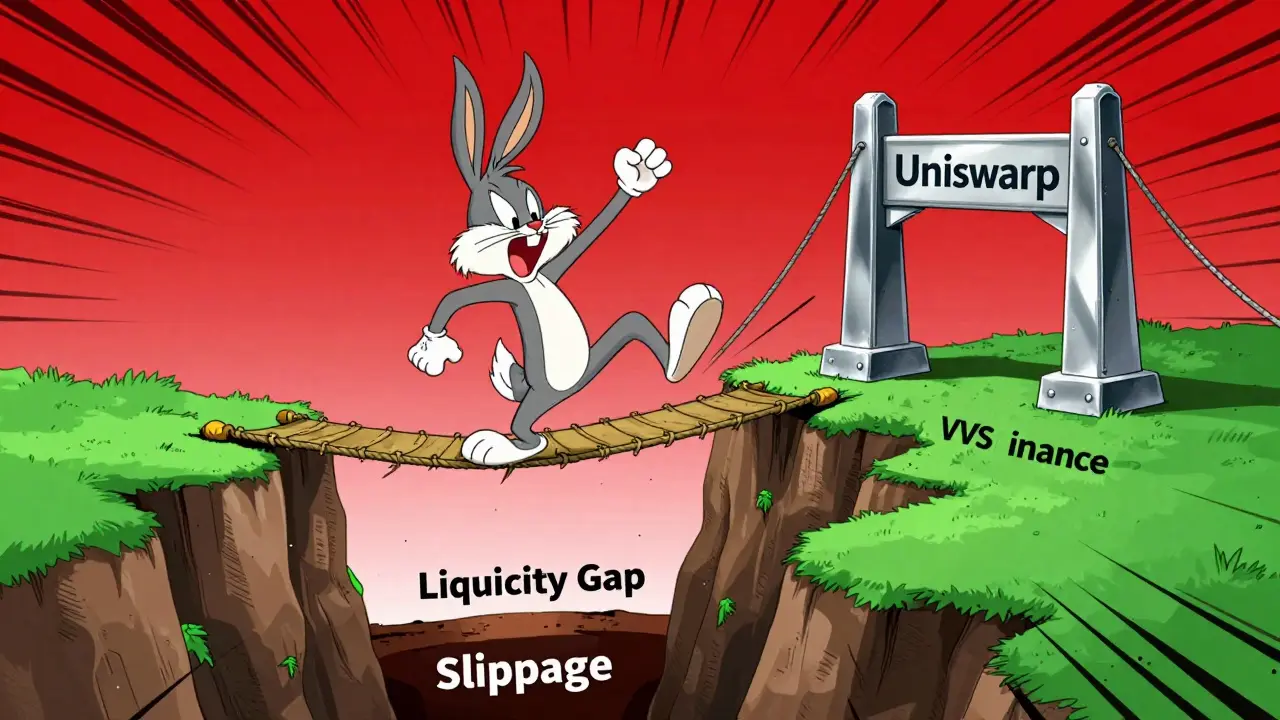
- Microscopic Depth: At the time of analysis, there were only $21 available at a +2% price deviation. This means if you tried to swap more than $20 worth of tokens, the price would jump by 2% instantly against you.
- Extreme Slippage: Because the pool is so shallow, any meaningful trade causes massive slippage. You might intend to swap $100 for CROS, but due to the lack of sellers, you might only receive the equivalent of $80, losing 20% of your value instantly.
If you try to trade larger amounts, the transaction might fail entirely because there simply isn't enough money in the pool to cover your order. This makes CroSwap unusable for anything other than microscopic, experimental transactions.
Fee Structure vs. Real Costs
CroSwap advertises a 0.2% trading fee. Let's compare this to its main competitors to see if this "low fee" claim holds water.
| Platform | Trading Fee | Avg Daily Volume (Approx) | Liquidity Status |
|---|---|---|---|
| CroSwap | 0.2% | $36 - $100 | Critical / Non-existent |
| PancakeSwap | 0.25% | $700M+ | High |
| Uniswap v3 | 0.05% - 1% | $1.8B+ | Very High |
| Trader Joe | 0.15% | $50M+ | Moderate/High |
While CroSwap's 0.2% fee is technically lower than PancakeSwap's 0.25%, the real cost of trading on CroSwap is much higher due to slippage. When you trade on a platform with deep liquidity like Uniswap, you pay the fee and get the market price. On CroSwap, you pay the fee AND accept a terrible price because the pool is empty. Therefore, the effective cost of trading on CroSwap is significantly higher than on established exchanges.
Security and Trust: Who Is Behind It?
In the world of DeFi, anonymity is common, but it comes with risks. CroSwap was launched by an anonymous team. There are no public founders, no verified company information, and no regulatory disclosures. While this doesn't automatically make a project a scam, it does mean you have zero recourse if something goes wrong.
Let's look at the trust signals:
- Trust Score: CoinGecko lists CroSwap with an unlisted (-) trust score. This usually indicates insufficient data to verify reliability.
- User Reviews: There are virtually no user reviews on major platforms like Trustpilot or Sitejabber. Reddit searches yield almost no discussion. A healthy crypto project typically has thousands of community members discussing features and issues. CroSwap has none.
- Smart Contract Audits: There is no widely publicized evidence of recent, comprehensive smart contract audits by top-tier firms. Without these, users are trusting code that may contain vulnerabilities.
The combination of an anonymous team, lack of community presence, and minimal operational history raises red flags. In 2026, with mature alternatives available, using an obscure, unaudited, and illiquid DEX is unnecessary risk.
Is CroSwap a Scam?
Labeling a project a "scam" requires proof of intent to defraud. Currently, there is no definitive evidence that CroSwap is a malicious honeypot designed to steal funds outright. However, it exhibits many characteristics of a "zombie" project-a platform that is technically live but functionally dead.
The danger here isn't necessarily that someone will hack your wallet immediately, but that you will lose value through inefficiency. If you deposit funds into a liquidity pool on CroSwap, you might find yourself unable to withdraw them efficiently due to lack of demand. Or worse, if the protocol suffers a bug, there is no customer support team to contact because there is no company.
Industry reports from Symbiosis Finance note that platforms with sub-$100 daily volume typically lack the liquidity necessary for meaningful trading and often cease operations quietly. CroSwap fits this description perfectly.
Better Alternatives on Cronos and Beyond
If you are interested in trading on the Cronos network or want low-fee swaps, there are far better options. Do not use CroSwap. Instead, consider these established platforms:
- VVS Finance: This is the leading DEX on the Cronos network. It has deep liquidity, multiple trading pairs, and an active community. It offers similar low fees but with actual usability.
- CronaSwap: Another robust option on Cronos with significantly higher volume and better security track record than CroSwap.
- Uniswap (via Bridge): If you want maximum security and liquidity, bridge your assets to Ethereum or Arbitrum and use Uniswap. Yes, gas fees might be higher on Ethereum, but the liquidity is unmatched.
- PancakeSwap: If you are on BNB Chain, PancakeSwap offers excellent liquidity and a proven track record since 2020.
These platforms have undergone years of testing, have transparent teams or open-source communities, and process millions in volume daily. They provide the safety net that CroSwap lacks.
How to Use CroSwap (If You Still Want To)
I do not recommend using CroSwap for any significant amount. However, if you are a developer testing smart contracts or a curious user wanting to experiment with tiny amounts (e.g., $1), here is how it works technically.
- Get a Wallet: Install MetaMask or use the Crypto.com DeFi Wallet. Ensure it supports the Cronos Network.
- Add Cronos Network: Add the Cronos Mainnet RPC details to your wallet if they aren't already there.
- Fund Your Wallet: Buy CRO or USDC on a centralized exchange (like Binance or Coinbase) and send it to your wallet address on the Cronos network.
- Connect to CroSwap: Visit the official CroSwap website. Double-check the URL to avoid phishing sites. Click "Connect Wallet" and approve the connection.
- Swap Tokens: Select WCRO and USDC. Enter a very small amount. You will likely see a high slippage warning. Adjust your slippage tolerance if necessary, but be aware you will get a poor rate.
Note: Never share your seed phrase. CroSwap, like all legitimate DEXs, will never ask for your private keys or seed phrase. If a site asks for this, it is a scam.
Future Outlook: Will CroSwap Recover?
The outlook for CroSwap is bleak. The DeFi market is consolidating. Users flock to platforms with liquidity and security. According to VanEck's industry reports, DEXs with fewer than 10 trading pairs and less than $100,000 daily volume are unlikely to survive past 2026 unless they pivot to a highly specific niche. CroSwap has shown no signs of innovation, new listings, or marketing efforts.
For CroSwap to become viable, it would need to increase its trading volume by over 2,700x to reach minimum sustainable thresholds. Given the current competition from VVS Finance and cross-chain aggregators, this growth trajectory is highly improbable. Most analysts expect such platforms to either shut down or remain irrelevant "ghost chains" in the ecosystem.
Is CroSwap safe to use in 2026?
While there is no direct evidence of malicious hacking, CroSwap is not considered safe for financial purposes due to extreme illiquidity and lack of oversight. The risk of losing value through slippage or being unable to withdraw funds is very high.
Why is CroSwap volume so low?
CroSwap suffers from a lack of adoption. It offers only one major trading pair (WCRO/USDC) and has failed to attract liquidity providers. Without deep pools, traders avoid it, creating a vicious cycle of declining activity.
What is the best DEX on Cronos?
VVS Finance is currently the leading decentralized exchange on the Cronos network, offering significantly higher liquidity, more trading pairs, and a stronger community than CroSwap.
Does CroSwap require KYC?
No, CroSwap is a decentralized exchange and does not require Know Your Customer (KYC) verification. You only need a Web3 wallet to access the platform.
Can I earn yield on CroSwap?
Technically, you can provide liquidity to earn fees, but given the near-zero trading volume, the returns would be negligible. Additionally, you face high impermanent loss risk due to the volatile and shallow nature of the pools.




Categories