

Don’t be fooled by the name. Bispex is not a cryptocurrency exchange like Binance or Coinbase. You can’t buy Bitcoin or sell Ethereum on it. Instead, it’s a prediction market platform where users bet on whether the price of a crypto asset will go up or down by a certain date. Its native token, BISP, is used to place these bets and access platform features. If you’re looking to trade actual crypto, Bispex isn’t for you. But if you’re curious about betting on price movements - like whether Solana hits $200 by March - then you’re in the right place. Just know this: it’s risky, poorly documented, and lacks the security and transparency of established platforms.
How Bispex Actually Works
Bispex lets you make yes-or-no predictions on cryptocurrency prices. For example: Will Bitcoin be above $60,000 on January 30, 2026? You buy shares in the "yes" or "no" outcome. If you’re right, you cash out. If you’re wrong, you lose your stake. It’s like sports betting, but for crypto prices. The platform uses smart contracts on blockchain to automatically settle bets and pay winners. No middleman. No delays. But also no oversight.
The BISP token is the engine behind it all. You need BISP to place bets, pay fees, and claim winnings. You can’t use Bitcoin or USDT directly. That means you have to first buy BISP on an exchange like Bitget - which lists it as of October 2023 - then transfer it to Bispex’s wallet to start trading. It’s an extra step most major platforms don’t require.
Security: A Major Red Flag
Bispex claims to use "the highest level of security measures." But there’s zero public proof. No audit reports. No details on wallet structure. No mention of cold storage or multi-signature setups. Compare that to Coinbase, which stores 98% of user funds in offline cold storage and publishes annual security audits. Or even Bitfinex, which suffered a $72 million hack in 2016 because it didn’t separate hot and cold wallets properly - and still improved its systems after.
According to Bitget’s own listing page, cybersecurity experts have flagged potential vulnerabilities in Bispex’s smart contracts. That’s not a minor concern. In 2022, Immunefi’s DeFi Security Report found that 60% of DeFi projects had exploitable smart contract flaws. Prediction markets like Bispex are especially risky - they’re complex logic systems where a single bug can let attackers drain entire pools of user funds. There’s no public record of Bispex ever being audited by firms like OpenZeppelin or CertiK, which are standard for any platform that wants to be taken seriously.
No User Base. No Reviews. No Trust.
Try searching for Bispex on Trustpilot, Reddit, or Bitcointalk. You’ll find almost nothing. No user reviews. No discussion threads. No complaints. No success stories. Just silence. That’s not normal. Even obscure platforms have at least a handful of users talking about their experience - good or bad.
Polymarket, a leading prediction market, has over 1,200 verified reviews on Trustpilot with a 4.2/5 rating. It has a Discord server with 45,000 members. Bispex? Nothing. That suggests one of two things: either nobody uses it, or users who tried it ran into problems and left without saying anything. Neither is a good sign.

Regulatory Risk: Flying Blind
In the U.S., the Commodity Futures Trading Commission (CFTC) has already taken legal action against Polymarket for operating an unregistered prediction market. If Bispex is targeting American users - and there’s no indication it isn’t - it’s playing with fire. There’s zero evidence Bispex complies with KYC (Know Your Customer) or AML (Anti-Money Laundering) rules. Major exchanges like Binance and Kraken spent millions building compliance systems after fines from FinCEN and the SEC. Bispex? No public filings. No legal disclosures. No transparency.
That makes it a potential target for regulators in the EU, U.S., Canada, Australia, and beyond. If the platform gets shut down tomorrow, your BISP tokens could become worthless overnight. And there’s no customer support to help you recover anything.
What You’re Not Getting
Here’s what you won’t find on Bispex:
- **Educational resources** - No guides on how prediction markets work, no tutorials on risk management.
- **Customer support** - No live chat, no email response times, no help center.
- **Trading tools** - No charts, no indicators, no price alerts.
- **Mobile app** - Only a basic web interface, no iOS or Android app.
- **Transparency** - No team bios, no GitHub activity, no roadmap updates since 2023.
Compare that to Augur or Polymarket. They offer detailed documentation, video walkthroughs, community forums, and even YouTube channels explaining how to use their platforms. Bispex gives you a website and a token. That’s it.
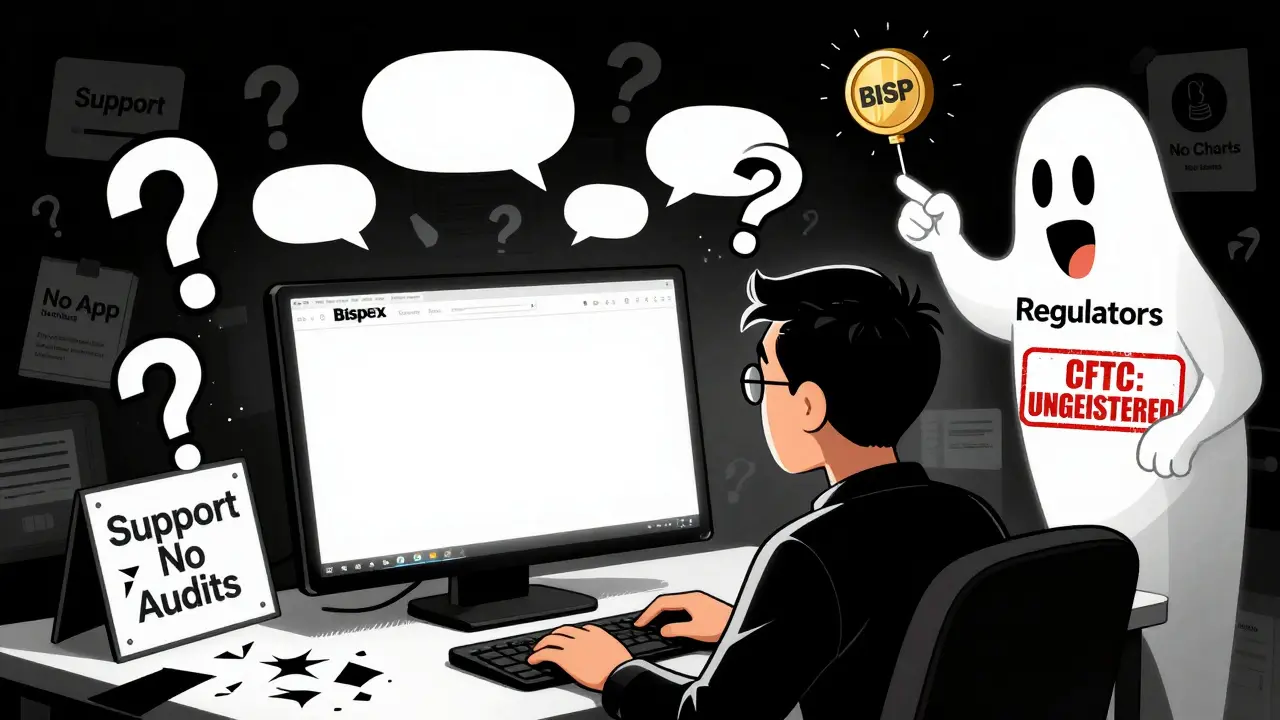
Market Position: A Ghost in a Crowded Room
The entire prediction market sector is worth about $2.3 billion as of late 2023. Polymarket alone holds $1.1 billion of that. Augur has $750 million. Bispex? No one knows. No data from DeFi Llama, CoinGecko, or Messari. Zero trading volume reported. Zero user count estimated. It’s not just small - it’s invisible in the market.
Meanwhile, the sector is growing at 34% per year. But growth is going to the platforms with security, compliance, and community. Bispex has none of those. It’s not just behind - it’s not even on the track.
Is Bispex Worth Trying?
Only if you’re willing to treat it like gambling with no safety net. If you’ve got money you can afford to lose - and you understand that you’re betting on unverified smart contracts with no recourse if things go wrong - then go ahead. But don’t call it investing. Don’t call it trading. Call it speculation with high risk and zero support.
For most people, the better choice is to stick with established platforms like Polymarket, Augur, or even centralized exchanges that offer crypto derivatives (like BitMEX or Bybit). They have audits, user bases, support teams, and legal frameworks. You’re still risking money, but at least you know what you’re getting into.
Bispex feels like a prototype that never got finished. It’s not dead - but it’s not alive either. It’s floating in the void between ambition and execution. And in crypto, that’s where most projects vanish.
What to Do Instead
If you want to try crypto prediction markets:
- **Use Polymarket** - It’s the most popular, has clear rules, and has undergone third-party audits.
- **Learn the mechanics** - Understand how liquidity pools and market prices work before betting real money.
- **Start small** - Never put in more than you can afford to lose.
- **Use a hardware wallet** - Never keep your prediction market tokens on an exchange or web wallet.
- **Check for audits** - Always look for public reports from firms like OpenZeppelin or Trail of Bits.
If you just want to trade crypto, skip prediction markets entirely. Use Coinbase, Kraken, or Binance. They’re regulated, secure, and reliable. Save Bispex for curiosity’s sake - not your portfolio.