Sentiment & Price Action Probability Calculator
Combine market sentiment with price action patterns to identify high-probability trade setups. Based on research showing that combining both approaches reduces failure rates from 63% to 32%.
Trade Setup Configuration
Set the Fear & Greed Index (0-100): 0 = Extreme Fear, 50 = Neutral, 100 = Extreme Greed
Select the candlestick pattern you're observing
Note: This tool is based on research showing that combining sentiment and price action reduces failure rates. Always confirm with volume and institutional data before trading.
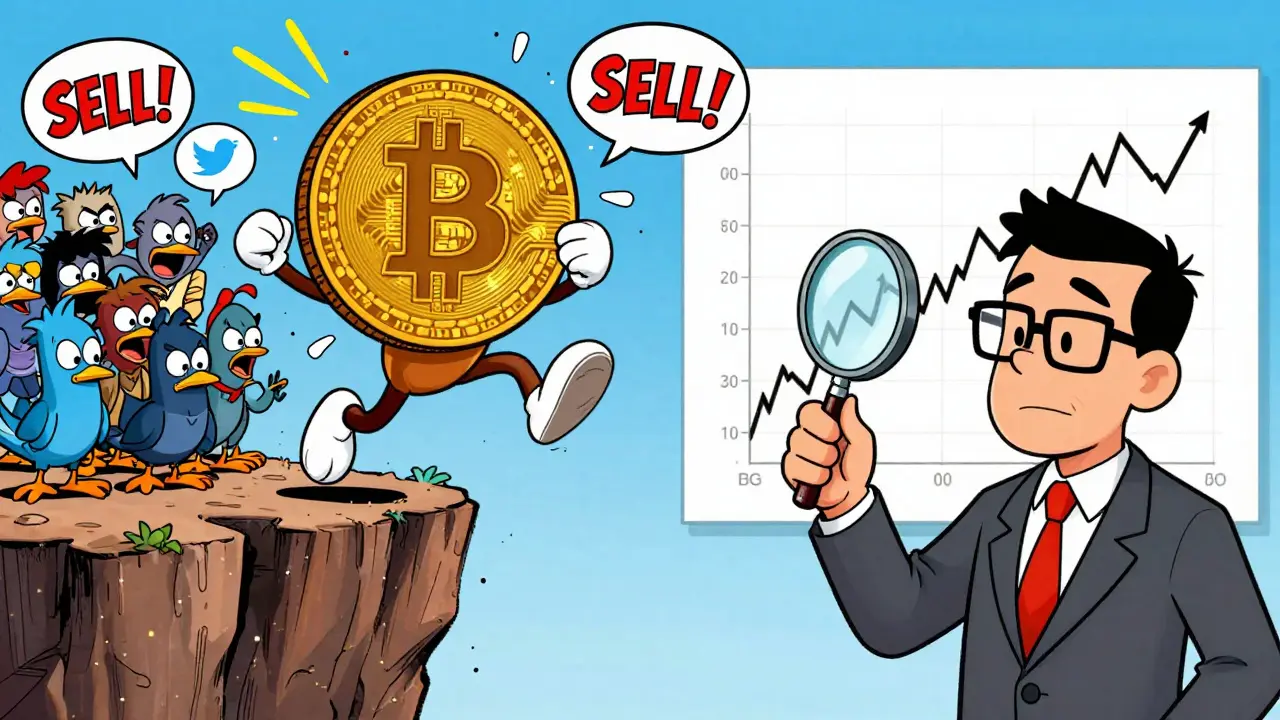
When you look at a Bitcoin chart and see it dropping hard, do you panic because everyone on Twitter is screaming "SELL!", or do you look at the price bars and ask: "Is this really a breakdown, or just a fakeout?" That’s the core difference between market sentiment and price action - one tells you what people are feeling, the other shows you what’s actually happening.
What Is Market Sentiment in Crypto?
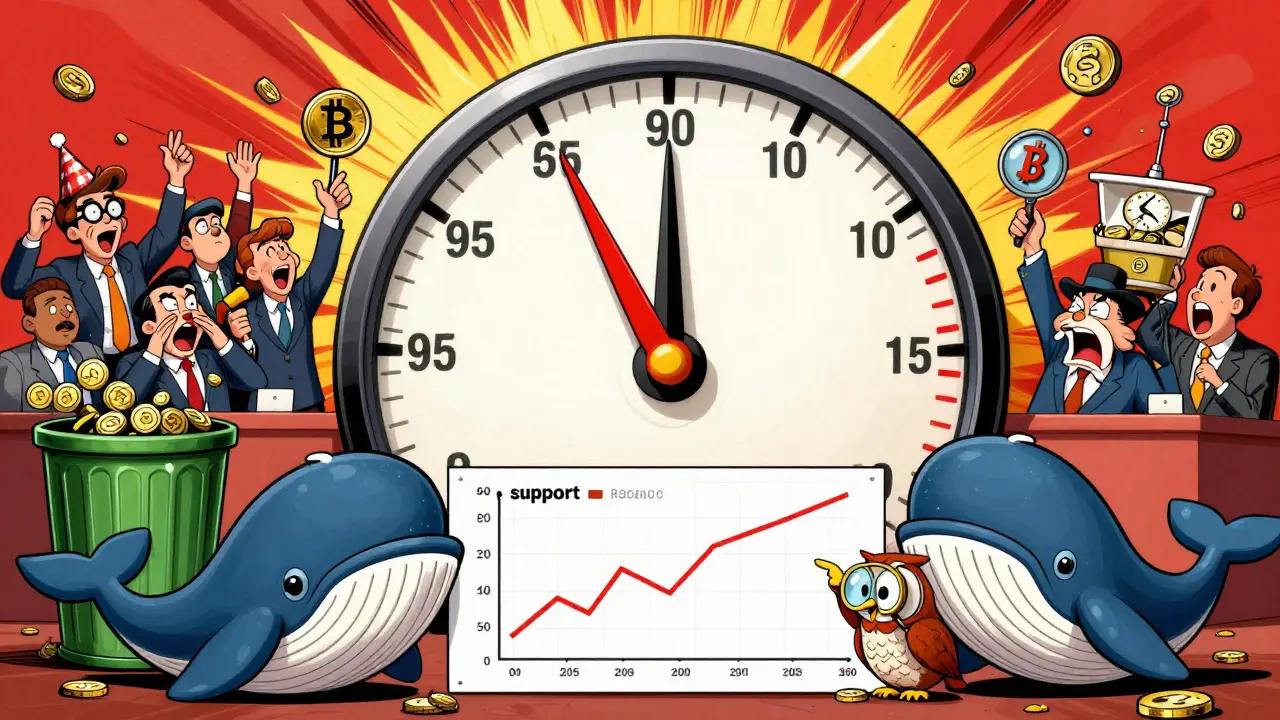
Market sentiment is the collective mood of traders. It’s not guesswork - it’s measured. In crypto, tools like the CBOE Volatility Index (VIX) for equities don’t exist directly, but similar indicators do. The Bitcoin Fear & Greed Index tracks social media buzz, search trends, and trading volume to give you a number from 0 (extreme fear) to 100 (extreme greed). When it hits 90+, you’re in a bubble. When it drops below 20, panic is everywhere - and that’s often when smart money starts buying.
Other sentiment tools include put/call ratios on crypto options (like those on Deribit), and exchange net flow data - if large wallets are dumping Bitcoin onto exchanges, that’s a red flag. The Commitment of Traders (COT) report, originally for futures, now has crypto equivalents showing how hedge funds and institutions are positioned. If institutions are heavily shorting BTC while retail traders are all long, that’s a classic contrarian signal.
Sentiment works best during big events: when the Fed announces interest rates, when Elon Musk tweets about Dogecoin, or when a major exchange gets hacked. During these times, emotion spikes, and sentiment indicators can warn you before the price even moves. But here’s the catch: sentiment can be manipulated. The 2021 GameStop squeeze proved that. In crypto, coordinated pump groups on Telegram can make fear turn to greed overnight - and then crash the market 24 hours later.
What Is Price Action in Crypto Trading?
Price action is the raw movement of price on a chart - no indicators, no noise. Just candles. It’s the language of the market. A pin bar with a long lower wick and small body? That’s rejection of lower prices. An inside bar after a strong move? That’s consolidation before a breakout. A double top at a key resistance level? That’s a classic reversal pattern.
According to backtests from The Trading Analyst (2024), pin bars in Bitcoin’s 4-hour charts have a 73.2% success rate when they form near previous swing highs or lows. Inside bars? 68.5% accurate. These aren’t magic - they’re patterns that repeat because human psychology doesn’t change. Traders see the same levels, react the same way, and create the same shapes over and over.
Price action doesn’t care about Twitter trends. It doesn’t care if a celebrity endorsed a coin. It only cares about where buyers and sellers stepped in. That’s why it’s so reliable in crypto - markets are open 24/7, with no “closing bell” to reset emotions. A price action trader watches for clear structure: support, resistance, trendlines, and breakouts. They wait for confirmation - a candle closing beyond a level - before entering. No guesswork. No emotion. Just execution.
When Sentiment Beats Price Action
Sentiment shines when the crowd is wrong. Look at Bitcoin in December 2024. The Fear & Greed Index hit 95. Social media was flooded with “to the moon” memes. Retail traders were leveraged to the max. Meanwhile, price action showed a flat range - no breakout, no momentum. The market was overheated. A sentiment-based trader would’ve gone short, betting on a pullback. Two weeks later, BTC dropped 28%.
During major macro events - like a U.S. inflation report or a central bank decision - sentiment indicators are more predictive than candle patterns. Why? Because price hasn’t reacted yet. Sentiment captures the anticipation. A 2024 Journal of Financial Markets study found sentiment analysis outperformed pure price action by 22.5% during Federal Reserve announcements. In crypto, that’s even more true. When the SEC announces a new rule, or when a country bans crypto, the emotional reaction hits before the price fully adjusts.
Also, sentiment helps spot extremes. When the Fear & Greed Index hits 10, and price is still falling - that’s not just a dip. That’s capitulation. That’s where the weak hands are gone, and the smart money is quietly accumulating. That’s the kind of setup that turns into a 50% rally.
When Price Action Beats Sentiment
Sentiment is noisy. Price action is clean. During sideways markets - when BTC trades in a $10,000 range for weeks - sentiment tools go haywire. Twitter is full of conflicting opinions. Reddit threads contradict each other. But price action? It tells you exactly where support and resistance lie. A trader using price action can identify a breakout from a triangle pattern and enter with precision - no need to wait for sentiment to “confirm.”
Pepperstone’s 2024 data shows price action is 27% more reliable in forex and crypto than in stocks. Why? Because crypto has no earnings reports, no dividends, no management teams. The only thing that matters is what people are willing to pay. That’s pure price action. A 2024 backtest of 10,000 BTC/USDT 4-hour candles showed that price action strategies had a 71.2% win rate in trending markets - far higher than sentiment-based ones.
Also, sentiment tools lag. By the time the Fear & Greed Index turns bullish, the rally may already be 15% along. Price action gives you real-time signals. You don’t need to wait for a newsletter or an alert. You see the candle close, you see the pattern form, and you act. No subscription fees. No data delays. Just your chart and your discipline.
The Real Secret: Combining Both
Most profitable traders don’t choose one over the other. They use them together. Reddit user u/QuantTrader89, with over 1,200 upvotes on a 2025 post, said: “Pure sentiment failed 63% of the time. Pure price action failed 57%. Combined? Failure rate dropped to 32%.” That’s not luck. That’s strategy.
Here’s how it works in practice:
- Watch for extreme sentiment - Fear & Greed Index below 20 or above 80.
- Look for a price action reversal pattern at a key support/resistance level - like a bullish pin bar at a 3-month low.
- Confirm with volume - is buying volume increasing as price rises?
- Check institutional positioning - are large wallets accumulating?
That’s a high-probability setup. You’re not just betting on emotion. You’re not just guessing from candle shapes. You’re aligning psychology with structure.
One trader on r/Forex posted about 147 consecutive profitable days using this exact method: wait for extreme bearish sentiment, then look for a bullish engulfing pattern at support. No trades outside that filter. That’s discipline.

What You Need to Get Started
You don’t need expensive tools. Start simple.
For sentiment:
- Use the Bitcoin Fear & Greed Index (free on alternative.me)
- Check Deribit’s put/call ratio (free on their website)
- Follow on-chain data from Glassnode or CryptoQuant - watch exchange reserves and whale activity
For price action:
- Learn 4 patterns: pin bars, inside bars, engulfing candles, and double tops/bottoms
- Draw support and resistance on daily and 4-hour charts
- Ignore indicators like RSI or MACD - they’re distractions
Practice on a demo account for 3 months. Don’t trade real money until you can identify these patterns consistently. Most traders fail because they jump in too soon. Mastery takes time - 9 to 12 months for price action, 6 to 9 months for sentiment. But together? You cut your learning curve in half.
The Bottom Line
Market sentiment tells you why the price might move. Price action tells you when and where it will move. One is emotion. The other is evidence.
Ignore sentiment, and you’ll get caught in rallies that have no fuel. Ignore price action, and you’ll buy at the top because everyone says “it’s going up.”
The best traders don’t pick sides. They use sentiment to time the mood, and price action to time the trade. That’s how you survive in crypto - where volatility is normal, emotions run wild, and the only truth is what’s written in the candles.
Can market sentiment be manipulated in crypto trading?
Yes, especially in crypto. Pump-and-dump groups on Telegram, coordinated social media campaigns, and fake news can artificially inflate sentiment. For example, a group might spread rumors about a coin being listed on Binance, causing Fear & Greed Index to spike - but if no real volume follows, the price collapses. Always confirm sentiment with price action and on-chain data before acting.
Is price action reliable during major news events?
Not always. During major news - like a Fed rate hike or a regulatory crackdown - price action can become chaotic. Patterns break down because everyone reacts at once. That’s why combining price action with sentiment is critical. If sentiment is extremely fearful and price starts forming a bullish reversal pattern, that’s a high-probability signal. But if sentiment is neutral and price breaks support with no volume, it’s likely a false move.
Do I need to pay for sentiment tools to trade crypto?
No. Free tools like the Bitcoin Fear & Greed Index, Deribit put/call ratios, and CryptoQuant’s exchange flows give you 90% of what you need. Paid tools offer more data, but they don’t guarantee profits. Many successful traders use only free resources and focus on mastering price action patterns instead.
How long does it take to master price action trading?
Most traders need 9 to 12 months of consistent chart review to recognize patterns reliably. That means studying at least 100 charts per week, noting what happened after each pattern formed. It’s not about memorizing shapes - it’s about understanding context: volume, trend, and key levels. Speed comes with repetition, not shortcuts.
Why do most retail traders fail using only one approach?
Because markets are complex. Sentiment alone leads to emotional trading - buying when everyone’s greedy, selling when everyone’s scared. Price action alone leads to false signals - trading every pin bar without context. The most successful traders use sentiment to filter their setups. They only take price action trades when sentiment aligns - like buying a bullish pattern during extreme fear. That’s the edge.