
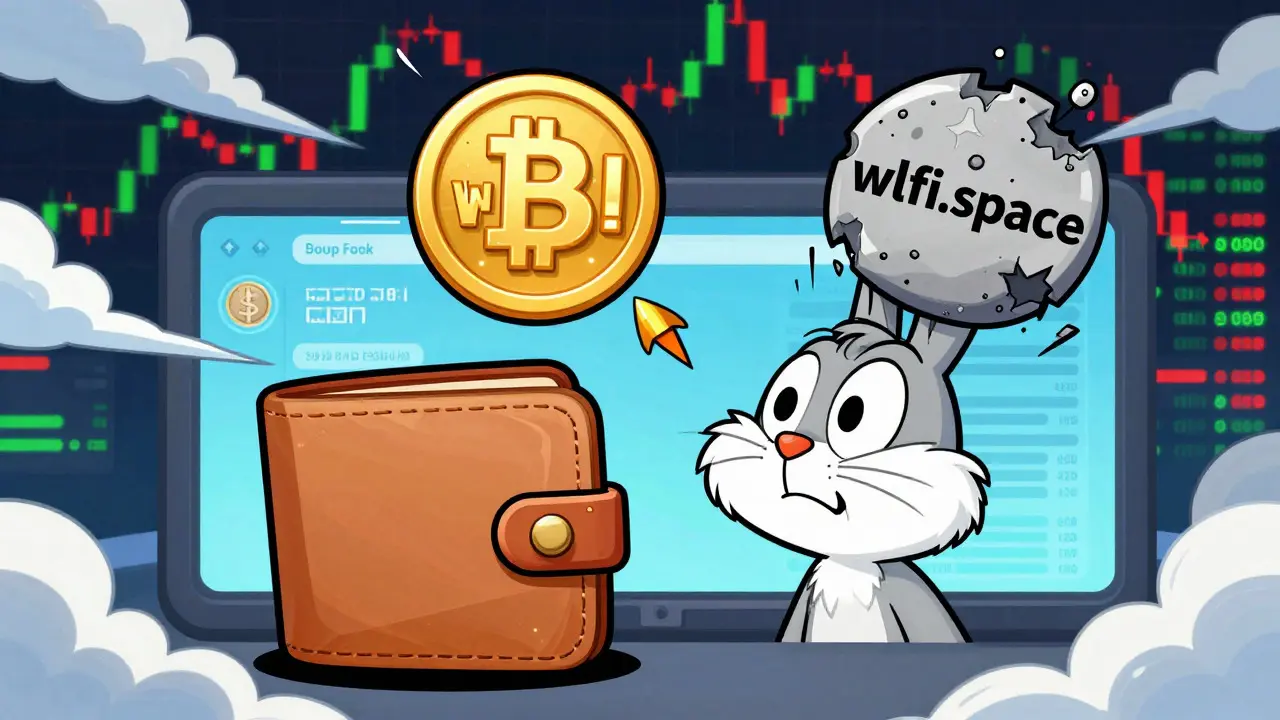
Have you seen the ticker WLFI flashing on your exchange dashboard or heard whispers about a new crypto project tied to the Trump family? If so, you are likely looking at World Liberty Financial. But here is the catch: there is more than one thing claiming that name. There is the main governance token powering a massive decentralized finance ecosystem, and then there is a confusing, near-zero-value listing called "wlfi.space" that seems to exist in a digital void. Understanding the difference between these two is crucial before you click "buy."
World Liberty Financial (WLFI) is not just another meme coin hoping for a viral moment. It is a politically branded decentralized finance (DeFi) platform that launched in October 2024. At its core, it combines a fiat-backed stablecoin called USD1, an on-chain lending market, and a governance system controlled by the WLFI token. However, the shadow of the wlfi.space variant looms large for those who haven't done their homework. This guide breaks down what the real WLFI token does, how the ecosystem works, and why that other "wlfi.space" listing might be a trap.
The Two Faces of WLFI: Real Protocol vs. Placeholder Listing
When you search for World Liberty Financial, you might stumble upon two very different assets. The first is the primary WLFI governance token, which is an ERC-20 asset on the Ethereum blockchain. As of August 2026, this token trades actively on major exchanges like OKX and Robinhood, with a market capitalization hovering around $1.6 billion. It has real utility, real volume, and a clear role in the protocol.
The second entity is the wlfi.space token. This is where things get murky. Data from CoinMarketCap and Binance shows this variant has a listed price of less than $0.000001, zero market capitalization, and zero trading volume. Its circulating supply is effectively zero, despite a declared total supply of 100 petatokens (100 quadrillion units). In practical terms, this appears to be a dormant placeholder or an inactive contract with no connection to the active World Liberty Financial governance or lending markets. If you are holding or buying the "wlfi.space" version, you are likely holding a digital paperweight.
For the rest of this article, we will focus on the main WLFI token, as that is the asset driving the narrative and the economics of the World Liberty Financial ecosystem.
How the World Liberty Financial Ecosystem Works
World Liberty Financial operates as a hybrid model designed to bridge traditional banking infrastructure with blockchain technology. It isn't just a token; it's a stack of three coordinated products:
- The WLFI Governance Token: This is the key to the kingdom. Holders vote on protocol upgrades, asset listings, fee parameters, and treasury allocations. It does not represent equity or dividends, but it controls the direction of the platform.
- The USD1 Stablecoin: This is the engine room. USD1 is a fiat-backed stablecoin pegged to the US dollar. By mid-2026, its supply reached approximately $4.6 billion across Ethereum, BNB Chain, and Tron, making it the fourth-largest fiat-backed stablecoin globally. It is backed by cash and short-duration U.S. Treasury bills, managed by BlackRock, with BitGo serving as the custodian.
- The Lending Market: Built on a fork of the Aave V3 protocol (though some sources reference Dolomite integration), this market allows users to lend and borrow assets using USD1 and other cryptocurrencies. The WLFI token governs the risk parameters of this lending engine.
The goal is to create a self-sustaining loop where the stablecoin provides liquidity, the lending market generates fees, and the governance token directs the strategy. However, unlike traditional governance tokens like AAVE or MKR, WLFI does not grant explicit claims on protocol revenue. Its value is speculative, derived from its influence over the growing USD1 ecosystem and the brand power behind it.
Tokenomics: Supply, Demand, and the Insider Problem
Understanding the tokenomics of WLFI is essential because the distribution of tokens heavily influences its price action and governance power. The total supply is fixed at 100 billion WLFI tokens, with a "zero-inflation" design meaning no new tokens are minted after the initial launch. However, "fixed supply" doesn't mean "all available now."
| Allocation Category | Percentage | Amount (Billions) |
|---|---|---|
| Token Sales (Public/Private) | 33.893% | 33.89 |
| Community Growth & Incentives | 32.6% | 32.6 |
| Co-founder Allocation (Trump Family Entities) | 30% | 30.0 |
| Team & Advisors | 3.507% | 3.5 |
As of early August 2026, only about 32 billion WLFI tokens were in circulation, meaning roughly 68 billion are still locked or subject to vesting schedules extending into 2028. This creates a significant overhang. When these tokens unlock, they can be sold, potentially flooding the market and depressing the price. Critics point out that the high concentration of tokens held by co-founders-entities closely tied to the Trump family, such as DT Marks, AMG, and WC Digital Fi-gives insiders disproportionate control over the protocol's future.
To counter inflationary pressure, the protocol implemented a buyback-and-burn mechanism in September 2025. Fees generated from liquidity positions on Ethereum, BNB Chain, and Solana are used to purchase WLFI on the open market and send it to a burn address. This has slightly reduced the total supply from 100 billion to approximately 99.946 billion, but whether this deflationary force can offset the massive upcoming unlocks remains a hotly debated topic among analysts.

The Political Brand: Asset or Liability?
You cannot talk about WLFI without addressing its political branding. World Liberty Financial emerged publicly in 2024 as a venture associated with Donald Trump’s immediate family. For some investors, this is a massive tailwind. The brand visibility is exceptional, drawing attention from retail investors who might otherwise ignore complex DeFi protocols. The narrative of "political crypto" has proven powerful, similar to how celebrity endorsements drive meme coins.
However, this same branding is viewed as a significant liability by institutional analysts and skeptics. The Motley Fool, for instance, labeled WLFI "uninvestable" compared to established assets like XRP, arguing that it functions more as a speculative instrument than a fundamental investment. They noted that 75% of the fees generated by token sales flow to a company majority-owned by the Trump family, raising questions about alignment with retail holders.
Furthermore, the political connection brings regulatory scrutiny. While the project filed a MiCA-compliant whitepaper through LCX.com in July 2025 to align with European regulations, the U.S. regulatory landscape remains opaque. Investors must weigh the marketing power of the brand against the potential for regulatory crackdowns or reputational damage if the political winds shift.
Controversies and Red Flags
The road since launch has been bumpy. In October 2024, a sophisticated phishing scam targeted WLFI investors, spoofing the project’s official social media accounts to drain wallets during the public sale. This highlighted the risks of high-profile launches attracting bad actors.
More concerning were allegations of centralization. In September 2025, reports surfaced that several investor wallets, including that of prominent crypto figure Justin Sun, had been frozen by the protocol. Polygon developer Bruno Skvorc famously called WLFI "the ultimate scam," alleging centralized blacklist powers that contradicted the ethos of decentralized finance. While the team argued these were security measures, the incident fueled distrust regarding the true decentralization of the platform.
Another controversy involved a "closed-loop" financing structure reported in April 2026. The WLFI team pledged nearly 5 billion WLFI tokens as collateral to borrow $75 million in stablecoins from a platform whose advisor was linked to WLFI. Critics warned this created circular liquidity risks, suggesting the project might be propping up its own stability rather than generating organic demand.

Is WLFI a Good Investment in 2026?
Evaluating WLFI requires separating hype from fundamentals. On the bullish side, the USD1 stablecoin is growing rapidly, securing a top-five position globally. The integration with respected firms like BlackRock and BitGo adds a layer of credibility rare in the crypto space. The buyback-and-burn mechanism provides a theoretical floor for the token price if fee generation continues to grow.
On the bearish side, the valuation metrics are stretched. With a fully diluted valuation (FDV) of over $5 billion, WLFI is priced like a mature blue-chip asset, yet it lacks the transparent revenue-sharing models of competitors. The heavy insider allocation and pending unlocks pose a constant threat of sell-side pressure. Additionally, the lack of direct profit-sharing rights means your return depends entirely on secondary market speculation.
Expert opinions are sharply divided. Mint Ventures estimated a fair value range of $0.0145-$0.0167 per token in mid-2025, well below the public sale prices of up to $0.05. Conversely, Linity rated the project highly due to its brand backing and infrastructure. Most neutral analysts categorize WLFI as a "high-risk, high-volatility" asset suitable only for speculative portfolios with a high tolerance for loss.
How to Buy and Store WLFI Safely
If you decide to take the plunge, follow these steps to ensure you are buying the correct asset:
- Choose a Reputable Exchange: Stick to major centralized exchanges like OKX, Robinhood, or Gate.io that list the primary WLFI/USDT pair. Avoid obscure platforms that might list the worthless "wlfi.space" variant.
- Verify the Contract Address: Before connecting your wallet, double-check the ERC-20 contract address on official channels like CoinGecko or the World Liberty Financial docs. Never trust links from unsolicited DMs.
- Use a Secure Wallet: For long-term storage, transfer your tokens to a non-custodial wallet like MetaMask or Ledger. Ensure your wallet supports Ethereum-based assets.
- Participate in Governance (Optional): If you want to exercise voting rights, visit the official governance portal (vote.worldlibertyfi.com). Note that there is a 5% single-wallet voting cap to prevent dominance by a single entity.
Always remember that in crypto, "not your keys, not your coins," but also "not your research, not your money." The distinction between the active WLFI token and the dormant wlfi.space listing is a prime example of why verification is non-negotiable.
What is the difference between WLFI and wlfi.space?
The main WLFI token is an active ERC-20 governance token on Ethereum with a multi-billion dollar market cap and real utility in the World Liberty Financial ecosystem. The "wlfi.space" variant is a separate, inactive listing with zero circulating supply, zero volume, and negligible value, likely serving as a placeholder or error on certain data aggregators.
Who owns the majority of WLFI tokens?
Approximately 30% of the total supply is allocated to co-founders, primarily entities tied to the Trump family (DT Marks, AMG, WC Digital Fi). Another 32.6% is reserved for community growth and incentives, while 33.89% was designated for token sales. This results in high insider concentration compared to many decentralized projects.
Does WLFI pay dividends or share revenue?
No. WLFI is a pure governance token. It does not distribute dividends or guarantee a claim on protocol revenues. However, the protocol uses a portion of its fees to buy back and burn WLFI tokens, which can indirectly support the price by reducing supply.
What backs the USD1 stablecoin?
USD1 is backed by cash and short-duration U.S. Treasury bills. BlackRock serves as the reserve manager, and BitGo acts as the custodian, providing a layer of traditional financial security to the stablecoin.
Is WLFI regulated in Europe?
World Liberty Financial submitted a MiCA-compliant whitepaper through LCX.com in July 2025 to seek admission to trading in the European Economic Area. However, as of mid-2026, investors should verify current regulatory status as approvals can change.
Why was Justin Sun's WLFI wallet frozen?
In September 2025, reports indicated that Justin Sun's wallet containing 1.3 million WLFI tokens was frozen by the protocol. This sparked controversy over centralized control, as the ability to blacklist addresses contradicts typical DeFi principles of permissionless access.


Categories