
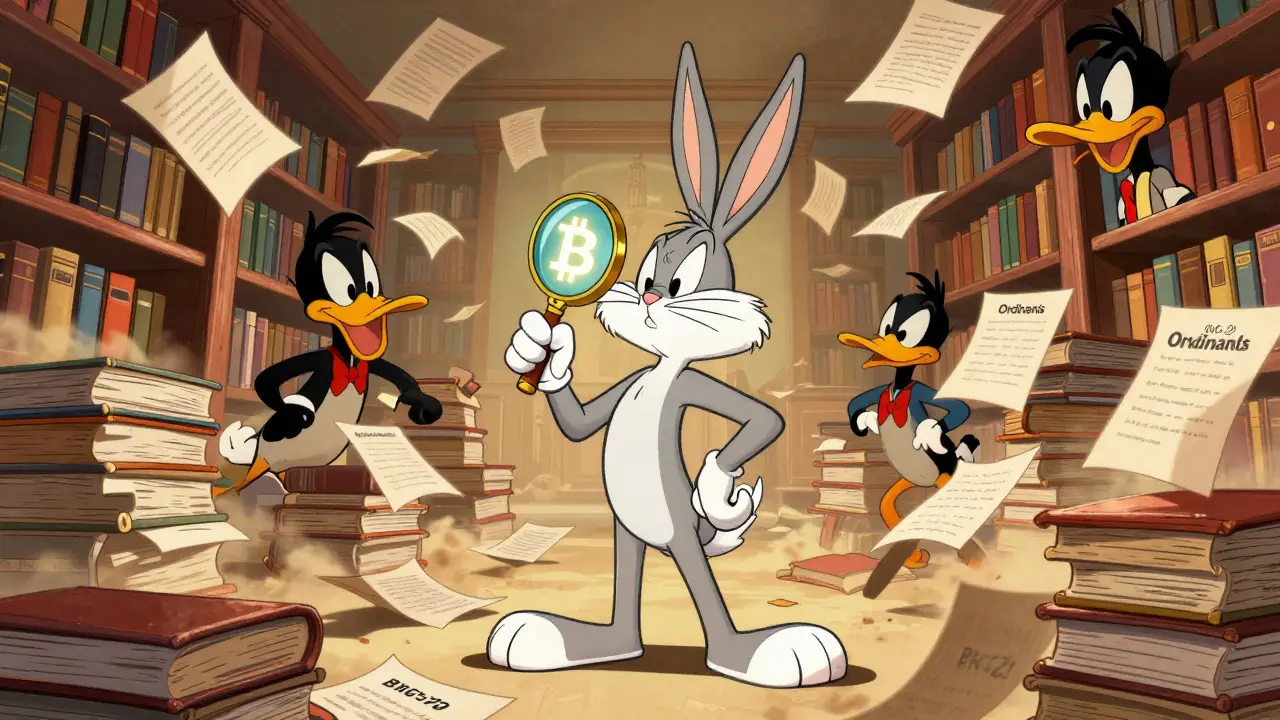
Have you ever tried to find a specific piece of data buried deep within the Bitcoin blockchain? It’s like looking for a needle in a haystack that keeps getting bigger every second. This is where TRAC (Ordinals), also known as Trac Token, comes into play. But before you start buying or selling, it is crucial to understand exactly what this asset is, because there is a major trap waiting for the unwary investor: confusion with another project sharing the same ticker.
TRAC (Ordinals) is not just another speculative coin. It is a BRC-20 token built on the Bitcoin blockchain that serves as the backbone for an infrastructure project designed to track and index metadata from various Ordinals protocols. Think of it as the library catalog for the chaotic world of Bitcoin inscriptions. However, if you search for "TRAC" on many major platforms, you might accidentally land on information about OriginTrail, an entirely different Ethereum-based project. This article cuts through the noise to explain what the Bitcoin-native TRAC actually does, how its tokenomics work, and why its value has fluctuated so wildly between 2025 and 2026.
The Core Function: Indexing the Unindexable
To understand TRAC, you first need to understand the problem it solves. Since the introduction of Bitcoin Ordinals, people have been attaching data-images, text, tokens-to individual satoshis (the smallest unit of Bitcoin). This created new standards like BRC-20 tokens and sats domain names. But Bitcoin itself doesn’t natively support searching or querying this data efficiently. You can’t just ask the Bitcoin network, "Show me all transfers of Token X."
This is where Trac Core enters the picture. Trac is an infrastructure layer that provides a decentralized system for tracking these metaprotocols. Instead of relying on a single centralized company to run the databases that make wallets and explorers work, TRAC aims to democratize this process. It allows developers and users to access Bitcoin-related data via APIs, making the vast amount of inscription-based activity searchable and usable.
In simple terms, while other projects build houses on the Bitcoin land (like NFTs or tokens), TRAC builds the map and the street signs. Without efficient indexing, navigating the Ordinals ecosystem would be nearly impossible for average users. By providing this utility, TRAC positions itself as a governance and utility token rather than a pure payment vehicle.
Tokenomics: Fixed Supply and No Inflation
One of the most critical aspects of any cryptocurrency is its supply dynamics. For TRAC (Ordinals), the numbers are straightforward and rigid. The total supply is hard-capped at 21,000,000 TRAC. As of mid-2026, 100% of this supply is already in circulation. There are no hidden reserves, no team allocations locked up for years, and no inflationary mechanism creating new tokens over time.
This fixed cap was established during the initial deployment. The original BRC-20 inscription was created on May 3, 2023, by a Bitcoin address starting with "bc1p" and ending with "4lx6". At that moment, the parameters were set: a maximum supply of 21 million and a mint limit of 1,000 TRAC per transaction. This per-mint limit was a common strategy in early BRC-20 deployments to prevent a single entity from snapping up the entire supply instantly, promoting a more distributed ownership structure from the start.
| Attribute | Value / Detail |
|---|---|
| Total Supply | 21,000,000 TRAC |
| Circulating Supply | 21,000,000 TRAC (100%) |
| Blockchains Supported | Bitcoin (via Ordinals/BRC-20) |
| Mint Limit (Historical) | 1,000 TRAC per transaction |
| Inflation Rate | 0% (Deflationary/Fixed) |
Because the supply is fully circulating, any increase in demand must come from existing holders selling their coins. There is no future dilution risk from new emissions, which is a significant differentiator compared to many governance tokens on other networks that slowly inflate over decades.

A Critical Warning: Don't Confuse It With OriginTrail
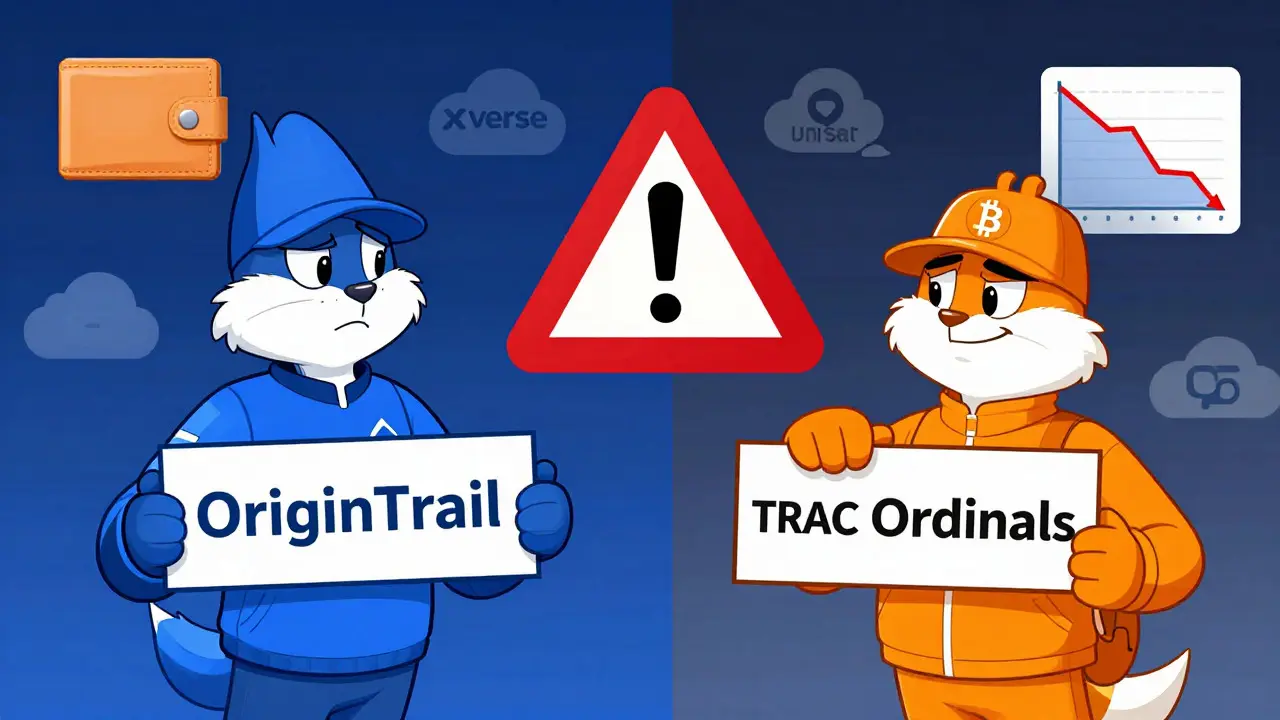
If you are researching TRAC, you will likely encounter a major headache: data aggregation errors. Many large platforms, including some localized pages on CoinMarketCap, mistakenly describe TRAC (Ordinals) as an Ethereum token powering the OriginTrail Network and its Decentralized Knowledge Graph (DKG). This is incorrect.
OriginTrail’s TRAC is an ERC-20 token on Ethereum. TRAC (Ordinals) is a BRC-20 token on Bitcoin. They share a ticker symbol but have zero technical relationship. When reading market data, always check the underlying blockchain. If the description mentions Ethereum, smart contracts, or DKG, you are looking at the wrong asset. For Bitcoin investors, the key identifiers are the BRC-20 standard, the Bitcoin inscription date of May 2023, and the association with Ordinals indexing.
Market Performance and Volatility (2025-2026)
The price history of TRAC (Ordinals) tells a story of high speculation followed by a sharp correction. Like many niche infrastructure tokens in the crypto space, its value is heavily tied to the broader sentiment around Bitcoin Ordinals and BRC-20 tokens.
In mid-2025, TRAC experienced a period of heightened interest. Data from June and July 2025 shows prices hovering between $0.28 and $0.36. At a price of $0.36, the market capitalization was approximately $7.56 million. During this peak, trading volumes on exchanges like Gate.io saw spikes, with daily volumes reaching nearly $130,000 for the TRAC/USDT pair. This suggested active speculative trading and growing awareness of the project’s utility.
However, by August 2026, the landscape had shifted dramatically. Prices dropped significantly, with reports showing TRAC trading around $0.018. This represents a drawdown of more than 90% from its mid-2025 highs. At this lower price point, the market cap shrank to roughly $377,000. Trading volume also thinned out considerably, with some days seeing less than $5 in total volume on certain aggregators.
This volatility is typical for small-cap assets in the crypto ecosystem. While the fundamental technology of Trac Core may remain unchanged, the financial valuation is driven by market cycles, liquidity availability, and investor confidence in the long-term viability of Bitcoin Ordinals as a whole.
Where to Trade and How to Store
For those interested in acquiring TRAC (Ordinals), the primary venues are centralized exchanges. As of 2026, the most notable platforms listing the token include MEXC, Gate.io, and Coinbase. These exchanges offer trading pairs such as TRAC/USDT, allowing users to buy the token using stablecoins.
It is important to note that liquidity varies. While Gate.io and MEXC have historically provided deeper order books, the overall market depth remains modest compared to major cryptocurrencies like Bitcoin or Ethereum. This means large trades can impact the price significantly due to slippage.
If you plan to hold TRAC long-term, you cannot store it in a standard Ethereum wallet like MetaMask. Since it is a Bitcoin-based asset, you need a wallet that supports Ordinals and BRC-20 tokens. Popular options include Xverse, Unisat, or Leather. These wallets allow you to view your TRAC balance, manage your inscriptions, and interact with the broader Ordinals ecosystem securely.
Future Outlook and Utility
The long-term success of TRAC (Ordinals) depends less on hype and more on adoption. If the Bitcoin ecosystem continues to grow its use of inscriptions for domains, tokens, and data storage, the need for reliable, decentralized indexing will increase. Centralized indexers pose a single point of failure; if they go down or censor data, the ecosystem suffers. TRAC’s goal is to create a resilient, community-governed alternative.
Governance plays a key role here. Holders of TRAC are intended to have a say in protocol decisions, such as which new metaprotocols get indexed or how the tracking network is secured. This creates a feedback loop where the utility of the indexer drives demand for the token, and the token holders help shape the future of the indexer.
However, challenges remain. The low trading volume in late 2026 indicates that retail interest has cooled. For TRAC to regain value, it needs to demonstrate tangible integration with major wallets and explorers, proving that its API is essential for the daily user experience. Until then, it remains a high-risk, high-reward bet on the infrastructure layer of Bitcoin's evolving digital economy.
Is TRAC (Ordinals) the same as OriginTrail?
No, they are completely different projects. TRAC (Ordinals) is a BRC-20 token on the Bitcoin blockchain focused on indexing Ordinals data. OriginTrail TRAC is an ERC-20 token on the Ethereum blockchain used for a decentralized knowledge graph. Always check the blockchain type to avoid confusion.
What is the maximum supply of TRAC (Ordinals)?
The maximum supply is fixed at 21,000,000 TRAC. As of 2026, 100% of this supply is already in circulation, meaning there are no new tokens being minted.
Which wallets support TRAC (Ordinals)?
Since TRAC is a Bitcoin Ordinals token, you need a wallet that supports Ordinals and BRC-20 standards. Popular choices include Xverse, Unisat, and Leather. Standard Ethereum wallets like MetaMask do not support it.
Where can I buy TRAC (Ordinals)?
TRAC (Ordinals) is primarily traded on centralized exchanges such as MEXC, Gate.io, and Coinbase. Look for the TRAC/USDT trading pair. Be cautious of low liquidity on smaller exchanges.
Why did the price of TRAC drop so much in 2026?
Like many niche crypto assets, TRAC is highly sensitive to market sentiment. After a speculative peak in mid-2025, interest waned, leading to reduced trading volume and a significant price correction. Its value is closely tied to the broader adoption of Bitcoin Ordinals infrastructure.
What is Trac Core?
Trac Core is the software component of the TRAC project that acts as the indexing engine. It reads data from Bitcoin full nodes, aggregates information from BRC-20 tokens and other protocols, and makes it accessible via APIs for wallets and explorers.

Categories