When the market crashes, it feels like everything is falling apart. When it surges, it seems like money grows on trees. But the truth is, volatility doesn’t care if you’re bullish or bearish-it just follows patterns. And those patterns are more predictable than you think.
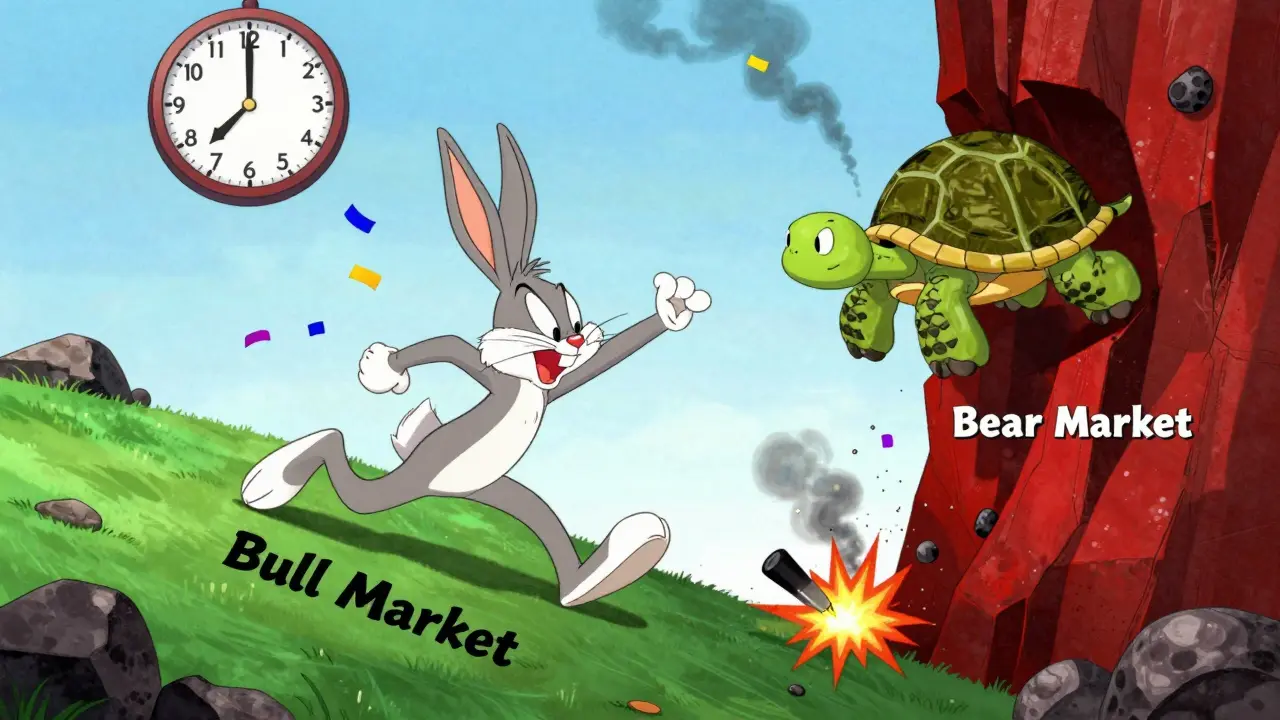
Let’s cut through the noise. A bull market isn’t just when prices go up. It’s when they rise at least 20% from a recent low and stay up for months. A bear market? That’s when prices drop 20% or more from a recent high and stay low. These aren’t just labels. They’re measurable phases with distinct behaviors in how prices move, how fast they move, and how often they flip direction.
How Long Do These Phases Last?
Bull markets don’t rush. They drag on. Since 1928, the average bull market lasted nearly 2.7 years-988 days. That’s long enough to buy a house, change jobs, or have a kid. Bear markets? They’re short, sharp, and brutal. On average, they last just under 10 months-289 days. Think of it like a storm: the lightning flashes fast, but the sunshine lasts for years.
Here’s the twist: you’re more likely to see a bear market than you think. Since 1928, there have been 27 bear markets and 28 bull markets. That means you’ve probably lived through more downturns than upswings. But since 1945, the frequency has dropped. Bear markets now happen every 5.1 years on average, compared to every 1.5 years before WWII. That’s not because markets got safer-it’s because central banks, regulations, and global liquidity have changed how crashes unfold.
Volatility Isn’t Just Down-It’s Wild
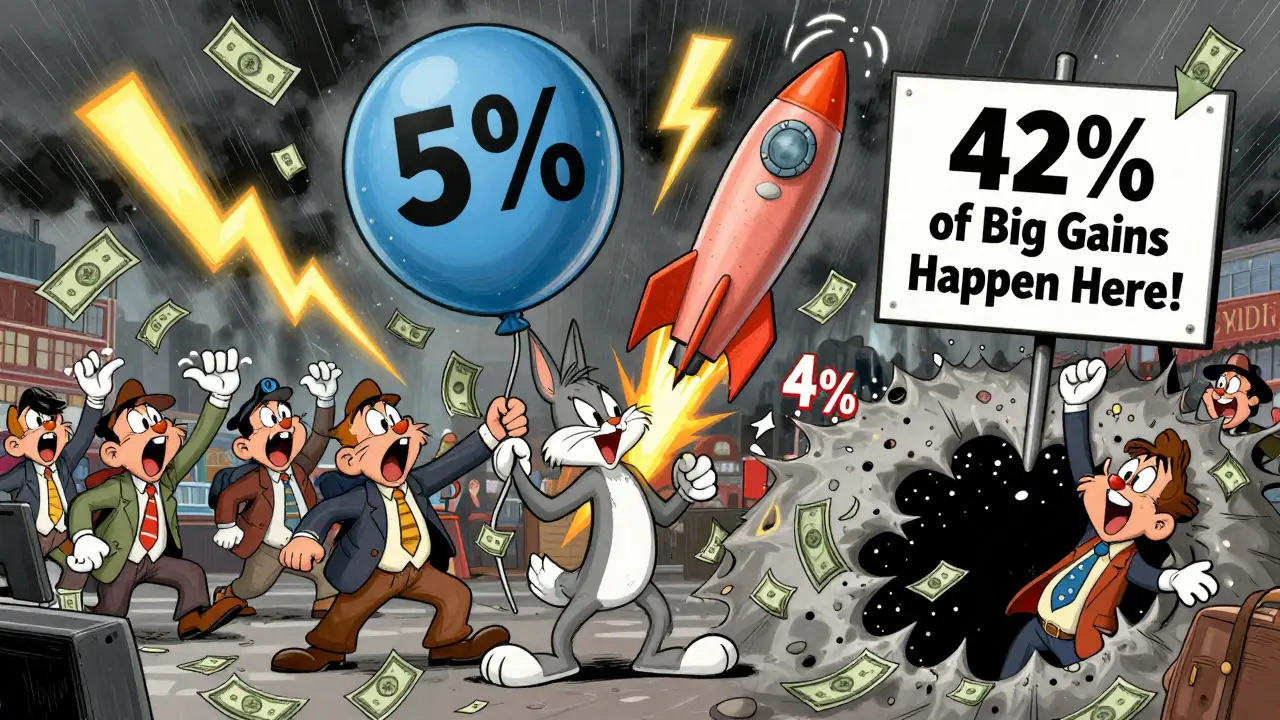
Most people assume bear markets mean constant losses. They don’t. In fact, 42% of the S&P 500’s biggest single-day gains in the last 20 years happened during bear markets. Yes, you read that right. The worst markets are also the most volatile-up and down.
Take 2022. The S&P 500 dropped 18% for the year. But half of the 46 most volatile trading days that year were up days. That’s not a glitch. That’s how volatility works. It clusters. When fear hits, traders swing wildly-buying, selling, panic-selling, then buying again. One day, the market jumps 5%. The next, it crashes 4%. It’s not random chaos. It’s a pattern.
Bull markets, by contrast, are quieter. Daily swings are smaller. The average daily move in a bull market is less than 1%. In calm years like 2017, the S&P 500 didn’t have a single day with a 2% swing. But when volatility spikes-like in 2008, when 72 out of 253 trading days saw moves of ±2% or more-you know something’s broken. That’s not noise. That’s the market screaming for clarity.
What Triggers the Crash?
Bear markets don’t happen because of one thing. They’re the result of a perfect storm:
- Economic recessions that crush corporate profits
- Inflation that eats into margins and scares investors
- Rising interest rates that make loans expensive and hurt growth
- Geopolitical shocks-wars, pandemics, sanctions
- Markets that got too expensive, like a balloon about to pop
These factors rarely act alone. In 2022, inflation hit 9%, the Fed raised rates aggressively, Russia invaded Ukraine, and tech stocks-overvalued since 2020-collapsed. All at once. That’s when volatility exploded.
And here’s something most people miss: you don’t need a full bear market to feel one. In late 2018, the S&P 500 dropped 19.9%. Just 0.1% away from bear territory. The market panicked. People sold. But it didn’t cross the line. That’s how close these thresholds are-and how sensitive markets are to small shifts.
Volatility Spreads-It’s Contagious
Stocks don’t scream in isolation. When equities go wild, bonds follow. In early 2024, a single tariff announcement caused the S&P 500 to swing 9.5% in one day. The next day, it fell 3.5%. Meanwhile, the 10-year U.S. Treasury yield jumped from 4.01% to 4.34% in under a week. That’s a 33-basis-point move in days-normally a 3-month shift. This isn’t just about stocks. It’s about how fear moves through the entire financial system.
When investors panic, they sell everything-even things they don’t want to sell. Bonds, commodities, crypto-all get dragged down. That’s why volatility in crypto often mirrors the S&P 500. When fear hits Wall Street, it hits Bitcoin, Ethereum, and Solana too. The markets are wired together now. What happens in New York echoes in Wellington, Singapore, and Nairobi.
What Does This Mean for You?
Here’s the practical takeaway: volatility isn’t your enemy. Misunderstanding it is.
If you’re in a bull market, don’t get lazy. Small corrections happen all the time. A 10% drop isn’t a crash-it’s a breathing room. Don’t sell because you’re scared. History shows most bull markets survive these.
If you’re in a bear market, don’t assume it’s the end. The worst days are often followed by the biggest rebounds. In fact, the top 10 best single-day returns in the S&P 500 since 2000 all happened within 30 days of the market hitting its lowest point in a bear cycle. Timing the bottom is impossible. But staying invested through the storm? That’s how you win.
And if you’re watching crypto? The same rules apply. Bitcoin dropped 75% from its 2021 high. Then it bounced 120% in 11 months. That’s not luck. That’s volatility doing its job-resetting prices, shaking out weak hands, and preparing for the next leg up.

What to Do When Volatility Hits
You can’t stop volatility. But you can prepare for it:
- Don’t measure your portfolio daily. Monthly checks are enough. Daily panic leads to bad decisions.
- Keep cash ready. Not to time the market, but to buy when others are scared.
- Rebalance once a year. Sell what’s gone up, buy what’s fallen. It’s automatic discipline.
- Ignore headlines. “Market in chaos!” is just noise. Look at the 12-month chart. That’s the real story.
- Understand your risk tolerance. If a 15% drop keeps you up at night, you’re too exposed. Adjust before the crash hits.
Volatility isn’t a bug. It’s a feature. It’s how markets correct, reset, and grow. The people who panic and sell are the ones who lose. The ones who stay calm, stay invested, and understand the rhythm? They win.
Why This Matters for Blockchain Investors
Crypto doesn’t follow Wall Street’s rules-but it follows volatility’s rules. Bitcoin’s 2022 crash? 70% down. 2023 recovery? 150% up. Ethereum’s 2021-2022 cycle? Same pattern. The 20% rule isn’t just for stocks. It applies to crypto too. When Bitcoin drops 20% from its peak? That’s a bear market. When it climbs 20% from its low? Bull market.
The difference? Crypto moves faster. A 20% swing can happen in a week, not a year. That means volatility hits harder and faster. But the pattern? Identical. The same 42% of big gains during bear markets? That’s true for Bitcoin too. The most explosive rallies happen when fear is highest.
If you’re investing in blockchain assets, treat volatility like weather. You can’t stop storms. But you can build a house that survives them.