
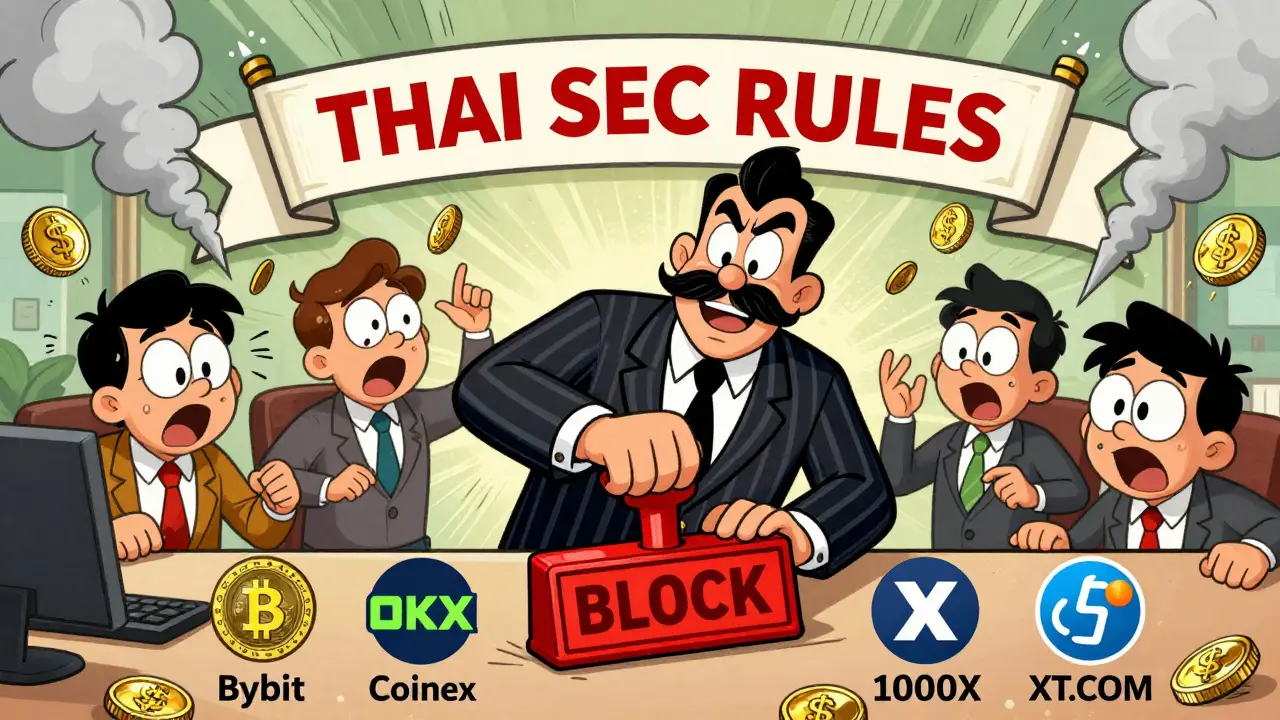
On June 28, 2025, Thailand cut off access to five major foreign cryptocurrency platforms overnight. Bybit, OKX, CoinEx, 1000X, and XT.COM suddenly stopped working for users in Thailand. No warning calls. No gradual phase-out. Just a hard block. This wasn’t a technical glitch-it was a government order.
Why Thailand Took This Step
Thailand didn’t wake up one day and decide to ban foreign crypto platforms out of nowhere. The move came after months of mounting pressure from financial regulators. The Thai Securities and Exchange Commission (SEC) had watched as unlicensed platforms flooded the Thai market, offering high returns with little oversight. Scams spiked. People lost life savings. Money laundering through P2P trades became harder to trace.The SEC’s official line was simple: protect Thai citizens. Foreign platforms weren’t following Thai laws. They didn’t verify users. They didn’t report suspicious activity. They didn’t even have offices in the country. Yet, they were taking money from Thai people. That’s not just risky-it’s illegal under the Digital Asset Business Act a 2018 law requiring all crypto businesses operating in Thailand to be licensed by the SEC.
The government didn’t just want to shut them down. It wanted to send a message: if you want to serve Thai users, you play by Thai rules.
How the Ban Worked
The enforcement was brutal in its efficiency. Two Royal Decrees, signed on April 13, 2025, gave authorities the power to act fast:- The Royal Decree on the Operation of Digital Asset Businesses (No. 2) required all foreign crypto platforms to obtain a Thai license if they targeted Thai users
- The Royal Decree on Measures to Prevent and Suppress Technology Crimes (No. 2) gave the Ministry of Digital Economy and Society (MDES) the power to block websites without a court order
By May 29, 2025, the SEC announced the five platforms would be blocked by June 28. That gave users just 30 days to withdraw their funds. Many didn’t make it in time. Some reported locked accounts, delayed withdrawals, or disappearing customer support.
And it wasn’t just the exchanges. Telecom providers had to block access. Banks had to freeze transfers linked to those platforms. Even social media apps were told to stop promoting them. If a bank failed to stop a scam transaction and it led to losses, the bank could be held legally responsible.
Who Got Hit the Hardest
The five blocked platforms weren’t random. They were among the most popular in Thailand:- Bybit - One of the top global crypto exchanges, with millions of Thai users
- OKX - A major player in Asia, known for low fees and high liquidity
- CoinEx - Popular for altcoin trading
- 1000X - A lesser-known but fast-growing P2P platform
- XT.COM - Heavily used for margin trading and derivatives
These platforms didn’t just serve casual traders. They were used by small businesses for cross-border payments, freelancers receiving income, and even some Thai startups raising capital. Overnight, their entire Thai user base was cut off.

The Fallout
The ban didn’t just affect users-it affected the whole ecosystem.Thai businesses that relied on crypto for international payments now had to route transactions through licensed local exchanges. That added delays, fees, and paperwork. One Bangkok-based exporter told reporters they lost three weeks on a $50,000 payment because their Indian supplier couldn’t receive crypto directly anymore.
On the other side, licensed Thai platforms like Bitkub and Zipmex saw a surge in new users. But they weren’t built for volume. Some users reported slow withdrawals and crashing apps during peak times.
And while the government claimed the ban would reduce fraud, reports from Thai police showed crypto-related scams didn’t drop overnight. Criminals just moved to Telegram groups, private wallets, and offshore P2P apps that still slipped through the cracks.
What’s Allowed Now
Thailand didn’t ban crypto. It banned unlicensed foreign crypto.Today, you can still trade Bitcoin, Ethereum, and other digital assets-but only through platforms licensed by the Thai SEC. There are currently 12 licensed exchanges operating in Thailand. Each must:
- Verify every user’s identity (KYC)
- Report all suspicious transactions
- Keep funds in segregated accounts
- Have a physical office in Thailand
Even foreign investors can trade-just not directly. They have to go through a Thai-licensed intermediary. That means no more anonymous P2P trades with someone in Vietnam or Indonesia. All transactions now leave a paper trail.

The Irony: Thailand Still Loves Blockchain
Here’s the twist: while Thailand shut down foreign crypto platforms, it’s quietly building its own digital future.In May 2025, the government announced plans to issue G Tokens digital asset tokens backed by government bonds, worth 5 billion baht ($150 million). These aren’t meant for speculation. They’re for raising public debt efficiently using blockchain technology.
Thai securities firms are testing a blockchain-based trading platform for stocks. The central bank is exploring a digital baht. The country is investing in blockchain infrastructure for land titles and supply chains.
So it’s not anti-crypto. It’s anti-unregulated-crypto. Thailand wants control. It wants transparency. It wants to be the leader-not the playground.
What This Means for You
If you’re a Thai citizen: you can still trade crypto, but your options are limited. You need to use a licensed platform. Withdrawals might take longer. Fees might be higher. But your money is safer.If you’re a foreigner trying to send money to Thailand: forget direct crypto transfers. You’ll need to use a bank or a licensed Thai payment processor. It’s slower. It’s more expensive. But it’s legal.
If you’re running a crypto business: if you want access to Thailand, you need to apply for a license. That means local offices, compliance teams, audits, and ongoing reporting. It’s not impossible-but it’s not cheap.
Will Other Countries Follow?
Thailand’s approach is extreme-even for Asia. Singapore allows foreign platforms with strict rules. Malaysia lets them operate with registration. Indonesia has a licensing system but still allows P2P trading.But Thailand went further: no court approval, no grace period, no exceptions. It was a one-shot, no-nonsense crackdown.
Other Southeast Asian countries are watching. If crime drops and the economy stays stable, expect similar moves in Vietnam, the Philippines, or Cambodia. If users rebel or businesses suffer, others may take a softer path.
For now, Thailand stands alone: the only country in the region that outright banned foreign P2P crypto platforms-and made sure the block was total.