Deflationary cryptocurrencies aren’t just a buzzword-they’re a structural shift in how digital money behaves. Unlike traditional currencies that lose value over time due to inflation, these coins are designed to get rarer. And that rarity isn’t theoretical. It’s coded into the blockchain, enforced by algorithms, and tracked in real time. By 2025, over 47 projects had built deflationary models into their core design, with a combined market cap of $850 billion. That’s nearly 4 out of every 10 dollars in crypto. But what does this actually mean for users, investors, and the network itself?
How Deflationary Cryptocurrencies Actually Work
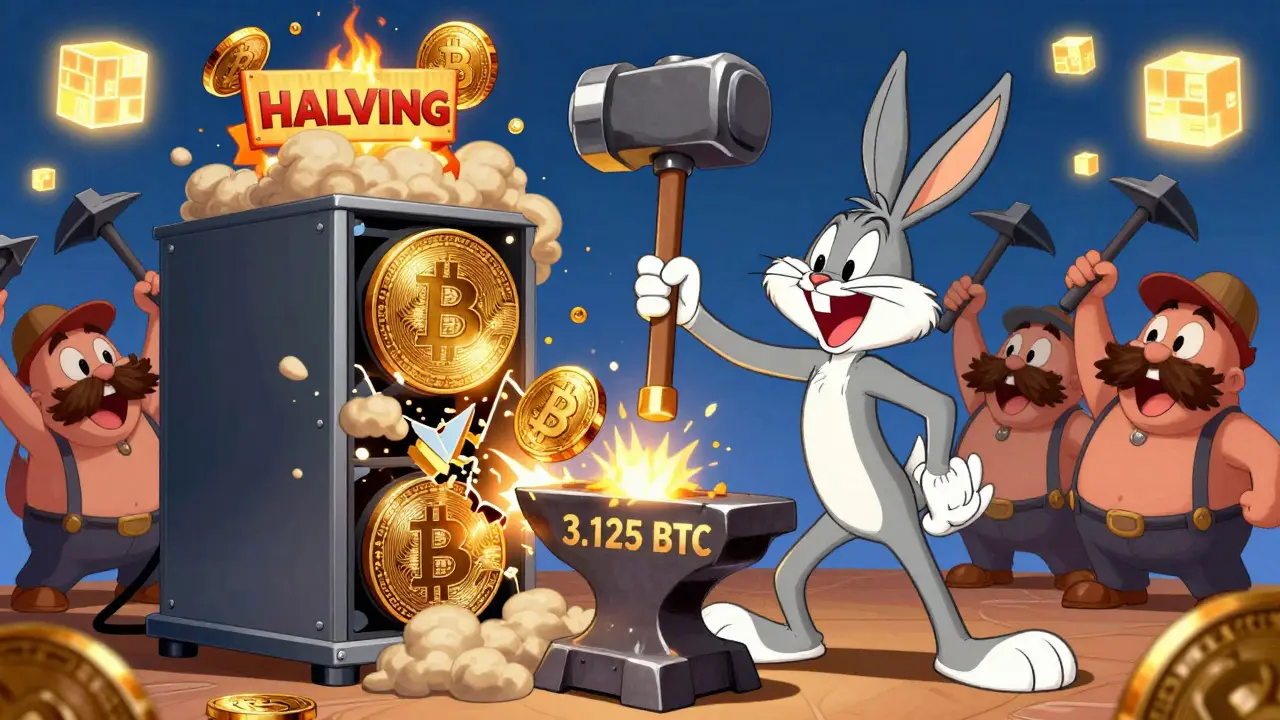
At its simplest, a deflationary cryptocurrency reduces its total supply over time. That’s it. No magic. No hype. Just math. The most famous example is Bitcoin is a decentralized digital currency with a fixed supply cap of 21 million coins, introduced in 2009, and designed to halve its block rewards approximately every four years. Also known as BTC, it was created by Satoshi Nakamoto and remains the largest deflationary asset by market value. Every four years, the reward for mining new Bitcoin drops by half. In April 2024, it fell from 6.25 BTC to 3.125 BTC per block. That means the annual issuance dropped from 328,500 BTC to just 164,250. No more new coins flooding the market. The supply is shrinking.
But Bitcoin isn’t the only player. BNB is the native token of Binance Chain, with a scheduled burn mechanism that permanently removes tokens from circulation based on trading volume and block production metrics. Also known as Binance Coin, it was launched in 2017 and has burned over 1.44 million tokens in its 33rd quarterly burn event, reducing total supply to 137.7 million as of October 2025. Binance doesn’t just announce burns-they automate them. Every second, roughly 0.000127 BNB is burned. That’s over 10 BNB a day. And they’re not done. Their goal? A hard cap of 100 million BNB. That’s a 27% reduction from the original supply.
Ethereum took a different route. It never set a fixed supply limit. Instead, it introduced EIP-1559 is a protocol upgrade to Ethereum that burns a portion of transaction fees, creating a deflationary pressure on ETH supply during periods of high network demand. Also known as Ethereum Fee Burn Mechanism, it was implemented in August 2021 and caused ETH to enter net deflation for 127 days in the first nine months of 2025. When the network is busy, more fees are burned than are minted as block rewards. In 2025 alone, over 1.2 million ETH were burned-worth $3.8 billion. Ethereum isn’t deflationary all the time, but it’s deflationary often enough to matter.
The Real Impact: More Than Just Price
People assume deflationary tokens always go up in price. That’s not always true. The real effect is behavioral. When users know supply is shrinking, they tend to hold. Not because they’re greedy, but because they’re rational. Why sell something that’s getting rarer? This creates a feedback loop: less supply + less selling = higher perceived value.
But here’s the catch: if people stop spending, the network suffers. Crypto isn’t just about holding-it’s about using. BullZilla ($BZIL) is an experimental deflationary cryptocurrency launched in October 2025 with a multi-layered tokenomics model including automatic transaction burns and a staking platform offering 70% APY. Also known as $BZIL, it introduced the "Roar Burn Mechanism" and "HODL Furnace" to incentivize long-term holding saw transaction volume drop 22% during its first bull run. Why? Because users were too busy staking and waiting for the next burn to actually use the token. That’s not a feature-it’s a bug.
Compare that to Bitcoin. Even with high fees ($4.27 on average during peak times), people still use it. Why? Because it’s the most trusted store of value. 97 of the top 100 institutional investors hold BTC. That’s not because of its burn rate-it’s because of its history, simplicity, and unchanging rules. Deflationary mechanics help, but they don’t replace trust.
The New Wave: Beyond Simple Burns
Most early deflationary projects just burned a fixed percentage of every transaction. It was easy to explain, but often meaningless. Crypto Basic is a market analysis platform that reported in October 2025 that 63% of deflationary tokens launched between 2022 and 2024 had annual burn rates below 0.1%, making their scarcity effects negligible. Also known as CryptoBasic, it provides data-driven insights into tokenomics and market trends found that most of these "burns" removed less than 0.0001% of the total supply each quarter. That’s like removing one grain of sand from a beach. It looks good on a press release-but it doesn’t move the needle.
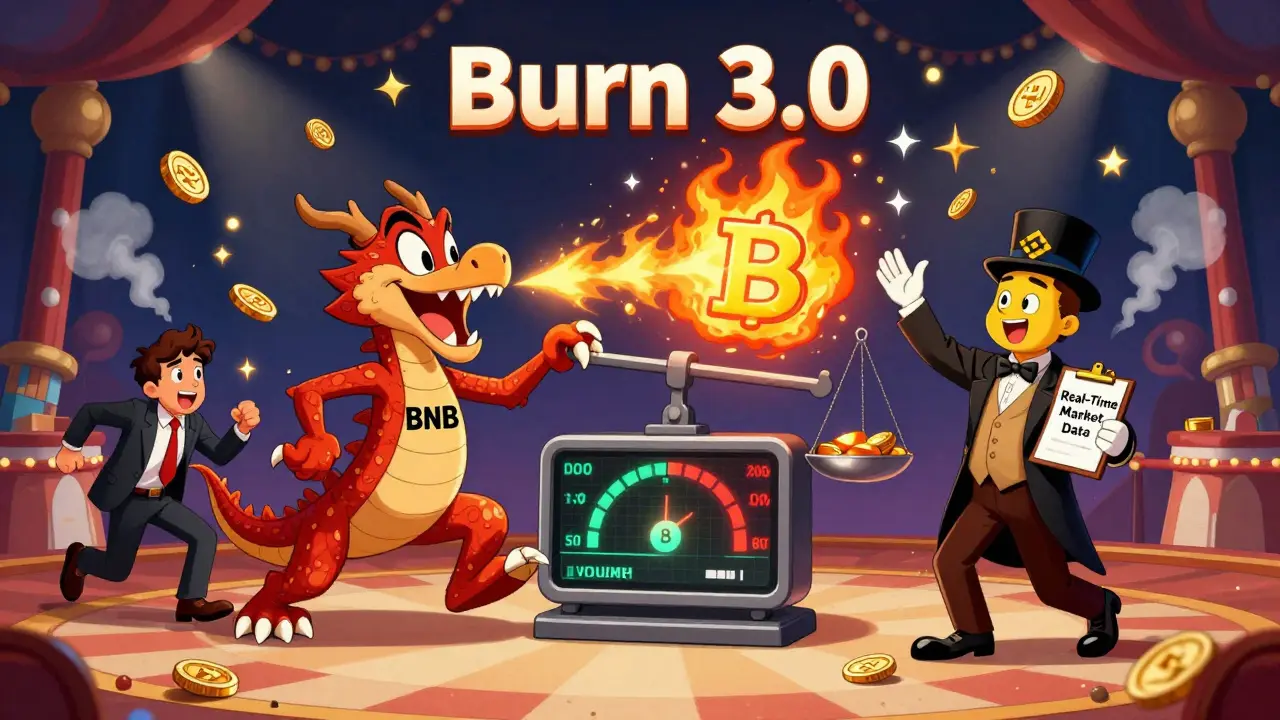
The next generation is smarter. BNB Chain is a blockchain platform developed by Binance that uses a dynamic burn mechanism called "Burn 3.0," which adjusts token destruction based on real-time market depth and trading volume. Also known as BSC, it was upgraded in October 2025 to incorporate live market data into its burn algorithm now uses "Burn 3.0," which doesn’t just burn tokens-it watches the market. If trading volume spikes, the burn rate increases. If the price drops, it slows down. It’s adaptive. It’s real-time. It’s not just about reducing supply-it’s about responding to demand.
Solana is a high-performance blockchain that implemented a 50% transaction fee burn in Q1 2025, causing net deflation during periods of high network usage and improving token scarcity during peak activity. Also known as SOL, it is known for fast transaction speeds and low fees, and its deflationary mechanism was enhanced in early 2025 to burn half of all transaction fees now burns half of every transaction fee. When the network is busy, it burns more. When it’s quiet, it burns less. It’s not a fixed rule-it’s a dynamic system. That’s the future: deflation tied to utility, not just math.
What’s Next? Seven Trends Shaping 2026
Deflationary models aren’t staying the same. They’re evolving. Here’s what’s coming:
- Hybrid models-65% of new projects in 2026 will combine burns with staking rewards or utility features. No more "burn and hope."
- Algorithmic burns-12 projects are now linking burns to real-world data like trading volume, price volatility, or even weather patterns (yes, really).
- Community-controlled burns-37% of DAO-governed tokens let holders vote on burn rates. If you hold the coin, you decide how much gets destroyed.
- Cross-chain burns-Hyperliquid pioneered this in September 2025. Burn tokens on one chain, and it affects supply on another.
- Burn-to-stake-23 projects are testing systems where burned tokens are converted into staking power. Less supply, more security.
- NFT-integrated deflation-17 projects now burn NFTs to reduce token supply. Own a rare NFT? Burn it, and the coin gets scarcer.
- Regulatory compliance-The EU’s MiCA 2.0 now requires full transparency on burn mechanics. No more hidden burns.
The winners won’t be the ones with the biggest burns. They’ll be the ones with the smartest ones.
The Risks: Why Most Deflationary Tokens Fail
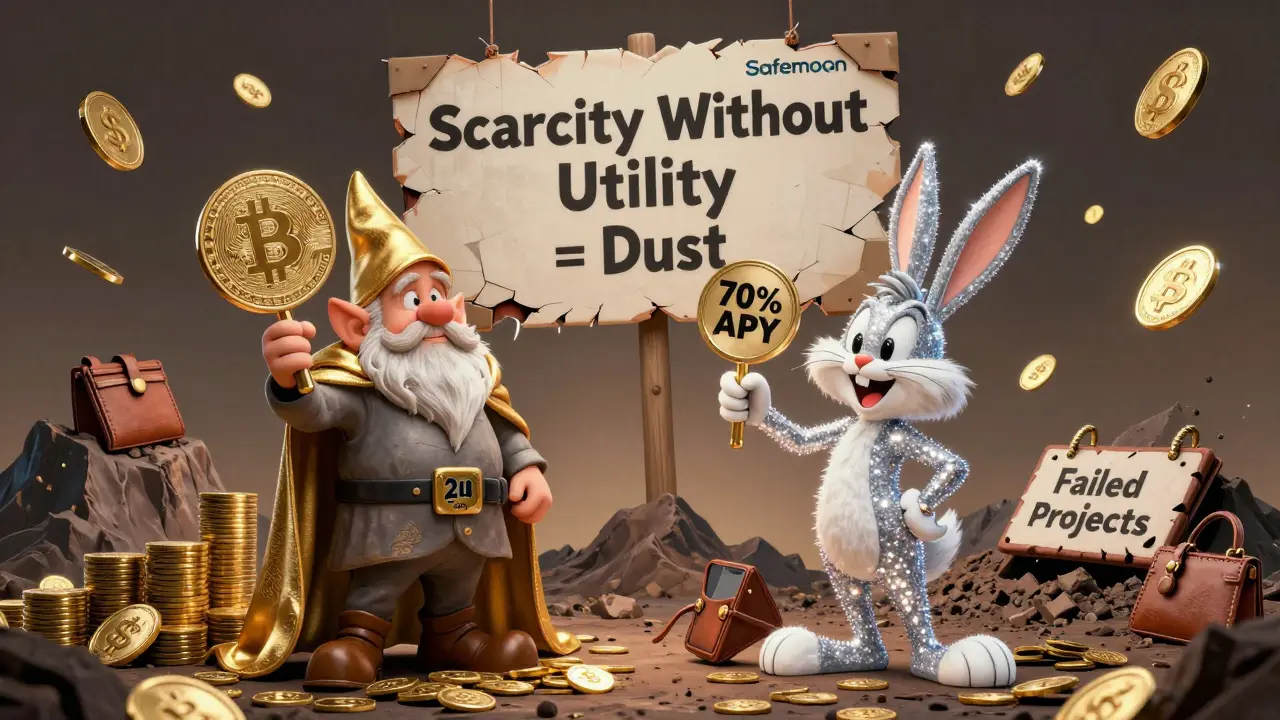
Not every deflationary token survives. In fact, most don’t. Crypto Basic is a market analysis platform that reported in October 2025 that 83 out of 100 pure deflationary tokens with no utility function failed within five years of launch. Also known as CryptoBasic, it provides data-driven insights into tokenomics and market trends found that 83 of 100 projects that only had a burn mechanism-and nothing else-died within five years. Why? Because scarcity without utility is just a shell. People don’t care if a coin gets rarer if they can’t use it for anything.
Take Safemoon is a deflationary cryptocurrency launched in 2021 that used automatic transaction burns and redistribution mechanics, but failed to gain lasting utility and saw its market value collapse by over 90% by 2025. Also known as $SFM, it was one of the most popular deflationary tokens in 2021 but collapsed due to lack of real-world use cases. It had burns. It had rewards. It had memes. But no one could use it to pay for anything. No dApps. No wallets. No adoption. It died.
Bitcoin survives because it’s digital gold. BNB survives because it’s the fuel for one of the world’s biggest exchanges. Solana survives because it’s fast and cheap. Deflationary mechanics help-but they don’t replace function.
Getting Started: What You Need to Know
If you’re thinking about diving in, here’s what you actually need to understand:
- Track the real supply-Most platforms show "total supply" and "circulating supply." The difference? Burned tokens. Make sure you’re looking at the right number.
- Understand the burn mechanism-Is it fixed? Dynamic? Community-controlled? A 0.5% burn per transaction sounds impressive-but if 10 million tokens are traded daily, that’s only 50,000 burned. Is that meaningful?
- Check for utility-Can you use this token to pay for services? To access dApps? To stake for rewards? Or is it just a speculative asset?
- Watch the community-Projects with active Telegram channels, transparent burn trackers, and regular updates are more likely to last.
Setting up a wallet for Bitcoin takes under 10 minutes. For BNB, you need to configure MetaMask with the BSC network. For BullZilla? You’ll need to learn about presales, staking, and burn dashboards. The complexity is rising. Know what you’re signing up for.
The Bottom Line
The future of deflationary cryptocurrencies isn’t about making coins scarce. It’s about making them valuable. Scarcity without utility is just a numbers game. But when scarcity is tied to real use-when burning tokens improves security, reduces inflation, or powers decentralized apps-that’s when it works.
Bitcoin’s model is proven. BNB’s is dynamic. Solana’s is smart. BullZilla’s is experimental. And the ones that fail? They’re the ones that promised scarcity but delivered nothing else.
Deflation isn’t the goal. Value is.
Are deflationary cryptocurrencies better than inflationary ones?
It depends on what you’re looking for. Deflationary tokens like Bitcoin and BNB create scarcity, which can drive long-term value if demand grows. But inflationary tokens, like Ethereum (in non-burn periods) or Solana, allow for more flexibility-new coins can be issued to reward developers or secure the network. Neither is universally "better." Deflationary models work best when paired with strong utility. Inflationary models can be more sustainable for active networks. The key is matching the tokenomics to the use case.
Do all deflationary cryptocurrencies have a fixed supply cap?
No. Bitcoin has a fixed cap of 21 million. BNB aims for 100 million through burns. Ethereum has no cap at all-it just burns fees when the network is busy. Some projects combine both: they start with a supply, then burn down toward a cap. Others have no cap and no burns. The presence of a cap isn’t what makes a token deflationary-it’s whether the total supply is decreasing over time, regardless of the mechanism.
Can a deflationary cryptocurrency become worthless?
Absolutely. Scarcity doesn’t guarantee value. If no one uses the token, no one wants it-even if there are only 10 coins left. Many deflationary tokens failed because they had no utility, no community, and no real-world application. The burn mechanism might look impressive on paper, but if you can’t buy anything with it or build on it, it’s just a digital collectible with no backing.
How do I track how many tokens have been burned?
Most major projects now offer live burn trackers on their websites. For Bitcoin, you can check the total supply on blockchain explorers like Blockchain.com-it’s fixed at 21 million minus what’s been lost. For BNB, Binance publishes quarterly burn reports with exact numbers. Ethereum’s burn data is visible on Etherscan. For newer tokens like BullZilla, check their official dashboard. Always compare circulating supply with total supply-the difference is the burned amount.
Is Bitcoin’s halving the same as a token burn?
No. A halving reduces the number of new coins created each year. A burn removes existing coins from circulation. Bitcoin’s halving slows inflation-it doesn’t reduce supply. But over time, as coins are lost forever (through forgotten private keys), Bitcoin becomes effectively deflationary. So while halving isn’t a burn, the combination of halving and lost coins creates a similar outcome: less supply over time.
Why do some projects fake burns?
Some projects burn tiny amounts-like 0.0001% of supply-to create the illusion of scarcity. This is called "burn theater." It’s a marketing tactic. The burn happens, the price spikes briefly, then crashes when people realize nothing meaningful changed. Real deflation requires consistent, measurable reduction. Look for projects that publish verifiable data, use public blockchain addresses for burns, and have third-party audits. If the burn data looks suspicious, it probably is.
Will deflationary models dominate the future of crypto?
They’ll be common, but not universal. Deflationary mechanics are becoming standard for store-of-value assets and ecosystem tokens. But for networks that need to incentivize participation-like validators, developers, or liquidity providers-inflationary models still make sense. The future isn’t deflationary vs. inflationary. It’s hybrid: the right mix of scarcity and supply for each use case. The best projects will use both, depending on what the network needs.