

Imagine you just bought a coffee for $5. Simple, right? Now imagine that buying that coffee involved paying a network fee, calculating your tax liability on the exact moment of purchase, and tracking which specific dollar from your previous purchases was 'used up' in the transaction. That is the reality of Crypto Transaction Costs is a dual-component financial calculation involving network fees paid to validators and cost basis calculations required for tax reporting.. It’s not just one number; it’s two distinct math problems happening simultaneously.
Most people get tripped up because they confuse the *fee* (what the network charges) with the *cost* (what it actually costs you financially, including taxes). If you want to know exactly how much money leaves your pocket when you move assets, you need to master both sides of this equation. Let’s break down the mechanics so you can stop guessing and start calculating with precision.
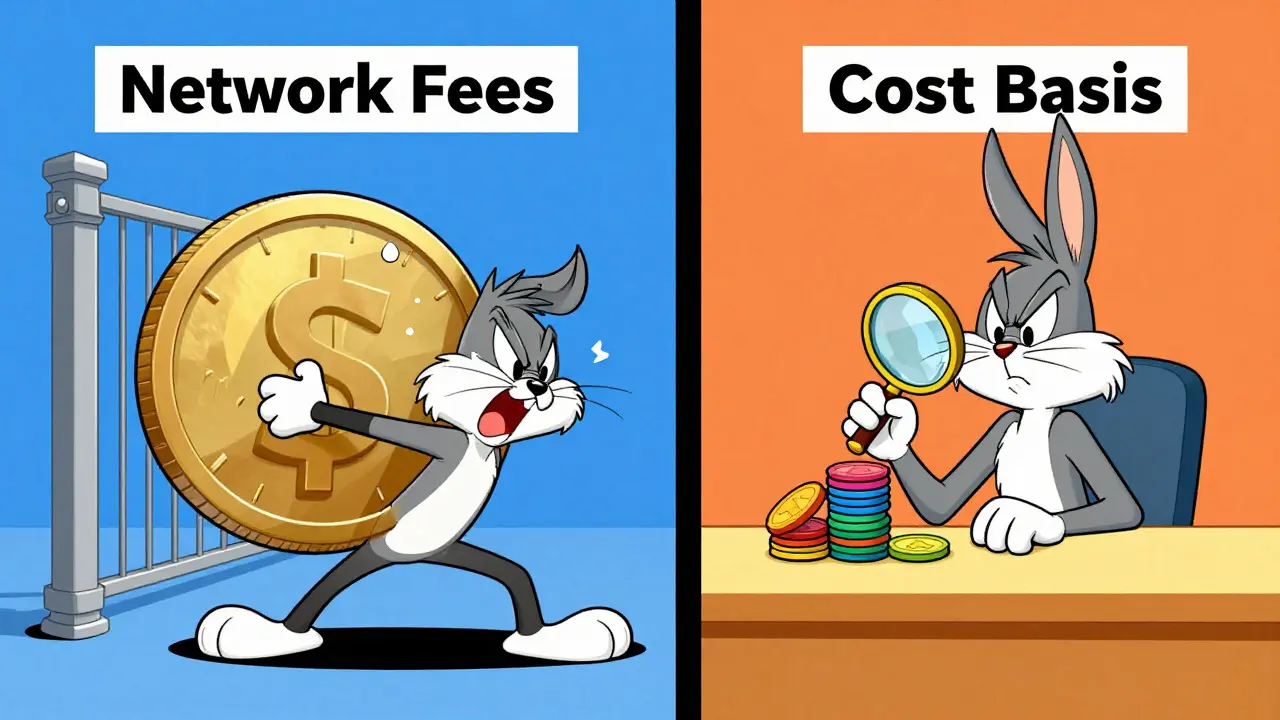
The Two Sides of the Coin: Network Fees vs. Cost Basis
Before we crunch numbers, we have to separate the concepts. When you see "transaction cost" in a crypto context, it usually refers to one of two things:
- Network Fees (Gas/Satoshi): The operational cost to move data on a blockchain. This pays miners or validators. It varies by network congestion and transaction size.
- Cost Basis (Tax/Accounting): The original value of an asset used to determine profit or loss for tax purposes. This is static per token unit but changes as you buy more at different prices.
You pay the network fee every time you send coins. You calculate the cost basis every time you sell or trade them. Ignoring either one leads to surprise bills from the IRS or overpaying for simple transfers.
Calculating Network Fees: The Mechanics
Network fees are where the confusion starts because there is no universal formula. Each major blockchain uses a different logic model. Here is how the big players work.
Bitcoin: Size Matters
Bitcoin is the first decentralized cryptocurrency using a satoshi-per-byte fee model based on transaction size. In Bitcoin, your fee depends on how much data your transaction contains, measured in bytes. A standard single-input, single-output transaction is roughly 140-180 bytes. However, if you use a multi-signature wallet or consolidate many small inputs, that size jumps to 250+ bytes.
The formula is straightforward:
- Determine your transaction size in bytes (e.g., 250 bytes).
- Check the current market rate in Satoshis per Byte (sat/B). Let's say it's 10 sat/B during normal times.
- Multiply: 250 bytes × 10 sat/B = 2,500 satoshis.
- Convert to BTC: Since 1 BTC = 100,000,000 satoshis, 2,500 sats = 0.000025 BTC.
If Bitcoin prices are high, that 0.000025 BTC might be worth $2.50. If prices crash, it might be $0.50. The fee is dynamic relative to price, even though the satoshi amount is fixed by the network state.
Ethereum and Polygon: The Gas Model
Ethereum is a smart contract platform using a gas-based fee system where costs depend on computational complexity. Ethereum doesn't care about byte size; it cares about computation. Every action (transfer, swap, mint) consumes "gas units."
The total fee formula for EVM-compatible chains like Ethereum and Polygon is a Proof-of-Stake layer-2 solution known for low-cost transactions using gwei pricing. is:
Total Fee = Gas Limit × (Base Fee + Priority Fee)
Let's look at a real-world example on Polygon. Sending a simple MATIC transfer requires 21,000 gas units. Suppose the Base Fee is 100 gwei and you add a 10 gwei tip to ensure fast processing.
- Gas Units: 21,000
- Total Gwei: 100 + 10 = 110 gwei
- Calculation: 21,000 × 110 = 2,310,000 gwei
- Conversion: 1 MATIC = 1,000,000,000 gwei. So, 2,310,000 / 1,000,000,000 = 0.00231 MATIC.
If MATIC is trading at $0.50, your fee is just $0.00115. Compare that to Ethereum mainnet, where the same transfer could cost $5-$50 depending on congestion. This is why understanding the specific chain's mechanics is critical for accurate cost estimation.
Mastering Cost Basis for Taxes
Now that we’ve handled the network fee, let’s talk about the bigger financial impact: your cost basis. This is what determines your capital gains or losses.
The basic definition is simple: Cost Basis = Total Purchase Price / Number of Tokens Acquired.
If you bought 10 AAVE tokens for $500 total, your cost basis per token is $50 ($500 ÷ 10). But life isn’t that clean. You probably bought more AAVE later at a higher price. Or maybe you traded ETH for AAVE. This is where it gets messy.
The Accounting Methods: FIFO, LIFO, HIFO
When you sell, you must decide which specific tokens you are selling. The IRS allows three main methods, and choosing the right one can save you thousands in taxes.
| Method | Logic | Tax Impact | Best For |
|---|---|---|---|
| FIFO (First In, First Out) | Sell oldest coins first | Often higher taxes if prices rose over time | Default method, easy tracking |
| LIFO (Last In, First Out) | Sell newest coins first | Can reduce taxable income if recent buys were expensive | Volatile markets with recent spikes |
| HIFO (Highest In, First Out) | Sell highest cost basis first | Lowest potential tax bill by maximizing losses/minimizing gains | Maximizing after-tax proceeds |
For most investors, HIFO is the strategic choice. By selling the tokens you bought at the highest price first, you minimize the difference between your sale price and your cost basis, thereby reducing your taxable gain. However, HIFO requires meticulous record-keeping. You need to know exactly which lot corresponds to which purchase date and price.
Practical Tools and Strategies
Doing this manually in a spreadsheet is a nightmare if you have more than 20 transactions. Here is how to streamline the process.
Using Blockchain Explorers and APIs
Before sending a large transaction, check the current fee rates. Sites like mempool.space for Bitcoin or Etherscan for Ethereum provide real-time fee estimates. For institutional users, API integrations allow you to calculate fees programmatically before executing trades, ensuring you don't accidentally trigger a high-gas event during peak congestion.
Automating Cost Basis Tracking
Crypto tax software has become essential. These tools connect to your exchanges and wallets via API keys, pulling in every deposit, withdrawal, and trade. They then apply your chosen accounting method (FIFO/HIFO) automatically.
However, don't trust the software blindly. DeFi interactions-like swapping tokens in Uniswap, staking in Aave, or providing liquidity-are often misclassified by generic software. You may need to manually adjust these entries to ensure the cost basis flows correctly from the input asset to the output asset.
Timing Your Transactions
Network fees are variable. On Ethereum, gas prices can surge from 20 gwei to 200 gwei in minutes during NFT mints or high-profile launches. If your transaction isn't urgent, wait for off-peak hours (often late night UTC) to save significantly. On Bitcoin, monitoring the mempool helps you spot dips in sat/B rates.
Common Pitfalls to Avoid
- Ignoring Exchange Fees: Network fees aren't the only cost. Exchanges charge spread, trading fees (0.1%-0.5%), and withdrawal fees. Include these in your total cost basis calculation if they are deducted from your purchased amount.
- Forgetting Cross-Chain Transfers: Moving assets from Ethereum to Arbitrum involves a bridge fee and potentially a new cost basis reset depending on jurisdiction rules. Track the exit point carefully.
- Mixing Wallets: If you move funds between your own wallets, it's generally a non-taxable event. But if you lose track of which wallet holds which cost basis lots, you'll struggle to apply HIFO correctly later.
Next Steps for Accurate Calculation
To get started, audit your last quarter of activity. Export your CSV files from all exchanges. Identify your top three most-traded assets. Pick one method (HIFO is recommended for savings) and try to calculate the cost basis for just those assets manually for one month. Once you understand the flow, plug the data into a tax tool to verify your manual calculations. This hybrid approach builds intuition while leveraging automation for scale.
Understanding these calculations transforms you from a passive user who guesses their expenses to an active manager who optimizes both network efficiency and tax outcomes. It takes time to set up, but the clarity is worth every minute.
What is the average cost of a Bitcoin transaction in 2026?
It varies daily based on network congestion. During normal periods, a standard transaction might cost between $1 and $5. During high demand, it can spike to $10 or more. Always check the current sat/B rate before sending.
Do I pay taxes on moving crypto between my own wallets?
Generally, no. Moving assets between wallets you control is considered a non-taxable transfer. However, you must still track the cost basis associated with those specific tokens to ensure accuracy when you eventually sell.
Which accounting method saves the most tax?
HIFO (Highest In, First Out) typically results in the lowest tax bill because it prioritizes selling tokens with the highest acquisition cost, thereby minimizing the realized capital gain. However, it requires detailed records to identify specific lots.
Why are Ethereum fees so much higher than Polygon?
Ethereum mainnet has lower throughput and higher demand for block space, leading to competitive bidding for slots (gas wars). Polygon is a Layer 2 scaling solution designed to handle more transactions at a fraction of the cost, making it ideal for frequent, low-value transfers.
How do I calculate cost basis for a DeFi swap?
Treat the swap as a sale of the input asset and a purchase of the output asset. Your cost basis for the new asset is the fair market value of the asset you gave up at the moment of the swap. Ensure your tax software captures the FMV at the exact timestamp of the transaction.





Categories