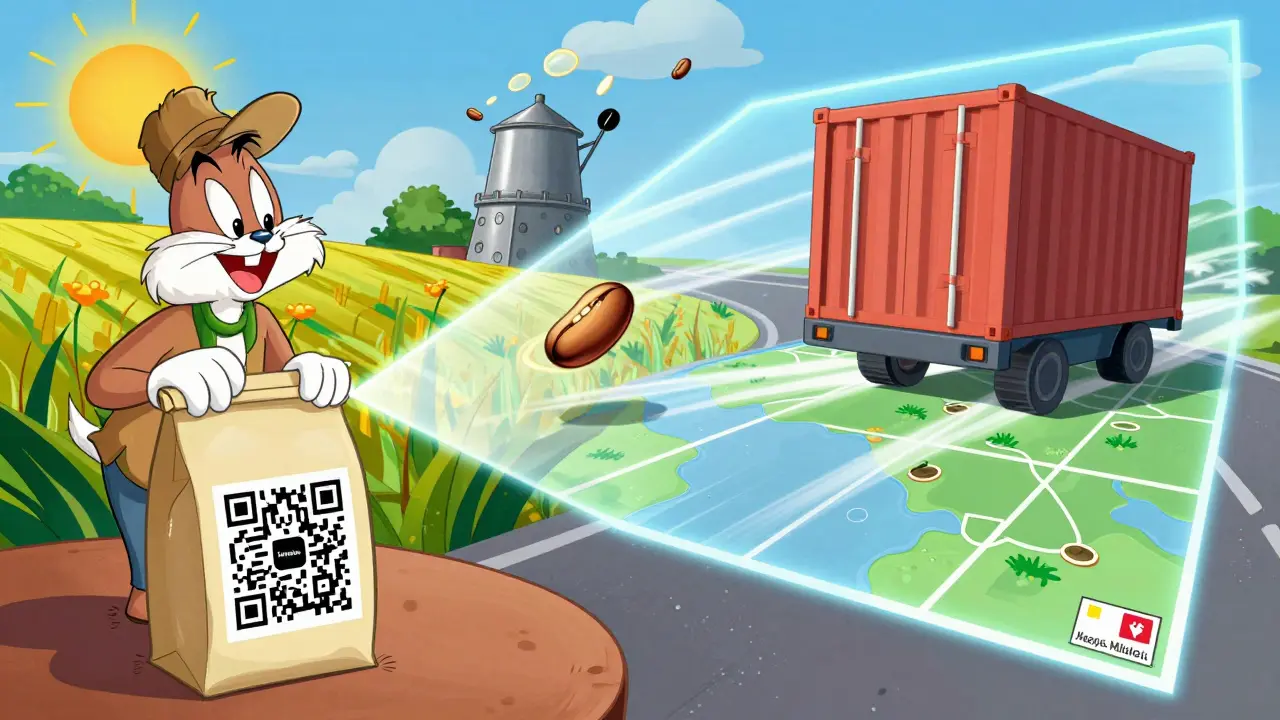
Imagine you buy a bag of coffee labeled "fair trade" and "organic." How do you know it’s true? Maybe the farmer got paid fairly. Maybe the beans weren’t sprayed with chemicals. But without proof, it’s just a label. That’s where blockchain NFTs come in - turning claims into verifiable facts.
What Blockchain NFTs Actually Do in Supply Chains
A Non-Fungible Token (NFT) isn’t just a digital art piece you buy for thousands. In supply chains, it’s a digital certificate tied to a physical product - like a bottle of olive oil, a pair of sneakers, or a vial of medicine. Each NFT is unique, stored on a blockchain, and can’t be copied or changed. When a product is made, an NFT is created for it. That NFT records everything: where the raw materials came from, who handled it, when it was shipped, and under what conditions. Unlike old-school paper logs or spreadsheets, this data doesn’t live in one company’s system. It’s spread across a network of computers. If someone tries to fake a shipment date or alter a certification, the network rejects it. Every step becomes a permanent, public record. You don’t need to trust the company. You can check the NFT yourself.How It Works Step by Step
Here’s how a product moves through an NFT-powered supply chain:- Origin: A coffee farmer harvests beans. A scanner records the harvest date, location, and organic certification number. An NFT is minted with this data.
- Processing: The beans go to a mill. The mill logs the processing method, water usage, and worker hours. That info gets added to the NFT.
- Shipping: The beans are packed and shipped. GPS trackers and temperature sensors automatically update the NFT with location and environmental conditions.
- Import & Distribution: At each customs checkpoint and warehouse, the NFT is scanned. Anyone with access can see the full history.
- Store Shelf: You scan a QR code on the bag. Your phone pulls up the NFT. You see the farmer’s name, photos from the farm, and a map of the journey.
Why This Beats Traditional Tracking
Traditional supply chains rely on invoices, emails, and audits - all of which can be lost, forged, or manipulated. A 2023 FDA study found that tracing contaminated food took an average of 7 days using paper-based systems. With blockchain NFTs, it takes under 2 minutes. In pharmaceuticals, counterfeit drugs kill over 1 million people a year. NFTs prevent this by verifying every batch from factory to pharmacy. In luxury goods, brands like LVMH use NFTs to stop fake handbags. In seafood, companies track tuna from ocean to plate to prove it wasn’t caught with slave labor. The difference isn’t just speed - it’s trust. Consumers aren’t just asking for sustainability anymore. They want proof. And blockchain NFTs deliver it without relying on third-party auditors.
Private vs. Public Blockchains: Which One Fits?
Not all blockchains are the same. Two main types are used in supply chains:- Public blockchains like Ethereum and Polygon are open to everyone. Anyone can verify a product’s journey. Great for consumer-facing brands that want maximum transparency.
- Private blockchains like Hyperledger Fabric are restricted to authorized participants. Used by companies that need to hide pricing, supplier names, or logistics routes from competitors.
Real-World Examples That Work
- Carrefour (France): Uses blockchain NFTs to track eggs from French farms. Customers scan a code to see the hen’s living conditions and feed source. - Walmart: Traces mangoes from Mexico. Before NFTs, tracing a single mango took 7 days. Now it takes 2.2 seconds. - De Beers: Tracks diamonds from mine to jeweler. Each NFT holds the stone’s cut, clarity, and ethical sourcing certificate. - Maersk: Uses blockchain to track shipping containers globally. Reduced paperwork by 40% and cut delays by 20%. These aren’t experiments. They’re live systems saving money, reducing waste, and building brand loyalty.Challenges - And How to Solve Them
It’s not perfect. Here are the biggest hurdles:- Integration: Many companies still use old ERP systems. Connecting them to blockchain needs custom software. Solution: Use middleware platforms like IBM Blockchain Platform or SAP Leonardo.
- Energy use: Ethereum used to be power-heavy. Now it runs on Proof-of-Stake, cutting energy use by 99.95%. Newer chains like Polygon and Solana are even lighter.
- Adoption: If only one supplier uses NFTs, the chain breaks. Solution: Industry coalitions like the Blockchain in Transport Alliance (BiTA) are creating shared standards.
- Training: Warehouse workers don’t know what a blockchain is. Solution: Simple apps with QR scanning and color-coded status lights (green = verified, red = issue).
The Future: IoT, AI, and Zero-Knowledge Proofs
The next wave is even smarter. Sensors in shipping containers now track humidity, temperature, and shocks. That data auto-updates the NFT. If a box of medicine was exposed to heat, the system flags it before it reaches a pharmacy. Zero-knowledge proofs are a game-changer. They let you prove something is true - without revealing the details. For example: "This coffee was grown without pesticides" - verified, but the exact farm location stays private. AI will soon predict delays before they happen. If an NFT shows a shipment from Colombia is 3 days behind schedule, the system can reroute it automatically. This isn’t science fiction. Companies in New Zealand, the EU, and Singapore are testing these systems now.Who Benefits the Most?
- Consumers: Know exactly what they’re buying. Support ethical brands with confidence. - Brands: Reduce fraud, cut recall costs, and earn premium pricing for verified products. - Small farmers: Get paid fairly. Their certification isn’t lost in a paper pile - it’s on the blockchain, visible to buyers worldwide. - Regulators: Real-time access to supply chain data means faster compliance checks and fewer inspections. The biggest winners? The ones who stop guessing and start proving.Getting Started: What You Need
If you’re thinking about implementing this:- Start with one product line. Don’t try to digitize your whole supply chain at once.
- Choose a blockchain platform. For beginners: Polygon (low cost, low energy). For enterprise: Hyperledger Fabric.
- Partner with a tech provider. Companies like VeChain, TradeLens, or Aura offer ready-made NFT supply chain tools.
- Train your team. Use simple dashboards - no blockchain jargon needed.
- Let customers verify. Add a QR code to packaging. Make transparency part of your brand story.
Can NFTs really prevent fake products?
Yes. NFTs create an unbreakable digital fingerprint for each product. If someone tries to sell a fake, the NFT won’t match the real one on the blockchain. Luxury brands like Gucci and LVMH already use this to block counterfeits. Even small businesses can use low-cost NFT platforms to protect their products.
Do I need to understand blockchain to use NFTs for my supply chain?
No. You don’t need to code or mine cryptocurrency. Modern platforms offer dashboards that look like Excel sheets with color-coded alerts. Your team just needs to scan QR codes and input basic data. The blockchain handles the rest in the background.
Are blockchain NFTs expensive to implement?
Not anymore. Early blockchain projects cost hundreds of thousands. Today, cloud-based platforms let small businesses start for under $5,000 a year. Many offer pay-as-you-go pricing based on how many products you track. The real cost is in training and integration - not the tech itself.
What industries benefit most from NFT supply chains?
Food and beverage, pharmaceuticals, luxury goods, fashion, and electronics. Any industry where provenance matters - where fraud, safety, or ethics are concerns - sees the biggest returns. Coffee, wine, organic cotton, and medical devices are top adopters.
Is this just a trend, or is it here to stay?
This isn’t a trend. The EU’s new Digital Product Passport law requires all electronics and textiles to have blockchain-based traceability by 2027. The U.S. FDA is pushing for drug traceability. Consumers are demanding proof. Companies that don’t adopt this will lose trust - and market share.
Blockchain NFTs don’t fix broken supply chains. They make them visible. And once you can see the truth, you can’t ignore it.