

Imagine checking your bank account balance and finding it locked. No explanation, no warning-just a sudden freeze that stops you from paying rent or buying groceries. For thousands of people in Bangladesh, this isn't a hypothetical nightmare; it’s the daily reality of trying to trade Bitcoin under one of the strictest cryptocurrency bans in South Asia.
If you are holding digital assets while living in Dhaka, Chittagong, or anywhere else in the country, you are walking a tightrope. The rules aren't just vague; they are contradictory. One official document might suggest mere ownership isn't a crime, while another circular from the central bank treats every transaction as potential money laundering. This confusion creates what legal experts call a "dangerous legal limbo," where the risk of prosecution is high, even if the law itself seems unclear.
The Regulatory Framework: A Web of Circulars
To understand why the stakes are so high, you have to look at how the ban was built. It didn’t happen overnight with a single law passed by parliament. Instead, it evolved through a series of warnings and circulars issued by Bangladesh Bank, the country's central bank.
The trouble started in December 2014 when the bank first warned citizens about the risks of Bitcoin. By February 2016, the tone had hardened significantly. The bank declared that using cryptocurrencies could violate two major pieces of legislation: the Foreign Exchange Regulation Act of 1947 and the Money Laundering Prevention Act of 2012. Then came the definitive blow in 2017, when the bank stated that cryptocurrencies are not legal tender and are strictly prohibited as a medium of exchange, store of value, or investment vehicle.
Here is the catch: there is no specific criminal code section that says "possession of Bitcoin is illegal." Instead, authorities prosecute users by linking their crypto activity to other crimes. If you move money into or out of the country using Bitcoin, you might be charged with violating foreign exchange laws. If the source of your funds is unclear, you face charges under money laundering statutes. This indirect approach makes it incredibly difficult for ordinary traders to know exactly where the line is drawn until they’ve already crossed it.
Potential Penalties: Fines and Imprisonment
When the hammer drops, the consequences can be severe. The primary tool used against crypto traders is the Money Laundering Prevention Act, specifically Section 6, which criminalizes transactions involving proceeds from illegal activities. Authorities interpret almost all unreported cryptocurrency transactions as suspicious.
Under the 2015 amendment to this act, penalties include:
- Imprisonment: Sentences ranging from 1 to 10 years, depending on the severity and volume of the transactions.
- Fines: Monetary penalties between 10,000 BDT and 1,000,000 BDT (approximately $100 to $9,000 USD).
- Asset Seizure: Confiscation of both the cryptocurrency holdings and any traditional currency linked to the trades.
These aren't theoretical threats. In February 2023, police seized 127 Bitcoin from a trader named Mohammad Ali in Dhaka. At the time, those coins were worth roughly 1.3 billion BDT ($12.1 million). In July 2022, the Criminal Investigation Department (CID) arrested 14 individuals for operating an underground exchange handling $2.3 million in transactions. These cases show that when the government decides to enforce the ban, they go after significant players-and often collateralize smaller users in the process.
How Enforcement Actually Works
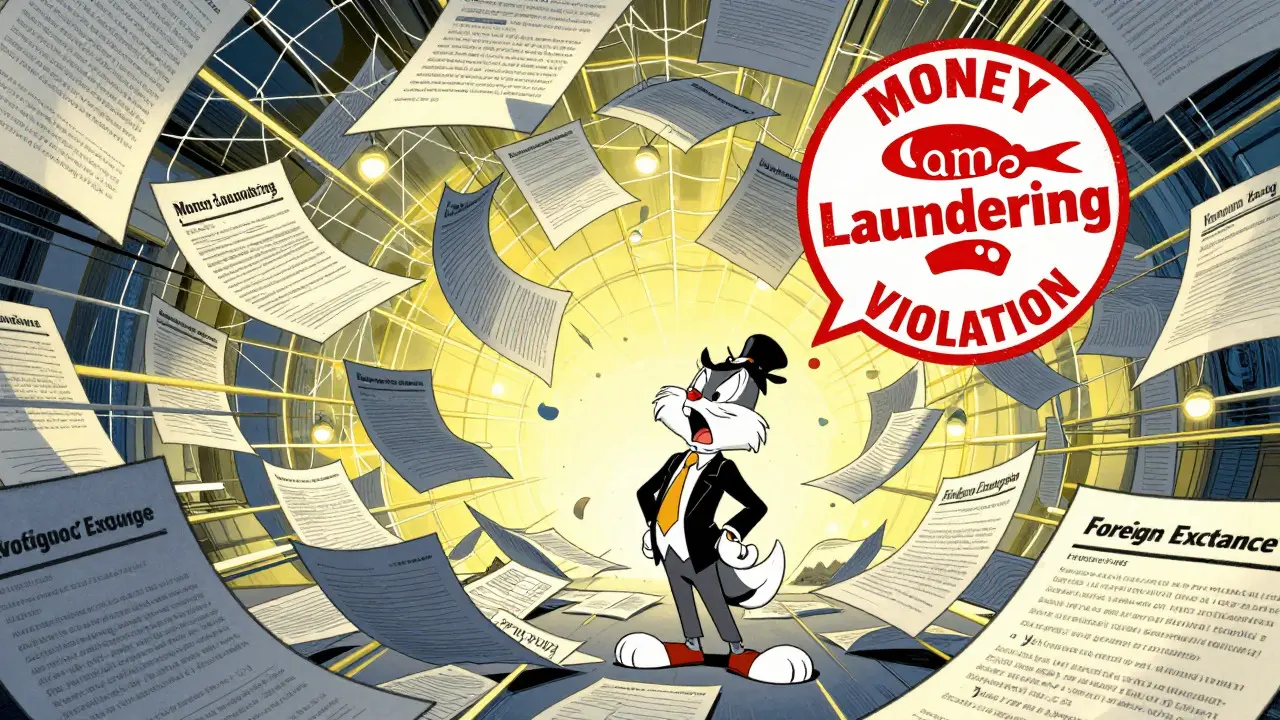
You might wonder how the government tracks something as decentralized as Bitcoin. They don't need to hack the blockchain; they just need to watch the bridges between crypto and fiat currency. The Bangladesh Financial Intelligence Unit (BFIU) monitors financial flows closely, focusing on two main choke points: international card transactions and mobile financial services.
In the fourth quarter of 2024 alone, the Bangladesh Automated Clearing House (BACH) flagged 127 suspicious transactions linked to crypto activity. More aggressively, mobile payment giants like bKash and Nagad have become enforcers by proxy. In 2024, these platforms blocked nearly 3,000 accounts suspected of facilitating crypto trades. For many users, losing access to their bKash account is the first sign that they are on the radar. Since most daily life in Bangladesh runs through these apps, a freeze effectively halts your economic existence.
The BFIU also targets peer-to-peer (P2P) networks. In May 2024, seven university students in Chittagong were investigated for moving $85,000 monthly through informal P2P channels. The lesson here is clear: if your money moves from a local bank account to a crypto wallet without a clear, approved commercial reason, algorithms flag it, and humans investigate.
The Underground Market: Risks Beyond the Law
Despite the risks, the demand for crypto remains stubbornly high. A 2024 report by the Blockchain Association of Bangladesh estimates that 500,000 to 700,000 people actively trade digital assets. They do this through shadow channels that carry their own dangers, separate from government crackdowns.
Most traders rely on local agents who charge 3-5% commissions to convert Tether (USDT) into Bangladeshi Taka. This system is fragile. In June 2024, a well-known agent named Sohel Rana vanished with approximately $350,000 belonging to 23 traders. Because these transactions happen outside the banking system, victims have no recourse. You can't file a police report for losing money to a crypto scammer when the very act of trading is technically prohibited.
Others use global exchanges like Binance or KuCoin, accessed via Virtual Private Networks (VPNs). While these apps remain available on the Google Play Store in Bangladesh, using them requires constant vigilance. Sensor Tower data from March 2025 shows around 150,000 to 200,000 active monthly users on these platforms within the country. But every login, every deposit, and every withdrawal leaves a digital footprint that banks can trace.
Taxation in the Gray Zone
If you think avoiding taxes will keep you safe, think again. The National Board of Revenue (NBR) doesn't have specific crypto tax laws, but they apply general income tax rules to digital asset profits. According to NBR Commissioner Md. Moniruzzaman, profits from crypto trading can be subjected to the standard 25% corporate tax rate or the 30% personal income tax rate.
This creates a paradox. To pay the tax, you must declare the income. To declare the income, you admit to trading an asset that the central bank has banned. Most traders choose silence, hoping to fly under the radar. But as the BFIU improves its data-sharing capabilities with banks and telecom providers, that silence becomes increasingly expensive.
| Enforcement Body | Method of Detection | Typical Action | Risk Level |
|---|---|---|---|
| Bangladesh Bank | Circulars & Bank Instructions | Account Freezes | High |
| BFIU | Transaction Monitoring | Investigation & Arrest | Very High |
| bKash/Nagad | Algorithmic Flagging | Service Suspension | Medium |
| NBR | Tax Audits | Fines & Back Taxes | Low-Medium |
Regional Context: Why Bangladesh Stands Alone
It helps to look next door to understand how isolated Bangladesh’s position is. India, despite initial hesitation, implemented a 30% tax on crypto gains in 2022 and allows trading, boasting 15 million active users by 2025. Pakistan began exploring Bitcoin reserves in early 2025, and Sri Lanka drafted a regulatory framework in late 2024. Even Nepal, which shares similar cultural and economic ties with Bangladesh, has seen shifts in public discourse regarding digital assets.
Bangladesh, however, maintains a stance of "strict prohibition with no shift." Finance Minister Abul Hassan Mahmood Ali reiterated in March 2025 that there are no plans to reconsider the ban. The government argues that allowing crypto would threaten monetary policy, especially given that remittances make up 6.1% of GDP. Critics, like Dr. B M Mainul Hossain from Dhaka University, argue the ban costs the country $150 million annually in lost tax revenue and stifles innovation.
Future Outlook: Blockchain vs. Currency
Is there any light at the end of the tunnel? The government distinguishes sharply between the technology and the token. The 2020 National Blockchain Strategy recognizes the value of blockchain for supply chains and governance, explicitly excluding cryptocurrencies. In January 2025, the central bank launched an Innovation Hub sandbox for non-crypto blockchain applications.
This suggests a future where developers can build on distributed ledgers, but users cannot hold Bitcoin. For now, if you are trading in Bangladesh, you are doing so at your own peril. The legal gray zone offers little protection, and the enforcement mechanisms are becoming sharper, not duller.
Is owning Bitcoin illegal in Bangladesh?
Technically, mere possession is not explicitly criminalized by a specific statute. However, the Bangladesh Bank prohibits its use as a medium of exchange or investment. In practice, owning crypto becomes punishable if authorities link it to money laundering or foreign exchange violations, creating a de facto ban.
What happens if my bank account gets frozen due to crypto trading?
If your account is frozen by Bangladesh Bank or a commercial bank following instructions from the BFIU, you may lose access to your funds indefinitely during an investigation. Unfreezing the account often requires proving the source of funds, which can be difficult if the transactions were meant to be discreet. Legal counsel is usually necessary to navigate the release process.
Can I use Binance or KuCoin safely in Bangladesh?
While these apps are available on app stores, using them carries significant risk. Banks monitor outgoing transactions to known crypto-related entities. Additionally, P2P trades on these platforms involve local bank transfers that can trigger alerts in the Bangladesh Automated Clearing House (BACH), leading to account freezes or investigations.
Are there taxes on cryptocurrency profits in Bangladesh?
Yes, although there is no specific crypto tax law. The National Board of Revenue applies general income tax rates. Profits may be taxed at 25% for corporations or 30% for individuals. However, declaring these profits admits to engaging in a banned activity, leaving most traders in a precarious position.
Will the crypto ban in Bangladesh be lifted soon?
As of mid-2026, there are no indications of a policy shift. Finance Minister Abul Hassan Mahmood Ali confirmed in 2025 that there are no plans to reconsider the ban. The government continues to distinguish between acceptable blockchain technology and prohibited cryptocurrencies, suggesting the ban will likely remain in place for the foreseeable future.




Categories