
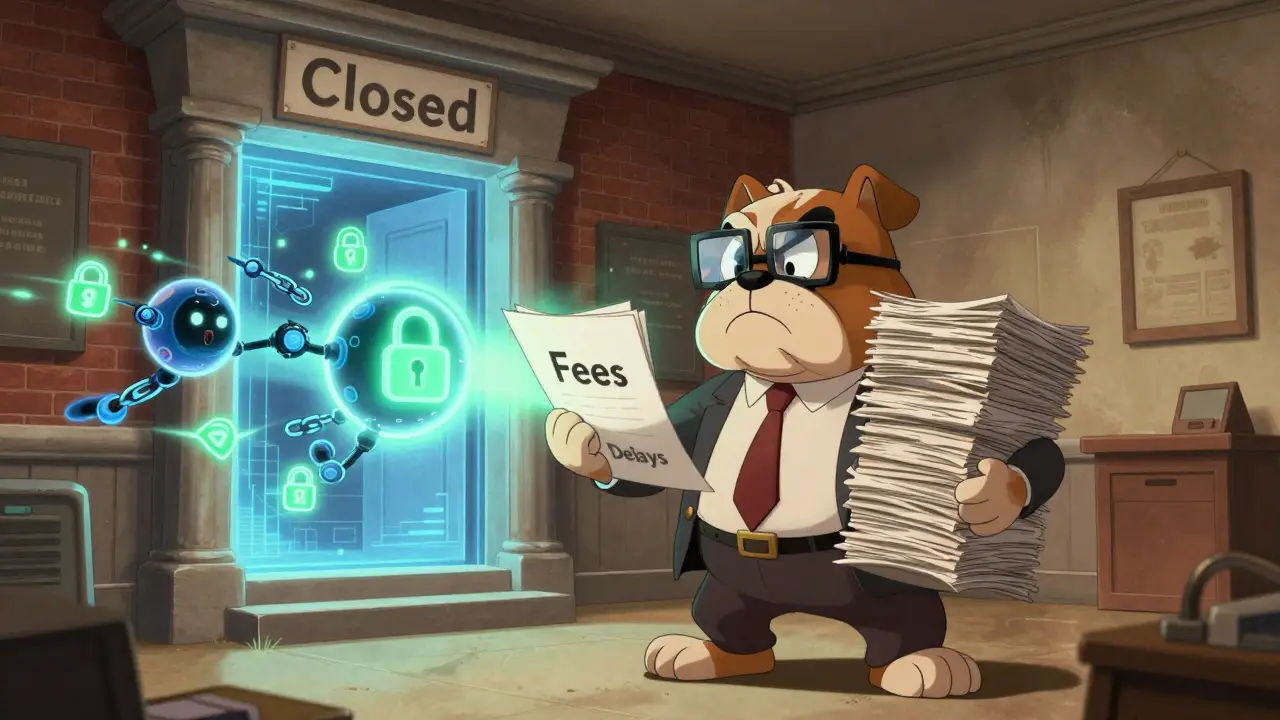
Imagine sending money across borders without a bank taking a cut. Or getting paid for your music instantly, instead of waiting months for labels and distributors to process checks. This isn't science fiction anymore. It is the core promise of blockchain, a technology designed specifically to remove the trusted third parties that have controlled our economic lives for decades.
For years, we accepted that we needed intermediaries-banks, brokers, platforms-to facilitate trust between strangers. But blockchain changes the game by replacing human or corporate trust with code and cryptography. The result? Transactions that are faster, cheaper, and more transparent. However, the reality is more nuanced than simply "killing" every middleman. Some disappear completely, while others evolve into new roles. Let’s look at how this works in practice, where it succeeds, and where it hits roadblocks.
The Core Mechanism: Trustless Systems
To understand how middlemen vanish, you first need to grasp the concept of a "trustless" system. In traditional finance, if you send $100 to someone overseas, you don’t trust them directly. You trust the bank to verify their identity, hold the funds, and ensure they get paid. The bank charges a fee for this service because maintaining that trust infrastructure is expensive.
Bitcoin, created by Satoshi Nakamoto in 2009, introduced the world to a distributed ledger system where no single entity controls the records. Instead, thousands of computers (nodes) around the world validate transactions through consensus mechanisms like Proof-of-Work. When you send Bitcoin, you aren’t asking a bank for permission; you are broadcasting a transaction to a network that verifies it mathematically. If the rules are met, the transaction happens. No gatekeeper. No approval queue.
This shift moves trust from institutions to algorithms. The cost of verification drops dramatically because it is automated and decentralized. According to Gartner’s 2023 Digital Innovation Survey, adoption of these technologies is growing at 55.6% year-over-year, driven largely by this desire to bypass costly intermediaries.
Smart Contracts: Automating Agreements
While Bitcoin handles value transfer, Ethereum, launched by Vitalik Buterin in 2015, expanded the potential by introducing smart contracts. These are self-executing agreements with terms written directly into code. Think of them as digital vending machines: you put in the right conditions (payment), and the machine automatically delivers the product (asset or service). There is no clerk, no manager, and no delay.
In real-world scenarios, this eliminates the need for lawyers, escrow agents, and brokers in many transactions. For example, in real estate, a smart contract could automatically transfer property title once the buyer’s crypto payment is confirmed. The code ensures both sides fulfill their obligations simultaneously-an "atomic exchange." This removes the risk of one party backing out after the other has performed their part, a risk that traditionally required expensive legal safeguards.
Ethereum’s virtual machine supports languages like Solidity, allowing developers to create complex logic for these interactions. As these tools mature, they enable atomic exchanges that were previously impossible without heavy intermediary oversight.
Industry Impact: Finance and Payments
The financial sector feels the impact of disintermediation most acutely. Cross-border payments are notoriously slow and expensive. Traditional systems often involve 3 to 5 banking intermediaries, each adding fees and delays. A World Bank report from 2022 noted that remittance costs average 6.5% of the transaction value. With blockchain solutions, this can drop to under 1%.
Consider the difference in speed. Traditional cross-border transfers can take 24 to 48 hours to settle. Enterprise platforms like Hedera Hashgraph achieve finality in just 3 to 5 seconds, processing over 10,000 transactions per second. Even public blockchains like Bitcoin, which processes about 7 transactions per second, offer near-instant settlement compared to legacy systems when using layer-2 solutions.
However, it is not a total replacement yet. JPMorgan’s JPM Coin processes $1 billion daily in institutional payments, showing a trend of "reintermediation." Banks are adopting blockchain not to disappear, but to become more efficient validators. They remain involved for customer service and regulatory compliance, but the heavy lifting of ledger maintenance is decentralized.

Digital Advertising and Media Royalties
Beyond finance, blockchain is disrupting industries plagued by opaque revenue streams. In digital advertising, giants like Google and Facebook act as massive intermediaries, taking 20-35% of ad spend. Blockchain-based ad exchanges allow advertisers to connect directly with publishers, potentially increasing ROI by 30-45%. By removing the platform fee, more money goes directly to content creators and advertisers.
The music industry offers another stark contrast. Traditionally, artists deal with 7 to 11 intermediaries-labels, distributors, collection societies-leading to payment delays of 18 to 24 months. Platforms like Tune.fm use blockchain to distribute royalties nearly instantly. One independent artist reported earning $2,300 from 47,000 streams in March 2023 via blockchain, compared to just $800 from the same streams through Spotify’s traditional model. The platform fees dropped from an industry-standard 25-40% to less than 5%.
The "Middleman Paradox" and Challenges
Despite these successes, the narrative of complete disintermediation faces criticism. DATARELLA’s 2018 analysis highlighted a "middleman paradox": killing the trust agent shifts responsibility to the individual. Previously, banks handled fraud protection, dispute resolution, and key recovery. Now, if you lose your private key, your funds are gone forever. As of 2023, approximately 3.7 million ETH had been lost due to forgotten passwords or misplaced keys.
This creates a steep learning curve. Reddit discussions in r/ethereum show that while 72% of users praise reduced costs, 63% cite difficulty for non-technical users. Irreversible transactions mean there is no customer support team to call if you make a mistake. This lack of recourse is a significant barrier for mass adoption.
Additionally, scalability remains a hurdle. While layer-2 solutions like Polygon achieve 7,000 TPS, base-layer networks still struggle during peak demand. Regulatory uncertainty also persists, with fragmented frameworks across 87 countries making compliance complex for global businesses.
| Feature | Traditional System | Blockchain Solution |
|---|---|---|
| Transaction Cost | High (6.5% avg for remittances) | Low (<1% for cross-border) |
| Settlement Time | 24-48 hours | Seconds to minutes |
| Error Recovery | Available (bank reversal) | None (irreversible) |
| Trust Source | Institutional reputation | Cryptographic proof |
| User Responsibility | Low | High (key management) |
Implementation Requirements
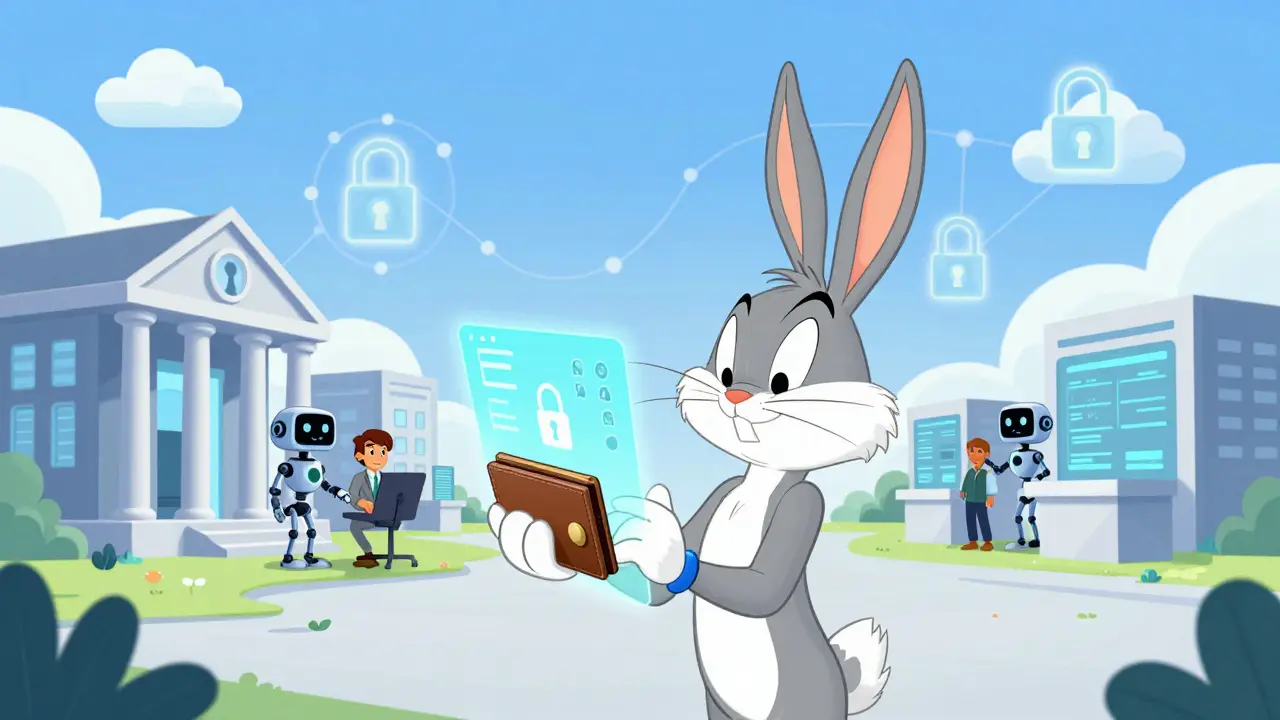
Getting started with blockchain disintermediation requires specific technical steps. For individuals, this means creating a digital wallet like MetaMask or Trust Wallet. You must understand gas fees-the computational cost of executing transactions on the network-which averaged $0.42 per Ethereum transaction in Q2 2023.
For businesses, integration is more complex. Public blockchains require minimal infrastructure, just internet access and software. However, enterprise implementations like Hyperledger Fabric demand dedicated servers with minimum 4GB RAM, 2 CPU cores, and 100GB storage. Developers need to master libraries like web3.js or Web3.py to connect applications to the blockchain. ConsenSys Academy estimates that business professionals need 80-120 hours of training to become proficient in these systems.
Security is paramount. Unlike traditional databases, blockchain data is immutable. Once a transaction is recorded, it cannot be altered. This prevents fraud but also means mistakes are permanent. Organizations must implement robust key management protocols and multi-signature wallets to mitigate risks.
Future Outlook: Reconfigured Intermediation
The future likely holds "reconfigured intermediation" rather than total elimination. The World Economic Forum predicts that by 2027, 10% of global GDP will be stored on blockchain technology. However, traditional intermediaries will transform into validators and service aggregators rather than disappearing entirely.
Gartner notes that through 2026, 80% of supply chain blockchain initiatives may fail to scale due to underestimating coordination costs. Success depends on identifying high-friction processes where trust costs exceed 15% of transaction value. In these areas, blockchain offers clear advantages. In low-friction contexts, traditional methods may remain more efficient due to lower complexity and better user experience.
As standards like ISO/TC 307 mature and regulations like the EU’s MiCA provide clarity, we will see more hybrid models. These combine the efficiency of blockchain with the familiarity and support structures of traditional services. The goal is not to remove all human elements, but to automate what can be automated, freeing up resources for higher-value tasks.
Does blockchain really eliminate all middlemen?
Not entirely. While blockchain removes the need for trusted third parties in transaction verification and execution, new roles emerge. Users take on more responsibility for security and compliance. Additionally, traditional intermediaries often adapt by becoming validators or service providers within the blockchain ecosystem, leading to "reintermediation" rather than pure disintermediation.
What are the main risks of using blockchain without intermediaries?
The primary risks include irreversible transactions, loss of private keys, and smart contract vulnerabilities. Without a bank to reverse errors or recover passwords, users bear full responsibility for their assets. Smart contracts can also contain bugs that exploiters target, as seen in the 2016 DAO hack. Security awareness and proper key management are critical.
How much can businesses save by using blockchain for payments?
Businesses can reduce cross-border payment costs from an average of 6.5% to under 1%. Settlement times drop from days to seconds. In sectors like music royalties, platform fees can decrease from 25-40% to less than 5%, significantly boosting net income for creators and reducing administrative overhead.
Is blockchain suitable for small businesses?
It depends on the use case. For simple peer-to-peer payments, yes. For complex supply chain tracking or custom smart contracts, the initial setup cost and learning curve may be prohibitive. Small businesses should evaluate if the friction they face exceeds 15% of transaction value before investing in blockchain solutions.
What is the role of smart contracts in disintermediation?
Smart contracts automate the execution of agreements without needing lawyers, brokers, or escrow services. They ensure that predefined conditions are met before assets are transferred, enabling atomic exchanges. This reduces reliance on human judgment and manual processing, speeding up transactions and lowering costs.




Categories