
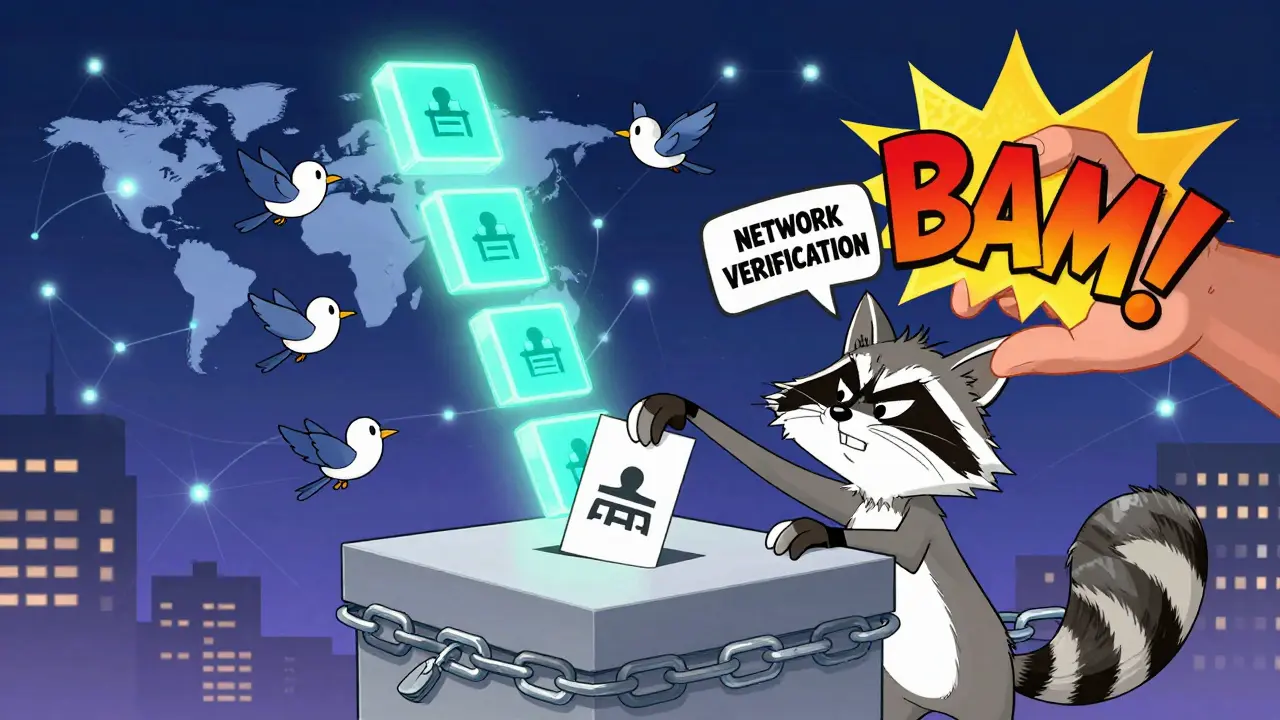
When you cast a vote, you expect it to count. Not just once, but every time. Not just in your local precinct, but across the entire system. Yet for decades, elections have relied on paper ballots, centralized databases, and human counters - all of which can be manipulated, miscounted, or hacked. In 2026, with cyberattacks on critical infrastructure more common than ever, the question isn't whether elections need better security - it's how we build it. Blockchain technology is no longer just for cryptocurrencies. It’s becoming the backbone of a new kind of democracy: one that’s transparent, tamper-proof, and verifiable by anyone.
What Blockchain Actually Does in Voting
At its core, blockchain is a digital ledger that records transactions across many computers. Each vote becomes a transaction - encrypted, time-stamped, and linked to the one before it. Once added, it can’t be changed. No central server holds all the votes. Instead, thousands of computers around the world hold identical copies. If someone tries to alter a vote, the network instantly rejects it because it no longer matches the majority.
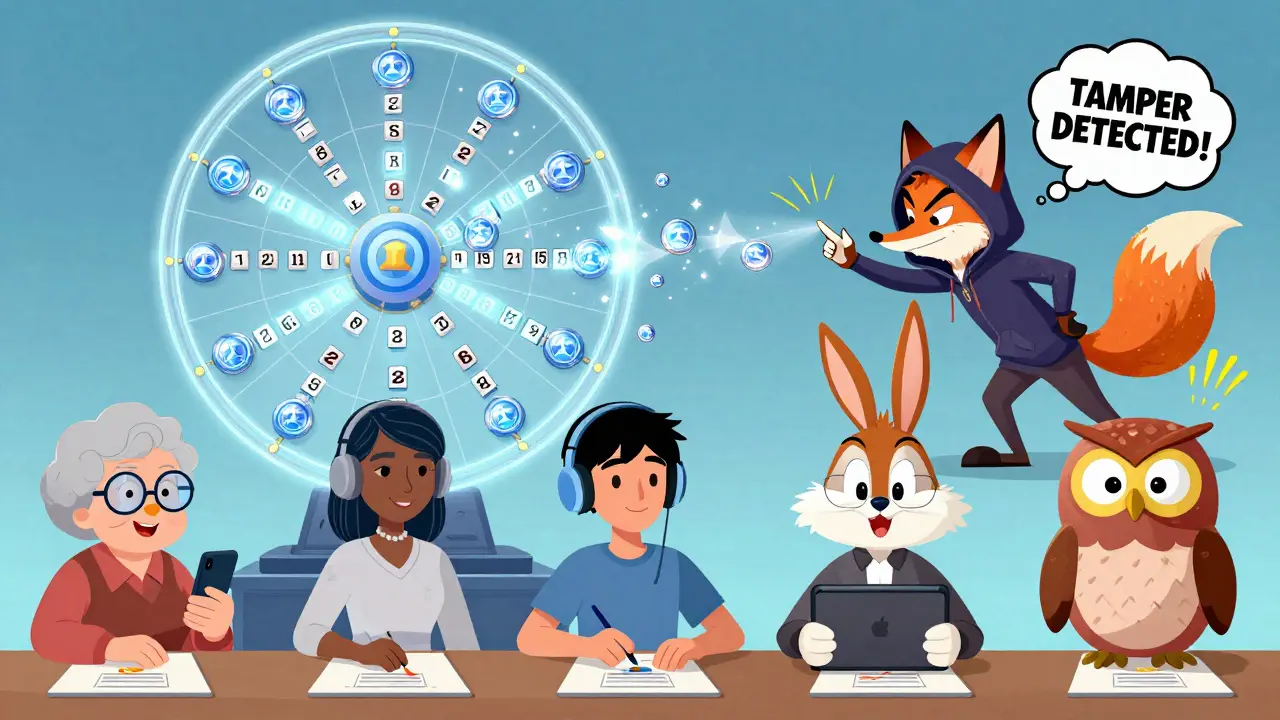
This isn’t theoretical. In 2024, a peer-reviewed study from the University of Auckland tested a blockchain-based voting system with over 12,000 simulated voters. The system recorded every vote on a public ledger, encrypted each ballot with a unique digital key, and used biometric authentication to confirm identity. The result? Zero successful tampering attempts. Every attempt to alter votes was detected and blocked within seconds.
Traditional voting systems have one fatal flaw: they rely on trust. You trust the poll workers. You trust the counting machines. You trust the government to report results honestly. Blockchain removes that need. It doesn’t ask you to trust anyone. It lets you verify everything yourself.
How It Stops Fraud Before It Starts
Duplicate voting? Impossible. In most countries, someone can register multiple times under different names or use stolen IDs. Blockchain solves this with identity verification tied to cryptographic keys. Voters don’t log in with a password. They authenticate using fingerprints, facial recognition, or government-issued digital IDs - all linked to a unique, unchangeable blockchain address.
Once authenticated, the system issues a single-use voting token. That token can only be used once. If someone tries to reuse it, the network flags it. No one can cast a vote without a valid token. And once a vote is cast, that token is burned - permanently deleted from the system. There’s no way to vote twice, even if you steal someone’s device.
Ballot stuffing? Also gone. Paper ballots can be smuggled in, counted in secret, or lost in transit. Blockchain votes are transmitted instantly to distributed nodes. Each vote is encrypted and stored on dozens of servers across different countries. To alter the outcome, a hacker would need to compromise every single node at the exact same time - a task that would take years, not minutes.
Transparency That Anyone Can Check
One of the biggest complaints about elections is secrecy. You’re told the results, but you can’t see how they were calculated. Blockchain changes that. The entire vote tally is public. Anyone with internet access can view the ledger - not individual votes, but the total count from each precinct, each region, each country.
Imagine this: After polls close, a citizen in Wellington, a journalist in Tokyo, and a watchdog group in Berlin all open the same blockchain explorer. They see the same numbers. No black box. No secret software. No “we’ll explain later.” Just raw, verified data. Independent auditors can run algorithms to cross-check totals against voter turnout records. If something doesn’t add up - say, 120% turnout in one district - the system flags it immediately.
This level of transparency isn’t just nice to have. It’s what builds trust. In Estonia, where limited blockchain components are used in e-voting, public confidence in election results rose by 27% over three election cycles. People didn’t just believe the government. They could see for themselves.
Why It’s Better Than Paper or Digital Voting Machines
Traditional paper ballots are slow, expensive, and prone to human error. Digital voting machines? They’re faster, but they’re closed systems. No one knows how the software works. There’s no audit trail. If a machine glitches, you can’t prove whether it was a bug or a hack.
Blockchain fixes both problems. It’s as reliable as paper - because every vote is permanently recorded - but as fast as digital. Votes are counted in minutes, not days. No need to transport boxes of paper. No manual recounting. No lost ballots.
And unlike commercial e-voting machines (which often use proprietary software from a single vendor), blockchain is open. The code is public. Anyone can inspect it. If a flaw is found, the community patches it. No company holds a monopoly on the system. That’s why countries like Canada and New Zealand are testing blockchain pilots - not because they want to replace paper overnight, but because they want a system they can fully understand and trust.
The Real Challenges - And Why They’re Solvable
Let’s be honest: blockchain voting isn’t perfect. It needs internet access. It needs trained staff. It needs voters who understand how to use it. In rural areas with poor connectivity, or among elderly populations unfamiliar with tech, adoption is harder.
But these aren’t flaws in the technology - they’re implementation challenges. And they’re being solved.
Hybrid systems are already in use. Voters can choose to vote in person with a paper ballot, or use a secure mobile app backed by blockchain. The paper ballot is scanned and recorded on the blockchain. The digital vote is encrypted and added too. Both are counted. The system reconciles them. If there’s a mismatch, it triggers an audit.
Education is the next step. Countries running pilots now include mandatory voter training modules - 10-minute videos explaining how the system works, how to verify your vote, and how to report issues. In pilot programs, over 90% of users said they felt more confident in the results after using the system.
Cost? Yes, setting up a blockchain network isn’t cheap. But compared to the billions spent on paper ballots, security guards, recounts, and legal challenges after disputed elections - it’s a bargain. A single blockchain election can save up to 60% in long-term costs, according to a 2025 World Bank analysis.

Who’s Using It Now - And What’s Next
Estonia was the first country to use blockchain in elections, starting in 2019. They don’t run full blockchain voting. Instead, they use it to secure the transmission of vote totals from polling stations to the central tally. It’s a small step - but it stopped a major hacking attempt in 2023.
Switzerland is testing a blockchain system for municipal votes. Canada’s Vancouver city council ran a pilot for community budget votes in 2024. In New Zealand, a local council in Wellington used blockchain to let residents vote on park upgrades. Turnout jumped 40% compared to previous mail-in ballots.
What’s next? Mobile voting apps. AI-powered fraud detection. Integration with national ID systems. By 2027, experts predict at least five countries will have national blockchain voting systems in place. The technology isn’t about replacing democracy. It’s about protecting it.
Why This Matters for Everyone
Elections aren’t just about picking leaders. They’re about trust. Trust that your voice matters. Trust that the system isn’t rigged. Trust that the person who wins actually won.
Blockchain doesn’t guarantee perfect elections. But it guarantees something more powerful: verifiable integrity. It gives power back to the people - not by making voting easier, but by making it undeniable.
If you’ve ever doubted whether your vote counted - this is the answer.
Can blockchain voting be hacked?
No system is 100% unhackable, but blockchain voting makes it practically impossible. Each vote is encrypted, distributed across hundreds of servers, and linked to previous votes in a chain. To alter one vote, a hacker would need to change every copy on every server at the same time - a task that would require control over the entire network, which is designed to be decentralized and resistant to such attacks. Real-world tests have shown zero successful breaches in blockchain voting pilots.
Do I need a smartphone to vote with blockchain?
Not necessarily. While many systems use mobile apps for convenience, voters can also cast ballots using secure kiosks at polling stations, computers at libraries, or even paper ballots that are scanned and recorded on the blockchain. The key is the blockchain backend - not the device you use to vote. Hybrid systems ensure no one is left out.
Is my vote private on a public blockchain?
Yes. Your vote is encrypted and recorded as a unique code, not your name or personal details. While anyone can see the total number of votes from each precinct, they can’t see who voted for whom. Identity verification and voting are kept separate. Your name is confirmed once, then disconnected from your ballot. This is called zero-knowledge proof - a cryptographic method that proves you voted without revealing your choice.
What happens if the internet goes down during voting?
Blockchain voting systems are designed with offline backups. If connectivity fails, polling stations can continue accepting votes using local devices that sync with the blockchain once the network is restored. Votes are stored temporarily on encrypted local servers and automatically uploaded when possible. In extreme cases, paper ballots are used as a fallback - and later scanned and added to the blockchain for verification.
Is blockchain voting legal everywhere?
Not yet. Laws vary by country. Some nations, like Estonia and Switzerland, have updated legislation to allow blockchain-based voting. Others, including the U.S. and Australia, restrict electronic voting at the national level. However, many local governments are running pilot programs under temporary legal exemptions. As trust grows and security is proven, legal frameworks are adapting - slowly but steadily.